
Fastenal’s Q2 Snapshot Reveals Strategic Footprint Optimization and Pricing Resilience
Fastenal's latest quarterly results underscore a deliberate shift towards customer site segmentation and managed inventory adoption, balancing physical network scale with digital supply chain solutions amid tariff and margin pressures.
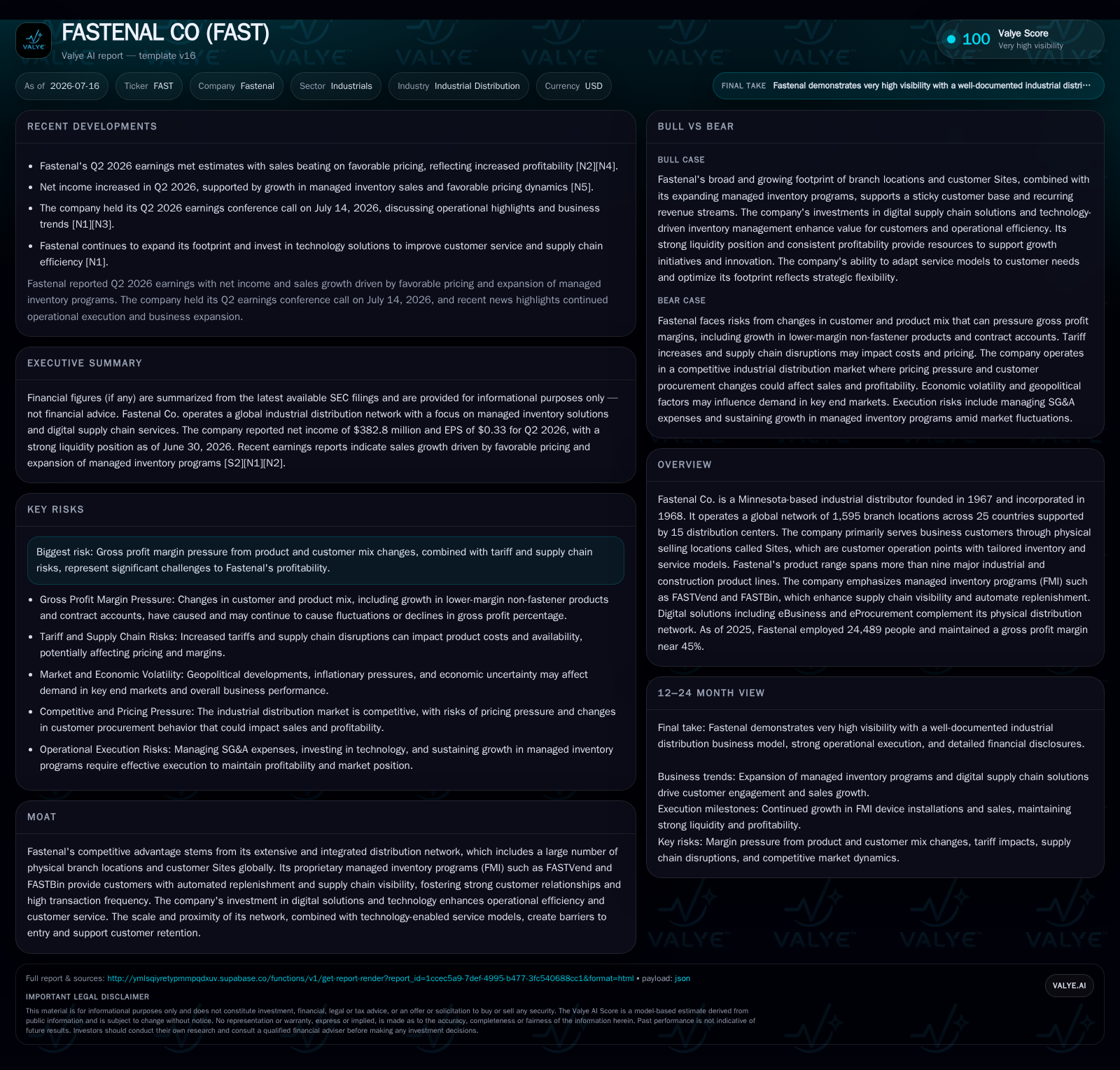
In its Q2 2026 filing, Fastenal shifted its growth narrative from branch expansion to optimizing high-value customer sites with tailored inventory programs. Managed inventory devices like FASTVend and FASTBin continue to deepen supply chain integration, supporting recurring revenues and pricing leverage. Despite ongoing supply chain disruptions and product mix headwinds, Fastenal sustained gross margins near 45%, reflecting resilient pricing power. This focused site-centric strategy coupled with robust digital capabilities positions the company well against peers such as W.W. Grainger and MSC Industrial Direct. Key risks remain tariff volatility, evolving product mix, and technology integration execution.
Q2 Operational Shifts Highlight Site-Centric Growth Strategy Over Branch Expansion
The implications are multifold: concentrating resources on high-spend Sites improves unit economics by elevating monthly sales density per location while streamlining inventory management. This enhances profitability potential versus broad-based branch proliferation that may dilute average sales per outlet. Moreover, the Site configuration facilitates enhanced supply chain technologies such as just-in-time inventory and demand-driven replenishment programs that are central to Fastenal’s competitive advantage.
Managed Inventory Programs Deepen Customer Engagement and Competitive Moat
Central to Fastenal’s operational excellence is its suite of proprietary Fastenal Managed Inventory (FMI) programs including FASTVend (industrial vending devices), FASTBin (bin stock replenishment), and FASTStock (on-site inventory management). These technologies automate ordering frequency by monitoring consumption patterns directly within customer facilities, substantially reducing procurement friction for business clients [S1][S2].
The latest filings confirm increasing penetration of FMI devices weighted by MEU (Managed Equipment Units) indicating heightened device installation at Sites correlates with stronger recurring revenue streams anchored in automated replenishment rather than ad hoc transactional sales. Adoption of these programs effectively embeds Fastenal into customers’ day-to-day operations creating high switching costs due to systems integration and supply chain visibility advantages.
This approach mirrors industry trends seen at peers like Motion Industries known for differentiated managed inventory solutions but distinguishes Fastenal through broader scale and multi-channel integration encompassing vending hardware, bin stock software controls, and analytic dashboards like FAST360 that provide both clients and internal account managers rich operational insight.
Margin Dynamics Reflect Pricing Power Amid Supply Chain Headwinds and Product Mix Changes
Amid ongoing macroeconomic challenges—including expanded tariffs inflating input costs—Fastenal maintained a gross profit margin around 45%, effectively holding steady compared to prior periods despite inherent pressures from a shift towards larger customers whose orders tend to generate lower gross margins due to volume pricing concessions [S27][S2]
Management’s commentary reflects tactical pricing actions deployed to offset tariff impacts without undermining competitive positioning. The ability to pass through higher costs signals durable pricing leverage rooted in service differentiation anchored by responsive local presence combined with managed inventory automation that customers increasingly depend upon.
However, risks linger as product mix variability continues to exert margin pressure; larger accounts purchase more direct materials at thinner margins compared to smaller accounts or indirect material transactions. Monitoring the balance between volume-driven growth at Sites vs. preserving margin profiles will be critical operating markers going forward.
"High-Touch, High-Tech" Model Anchoring Supply Chain Optimization Efforts
Fastenal’s hybrid business model integrates an extensive physical branch network supported by sophisticated digital platforms exemplifying its 'high-touch, high-tech' ethos [S1]. Decentralized selling personnel empowered locally maintain close customer relationships facilitating agility in order fulfillment while centralized supply chain functions optimize distribution throughput across the company’s 15 global distribution centers.
Investments in enterprise-wide analytics tools such as FAST360 harness Microsoft Power BI technology enabling real-time data visualization of spend patterns, inventory levels, and procurement trends enhancing decision-making at both client-side operations and Fastenal’s commercial teams [S22]. The seamless interface between onsite venders/bin stock devices and digital dashboards unlocks full supply chain visibility for customers reducing procurement inefficiencies.
This confluence of proximity-driven service complemented by technology infrastructure promotes operational efficiency gains that competitors lacking either component struggle to match.
"Customer Spend Segmentation": Targeting High-Value Sites to Drive Revenue Quality
Fastenal rigorously segments its customer Sites by monthly spend thresholds ($50k+, $10k+, $5k-$10k+, <$5k), focusing resource allocation toward expanding the highest spending segments exhibiting strongest growth rates [S1][S26]. The $50k+ segment notably grew over 14% YoY which correlates closely with accelerating FMI device adoption—coalescing into enhanced recurring revenue quality.
This segmentation enables optimized sales efforts through role specialization among selling personnel dedicated to complex key accounts at top-tier Sites while tactical selling teams service lower spend clusters. The articulation of spend bands also serves internal forecasting models aligning channel investments toward Sites representing disproportionate revenue potential thereby improving capital efficiency.
Peer Benchmarking: Positioning Against Grainger, MSC Industrial Direct, and Motion Industries’ Service Innovations
Compared with W.W. Grainger—a peer sharing a diversified industrial distribution model combining dense branches with digital channels—Fastenal demonstrates competitive strength through higher site-level granularity enabled by its pioneering FMI footprint complemented by more localized branch density offering faster delivery kinetics. Grainger historically leverages scale differences but less aggressively penetrates automated vending systems integrated deeply at customer sites.
MSC Industrial Direct represents another comparator emphasizing breadth in industrial supplies but with less pervasive managed inventory adoption relative to Fastenal’s approach fostering stronger lock-in effects on end users. Motion Industries exemplifies best practices in managed inventory services but operates on a narrower geographic scale which limits direct global parallels.
Overall Fastenal’s blend of extensive physical presence coupled with proprietary technology services sets it apart within the competitive landscape dominated largely by traditional distributors increasingly investing in digital transformation.
Growth Drivers: Branch Network Rationalization Driving Profitability While Penetrating Key Accounts via Sites & Digital Channels
Growth is driven primarily through strategic rationalization—maintaining or slightly adjusting total branch count—but boosting capacity utilization via expanding high-value Site count notably those surpassing $50k monthly spend thresholds backed by FMI technologies generating sticky recurring revenues [S2][S1]
Moreover, continuous investments into distribution center throughput upgrades alongside digital toolset expansions such as eProcurement platforms facilitate scalable sales enablement beyond physical confines effectuating omnichannel reach enhancement.
These vectors collectively fuel upstream penetration into manufacturing customers—the largest end market segment serving both direct materials integrated into final products as well as indirect materials supporting facility operations—enhancing share gain opportunities amidst fragmented market structure exceeding $140 billion annually sector-wide [S11]
Risks: Tariff Impact, Product Mix Volatility, IT Transformation & Human Capital Constraints Pose Execution Threats
Despite operational progress risks persist including uncertainty surrounding tariff expansions disrupting cost stability creating pressure on input prices impacting margins unless offset by price escalations acceptable to customers [S18][S23].
Integration challenges related to upgrading or maintaining information technology systems critical for managed inventory visibility may impair operational continuity or delay innovation timeline adherence potentially eroding competitive positioning. Cybersecurity risk exposure inherent in digitized data flow necessitates ongoing vigilance.
Workforce dynamics also add complexity; selling personnel cost inflation tied to wage growth combined with requisite hiring for technology support functions increase SG&A expense baseline although partially mitigated through improved operating leverage strategies reported recently [S27][S1].
These factors require tight execution discipline balancing growth ambitions against emerging macro headwinds.
Financial Profile Discussion
As of June 30, 2026, Fastenal held cash and equivalents of approximately $205 million against total debt of about $120 million, resulting in a net cash position near $85 million, which supports balance sheet flexibility for strategic investments or contingencies [F1]. The company’s current ratio stood robustly at approximately 4.18x, indicating strong short-term liquidity coverage and mitigating working capital risks amid inventory scaling needs [F1].
Maintaining disciplined capital deployment positions Fastenal well amid uncertain economic cycles while supporting incremental capital expenditures targeting automated vending equipment rollouts and distribution infrastructure upgrades, consistent with prior investment levels [S25].
Operating profitability remains solid with gross margin stability near 45%, sustained through pricing acumen despite product mix shifts, alongside modest SG&A expense leverage reflecting ongoing investments in employee specialization and technology-facing roles that facilitate future growth [F1][S27]
What to Watch Next
Market participants should monitor quarterly updates regarding new Site additions versus closures particularly within the high-spend segments as these signify execution efficacy on footprint optimization strategy. Adoption velocity metrics for FMI device installations provide near-term leading indicators of recurring revenue expansion potential. Additionally, tracking monthly sales per Site progression serves as a pivotal utilization metric correlating directly with profitability trends.
Watch also management commentary around tariff developments influencing price/cost pass-through abilities plus updates on IT system enhancements underpinning next generation supply chain visibility tools tied closely to FAST360 analytics platform improvements. Finally monitoring labor market impacts on selling personnel productivity proxies help gauge operating leverage sustainability under wage inflation pressure.[N1][N2][S2]
Disclaimer: This analysis is based exclusively on publicly available regulatory filings up to July 16, 2026. It does not contain investment advice or forecasts but aims at providing an informed examination of Fastenal's business operations within its industrial distribution sector context.
Disclaimer: This is research-only, informational analysis and not investment advice. It may include AI-generated interpretation and general industry context. Always verify important details using primary sources.

Comments