
New Horizon Aircraft Advances Full-Scale Hybrid eVTOL Amid Certification and Production Buildout
The company progresses its Cavorite X7 hybrid-electric eVTOL development with prototype success and regulatory engagement, facing capital and certification challenges.
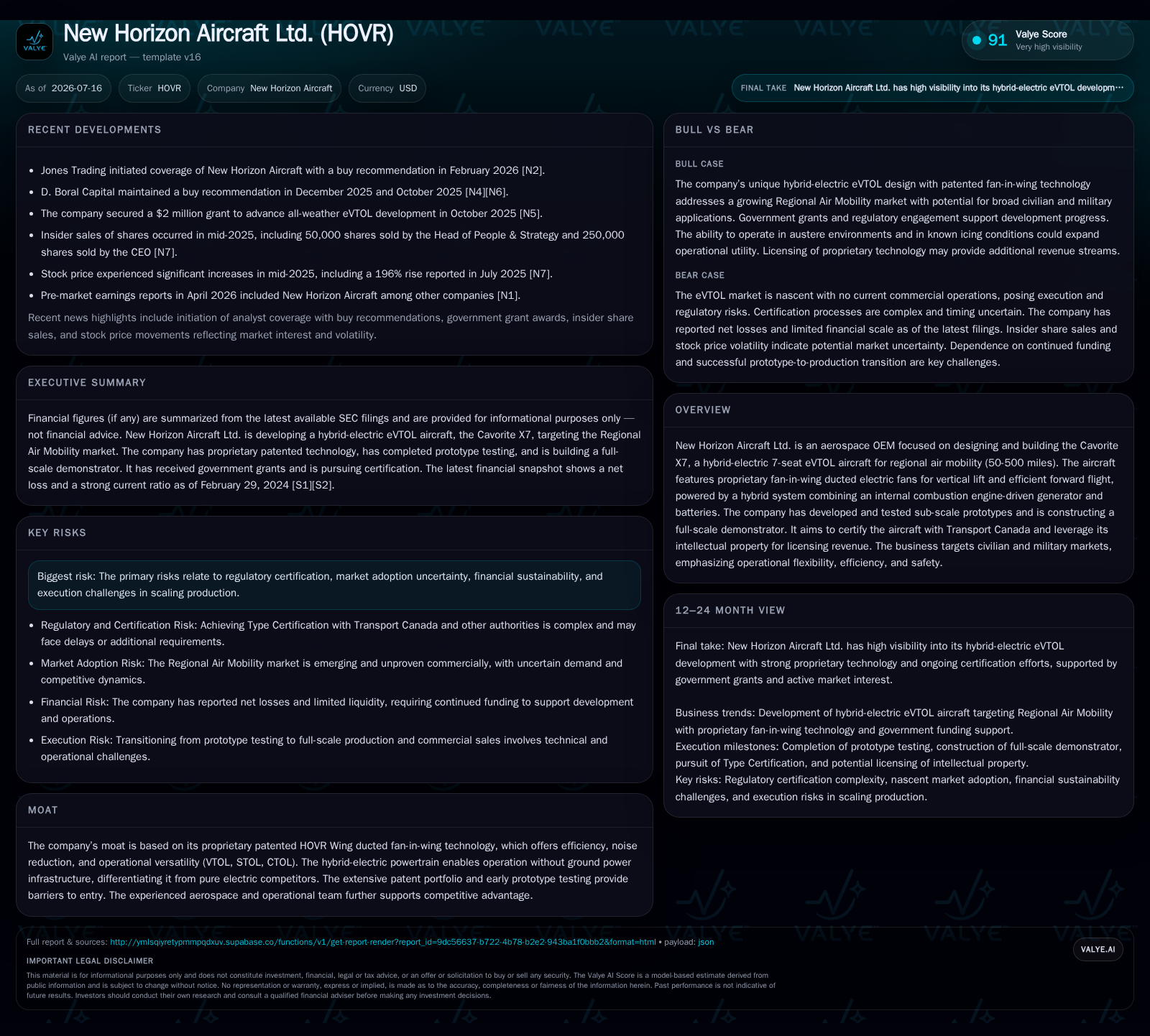
New Horizon Aircraft Ltd. reported fiscal year 2026 results detailing substantial development progress on its Cavorite X7, a hybrid-electric 7-seat eVTOL designed for Regional Air Mobility. The company is building a full-scale demonstrator following positive prototype testing and is targeting Transport Canada certification, including for flight into known icing conditions—a significant operational differentiator. While committed to scaling production capabilities and technology commercialization, the firm continues to incur operating losses as it invests heavily in R&D, manufacturing readiness, and market preparation amid a competitive and evolving advanced air mobility landscape.
Recent Operating Update
New Horizon Aircraft Ltd. released its fiscal year ended May 31, 2026 financials and business update on July 16, 2026 [S3]. The company highlighted that it has transitioned from operating primarily at sub-scale prototype levels toward constructing a full-scale technical demonstrator of its Cavorite X7 aircraft. This demonstrator aims to accommodate seven occupants (six passengers plus one pilot) and has been designed with significant performance ambitions — notably speeds potentially exceeding 250 mph with payload capacity around 1,500 lbs over ranges greater than 500 miles with fuel reserves [S17]. The company plans to pursue Type Certification with Transport Canada prior to 2030, including establishing compliance for Flight Into Known Icing (FIKI) conditions which is rare in the eVTOL sector [S18].
Business Model and Technology Overview
New Horizon operates as an advanced aerospace OEM focused on the design, development, certification, and planned production of its hybrid-electric eVTOL aircraft targeting regional air mobility markets spanning roughly 50 to 500 miles [S1]. The key product innovation lies in its patented proprietary "HOVR Wing" ducted fan-in-wing technology using enclosed electric fans embedded within wing ducts for vertical lift combined with an aerodynamic wing configuration optimized for efficient forward flight [S26]. This contrasts with the open rotor designs most competitors use and offers more efficient thrust generation while significantly lowering noise emissions due to acoustic liners within ducts [S26].
The hybrid-electric powertrain combines an internal combustion engine driving an onboard generator alongside battery arrays supplying electrical power during vertical takeoff and landing phases. Augmenting battery energy with generator output reduces battery size requirements—addressing current limitations of battery energy density—and improves operational safety margins by allowing inflight recharging after VTOL phases [S1]. This architecture also enables operation in locations without ground power infrastructure unlike pure electric eVTOLs reliant on charging stations—an important differentiator for remote or austere environments common in regional mobility markets or emergency response applications [S1].
Revenues are expected primarily from direct aircraft sales upon certification completion combined with potential licensing of the extensive IP portfolio protecting the HOVR Wing design and associated hybrid propulsion innovations [S18]. Ancillary revenue streams may develop through after-sales services like pilot training—already underway through third-party providers—and digital platform offerings integrated into the aircraft lifecycle [S1].
Industry Structure and Competitive Position
The advanced air mobility aerospace manufacturing sector is characterized by high capital intensity driven by prolonged R&D cycles, complex regulatory certification processes across jurisdictions such as Transport Canada Civil Aviation (TCCA), FAA in the U.S., and evolving global standards. OEMs like New Horizon face stiff competition from established players venturing into eVTOLs — for example Joby Aviation publicly advancing production aircraft certifications — as well as specialized startups adopting varying propulsion architectures (battery-electric open rotors vs. hybrid ducted fans).
New Horizon’s moat stems from its unique ducted fan-in-wing system which not only boosts efficiency but supports multiple takeoff modes: vertical (VTOL), short takeoff and landing (STOL), and conventional takeoff and landing (CTOL). This operational versatility contrasts favorably with many pure electric VTOLs restricted by range or infrastructure dependencies [S26]. Furthermore, targeting FIKI certification enhances operational utility by permitting flights through icing conditions commonly avoided or unfeasible for many competitors’ designs [S18]. Nonetheless, the industry remains nascent with no scaled commercial operations yet; success hinges heavily on regulatory milestones.
Growth Drivers
Significant growth enablers arise from technological advances improving battery energy densities and hybrid electric propulsion efficiencies that incrementally reduce weight while extending range capabilities. New Horizon benefits from these trends but complements them via its hybrid approach mitigating sole reliance on batteries.
Market demand for regional air mobility solutions addressing congestion in ground transport corridors is projected to expand substantially; research forecasts the global Advanced Air Mobility market could approach $1 trillion by 2040 under base cases then grow further to $9 trillion by mid-century [S18]. Moreover, military applications involving rapid emergency response flights or operations in remote areas represent adjunct opportunity vectors supported by the aircraft’s flexibility and rugged design concepts [S1].
Development of vertiport infrastructure enables practical ecosystem deployment—rightly recognized as critical alongside vehicle readiness—and New Horizon is beginning marketing efforts centered on consumer awareness emphasizing safety reputation alongside distinctive visual design cues to differentiate against peers [S19]. Intellectual property licensing adds optional value creation levers besides direct manufacturing.
Risks and Watchpoints
Certification delays remain principal risk factors due to the rigorous evaluation necessary for novel configurations like hybrid-electric systems combined with ducted fan-in-wing mechanics—a combination not broadly tested commercially yet. Delays would not only inflate development costs but postpone revenue generation substantially given no sales are expected pre-certification [S19]
Operational risks include reliability uncertainties related to integrating combustion generators with electric propulsion under dynamic flight loads plus unknown maintenance complexities affecting service economics. Moreover, scaling from prototypes to serial production entails supply chain challenges particularly for specialized components such as batteries, high-performance motors, avionics hardware subject to tight aerospace standards—disruptions here could defer delivery timelines or increase costs [S1]
What To Watch Next
Key milestones include progress on Type Certification completion steps with TCCA including submittal and approval of test data validating FIKI capability which would uniquely position the Cavorite X7 in operational scope [S18]. Timeline shifts here will materially affect commercialization horizons.
Further construction progress updates on the full-scale demonstrator will signal engineering execution confidence following successful half-scale prototype tests providing safety, power efficiency validation above initial expectations [S17]. Production capability announcements such as new facilities or manufacturing partnerships will also elucidate scalability pathways.
Financing activities over coming quarters will be crucial indicators of runway extension adequacy given accelerating capital consumption forecasts tied to certification completion efforts plus initial tooling expenditures necessary before serial production launch [S1], [F1]. Expanded marketing reach including order backlog disclosures (if any) or license agreement signings would provide tangible proof points of go-to-market traction.
Financial Profile Discussion
Management does not currently plan dividends nor share repurchases reflecting reinvestment priorities underpinning growth objectives but acknowledges shareholder dilution risk inherent in pursuit of supplemental capital rounds required for sustaining development momentum [S23], [S24]. Monitoring capital raise announcements will thus be critical given ongoing funding needs linked directly to successful certification advancement.
Disclaimer: This analysis is based solely on publicly filed SEC documents as of July 16, 2026, without access to non-public information. It aims to provide an informed perspective on New Horizon Aircraft Ltd.’s business strategy and industry context without offering investment advice or price targets.
Disclaimer: This is research-only, informational analysis and not investment advice. It may include AI-generated interpretation and general industry context. Always verify important details using primary sources.

Comments