
Insteel Industries Surpasses Q3 Revenue Estimates but Faces Profit Margin Pressure
Q3 results highlight revenue resilience amid tariff-driven pricing shifts and raw material cost pressures affecting profitability.
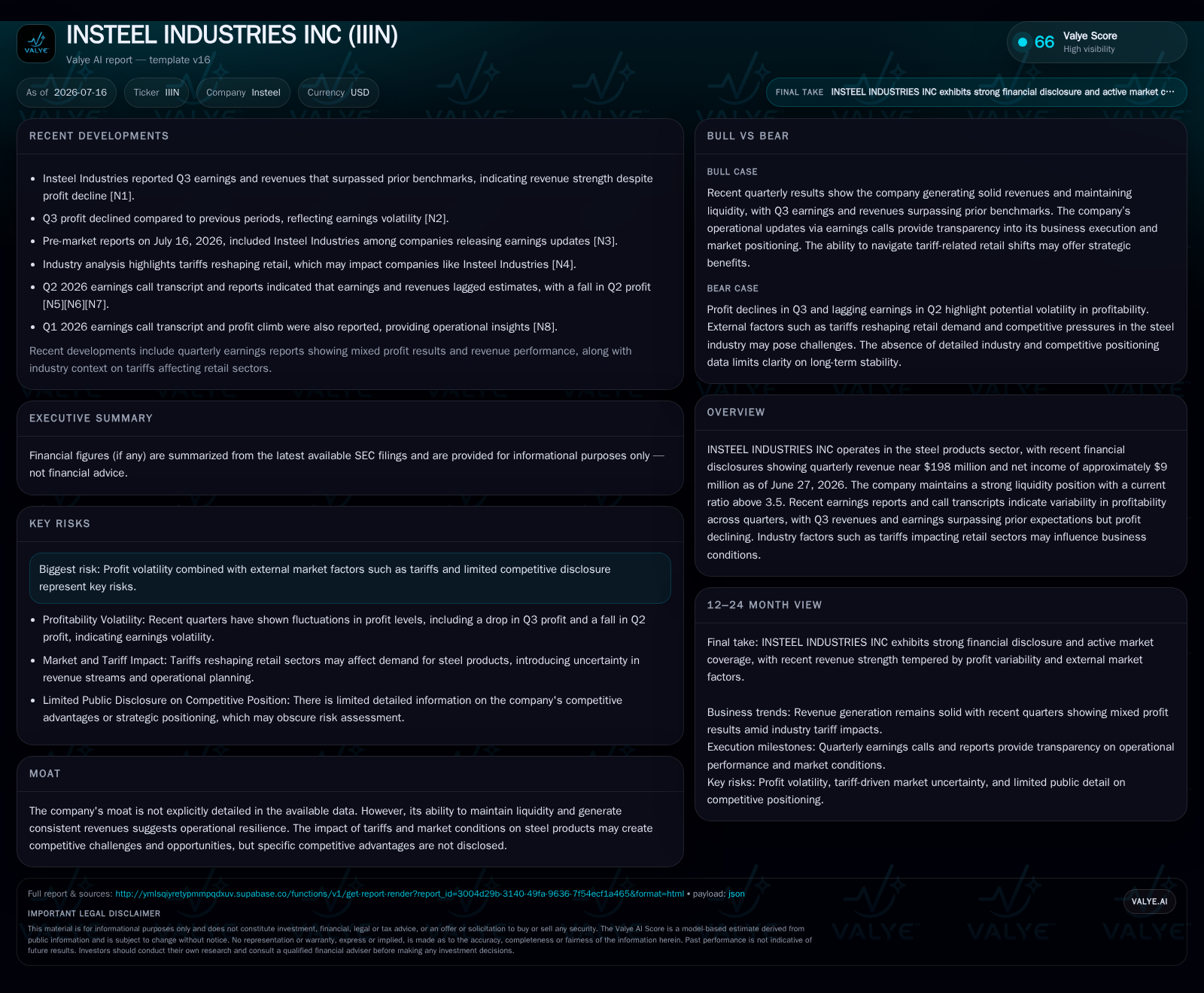
Insteel Industries reported third-quarter revenue of approximately $198 million for the quarter ending June 27, 2026, surpassing market expectations. Despite top-line strength, net income declined to around $9 million, reflecting margin compression driven by elevated scrap steel prices and raw material costs amid ongoing steel tariffs. The company’s liquidity remains robust with a current ratio above 3.5, underpinning operational flexibility in a volatile midstream steel wire manufacturing environment. Tariff-induced price volatility and fluctuating capacity utilization emerge as key factors influencing near-term earnings dynamics.
Q3 Operational Performance Highlights: Revenue Growth Meets Margin Headwinds
Insteel Industries Inc. announced third-quarter revenue of approximately $198 million for the quarter ended June 27, 2026, surpassing analyst expectations driven by favorable pricing adjustments despite somewhat subdued demand volume [S2][N1]. The company reported net income near $9 million, a decline relative to previous quarters primarily attributable to elevated raw material costs and decreased operating margins [S2][N3]. Management highlighted that average selling prices per ton rose in response to steel tariffs impacting cost pass-through capabilities; however, rising scrap steel costs compressed gross margin performance. Operating leverage effects were evident as capacity utilization fluctuated during the period amid variability in construction sector activity.
Steel Wire Manufacturing Economics: Understanding Pricing Power and Raw Material Exposure
Insteel’s core offering consists predominantly of steel wire and reinforcing steel products aimed at construction and infrastructure clients. As a midstream player in the steel value chain, the company transforms raw wire rod inputs into finished fabricated products. Revenue is primarily volume-driven—tonnage shipped multiplied by average selling price—augmented by product mix effects favoring higher-margin reinforcing steel segments. Pricing power stems partially from market conditions influenced by US-imposed steel tariffs which elevate domestic wire rod prices, enabling some pass-through into product pricing [S2]. However, this situational advantage is balanced against the volatility of scrap steel and other raw material prices, which constitute significant production cost components. Procurement strategies and contract terms with customers affect the company’s ability to manage these input cost swings.
Tariffs and Market Dynamics: Their Concrete Effect on Insteel's Product Pricing and Demand
The US steel tariff environment remains pivotal to Insteel’s price-setting dynamics. Tariffs inflating raw material costs have also triggered corresponding hikes in the average sales price of finished products, supporting revenue growth despite uncertainty around demand elasticity [S2][N1]. Construction sector trends directly feed into demand for reinforcing steel; government infrastructure stimulus actions amplify this effect, yet ongoing trade policies inject additional pricing volatility that complicates forecasting. Peer data from companies such as Nucor Corporation underline similar tariff-induced pricing impacts that create short-term revenue boosts but challenge margin stability when raw materials surge unpredictably.
Capacity Utilization as a Lever for Profitability Amid Demand Variability
Fixed manufacturing costs entail that capacity utilization is a critical lever for profitability in Insteel’s operations [S2]. Underutilization amid softening construction orders erodes absorption of fixed overheads, pressing operating margins downward. The quarterly report suggests some moderation in utilization rates compared to previous quarters consistent with variable tonnage shipped and fluctuating order intake. Efficiency improvements or incremental volume gains could enhance margin recovery if structural demand stabilizes.
Order Backlog and Construction Market Signals: Gauging Future Demand Visibility
Order backlog levels serve as essential leading indicators within this capital-intensive industry segment. Insteel’s backlog offers moderate visibility into subsequent quarters’ production volumes given its focus on construction-related markets where project schedules dictate purchasing timing [S2]. Potential risks include cancellations or delays correlated with macroeconomic uncertainties or shifting trade regulations. Nonetheless, backlog health provides partial assurance of near-term demand that bolsters operational planning.
Competitive Landscape: Benchmarking Against Industry Peers in Steel Fabrication and Wire Products
Insteel competes against both integrated steel producers such as Steel Dynamics, Inc., which combine upstream raw material processing with downstream fabrication, and specialized steel wire manufacturers like Commercial Metals Company. Unlike fully integrated players who benefit from supply chain control and scale advantages, Insteel’s positioning relies on nimble fabrication capabilities and focused product offerings tuned toward reinforcing steel demand niches. This configuration implies competitive sensitivity to input cost fluctuations and tariff policy shifts that affect upstream materials.
Growth Opportunities: Infrastructure Stimulus, Product Mix Diversification, and Technological Advances
Demand drivers grounded in elevated infrastructure spending—especially from federal initiatives targeting durable construction—offer tangible growth paths for Insteel [S2]. Product mix enhancements emphasizing higher-margin reinforcing steel formulations align with durable building material trends favoring sustainability and strength. Additionally, incremental technology adoption in manufacturing processes may improve production yield and reduce scrap rates over time. Geographic expansion remains a potential avenue although not specifically delineated in recent disclosures.
Risk Factors: Tariff Uncertainty, Raw Material Price Volatility, and Capacity Underutilization Threats
Insteel continues to face fundamental risks largely typical of steel product manufacturers [S2]. Chief among these are pronounced volatility in scrap steel prices exacerbated by international tariff regimes impacting procurement costs unpredictably. Capacity underutilization risk remains present when market demand softness emerges following episodic construction cycles or macroeconomic contractions. Competitive pressures from imports or alternative construction materials could further weigh on market share or pricing flexibility depending on trade policy evolutions.
Key Milestones Ahead: What Investors Should Monitor in Upcoming Quarters' Executive Guidance and Order Book Updates
Critical near-term monitoring metrics include quarterly guidance updates focusing on revenue trajectories tied to average selling price per ton movements vis-à-vis raw material cost trends [S2][S3]. Changes in order backlog size will help assess whether construction sector momentum sustains or contracts further. Capacity utilization statistics reported will clarify whether operating leverage gains or losses dominate earnings profiles going forward.
Financial Profile Discussion: Liquidity Strength Offsets Profit Volatility in a Capital-Intensive Industry
As of June 27, 2026, Insteel Industries holds cash and equivalents near $22.9 million against current liabilities of approximately $78.1 million, resulting in a robust current ratio of about 3.57—a signifier of substantial short-term liquidity headroom [F1]. While net income declined this quarter reflecting margin pressures from raw material cost inflations amidst tariff-driven price adjustments, free cash flow generation remains sufficient to meet dividend commitments and maintain capital expenditures typical for this heavily capex-dependent sector.
This analysis abstains from conjecture beyond disclosed facts while providing industry context essential to evaluating Insteel Industries’ operating environment during its latest reporting period. It aims solely to elucidate business model elements, competitive dynamics, key performance indicators pertinent to midstream steel fabricators specializing in wire products, along with identifiable risk vectors shaping near-term financial outcomes.
Disclaimer: This is research-only, informational analysis and not investment advice. It may include AI-generated interpretation and general industry context. Always verify important details using primary sources.

Comments