
First BanCorp’s Earnings Growth Acceleration Amid Regulatory and Competitive Pressures
First BanCorp leverages regional diversification and broad product offerings to sustain growth while navigating evolving interest rates and regulatory landscapes.
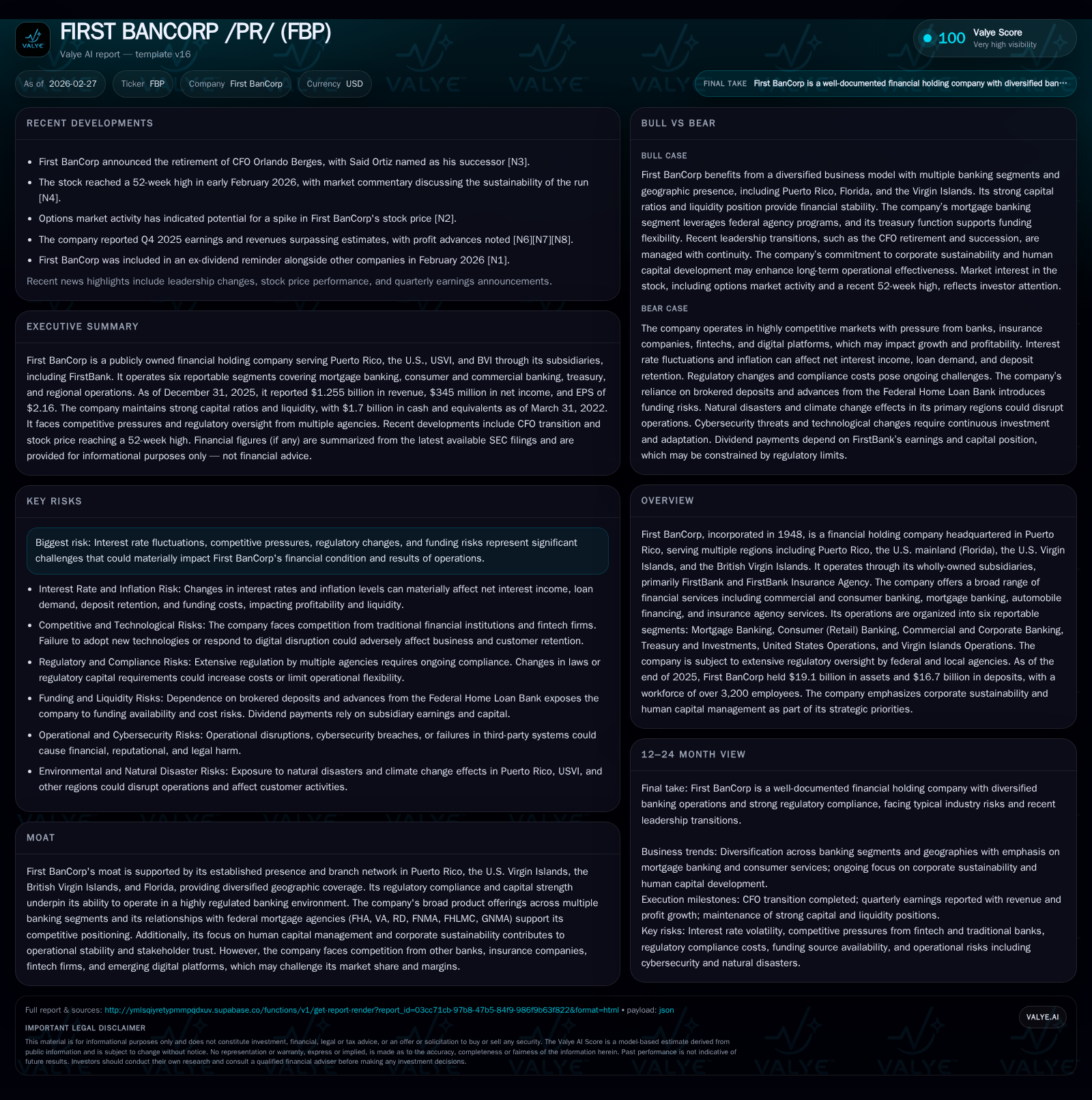
First BanCorp, a financial holding company based in Puerto Rico with operations in multiple U.S. jurisdictions, reported steady revenue growth in 2025 driven by loan origination and diversified banking segments. Its future growth is supported by its strong capital ratios and broad regional footprint, yet constrained by competitive pressures from fintech entrants and regulatory compliance costs. Noteworthy changes include a CFO transition and consistent capital return via stock buybacks. Investors should monitor funding cost dynamics and regulatory developments as key milestones.
Company Overview and Historical Performance
First BanCorp (FBP) stands as a well-entrenched financial holding company headquartered in San Juan, Puerto Rico. Established in 1948, it operates primarily through its subsidiary FirstBank alongside FirstBank Insurance Agency. The company’s operations span six reporting segments: Mortgage Banking; Consumer (Retail) Banking; Commercial and Corporate Banking; Treasury and Investments; United States Operations; and Virgin Islands Operations. The geographic reach includes Puerto Rico, the U.S. Virgin Islands (USVI), British Virgin Islands (BVI), and the U.S. mainland (Florida), affording the bank diversified market exposure [S1][S9][S29].
The firm’s asset base reached approximately $19.1 billion at the end of FY2025 with loans held for investment totaling about $13.1 billion supported by deposits of $16.7 billion. Equity stands at roughly $2 billion [F1].
Growth Drivers (2019–2025)
Revenue trends reflect incremental expansion fueled primarily by mortgage banking activities—leveraging relationships with federal agencies such as FHA, VA, FNMA—and commercial lending initiatives oriented toward mid-market and government sectors within Puerto Rico plus U.S.-based consumer products [S9]. First BanCorp’s revenue grew consistently over recent years:
Historical performance (annual)
| FY | Rev ($mm) | Net ($mm) | CFO ($mm) | Capex ($mm) | Rev YoY | Net YoY |
|---|---|---|---|---|---|---|
| 2025 | 1255 | 345 | 449 | 11 | +2.4% | +15.4% |
| 2024 | 1226 | 299 | 404 | 10 | +6.0% | -1.4% |
| 2023 | 1156 | 303 | 363 | 23 | +17.3% | -0.7% |
| 2022 | 986 | 305 | 440 | 20 |
Source: SEC companyfacts cache [F1].
Capital returns and efficiency (annual)
| FY | Buybacks ($mm) | FCF ($mm) | ROE% |
|---|---|---|---|
| 2025 | 154 | 438 | 17.5 |
| 2024 | 102 | 394 | 17.9 |
| 2023 | 203 | 340 | 20.2 |
| 2022 | 278 | 420 | 23.0 |
Source: SEC companyfacts cache [F1].
Revenue gains have been partially offset by margin pressures stemming from fluctuating interest rates impacting net interest income—driven by timing mismatches between asset repricing and liabilities—and prepayment dynamics affecting mortgage-backed securities yields [S1]. Nevertheless, operating cash flow expanded to $449 million in FY2025 indicating solid underlying cash generation.
Capital expenditures have remained controlled near low double-digit millions annually reflecting limited need for major infrastructure investments but continued technology enhancements likely underpinning digital services development [F1].
Business Segments and Market Position
Mortgage Banking
Focused on residential loan origination, servicing, sale activities supported largely by federal agency collaborations (e.g., FNMA, FHA). This segment benefits from cyclical home buying trends but remains vulnerable to rising interest rates suppressing refinance volumes [S9].
Consumer (Retail) Banking
Retails branch network deposits serve as primary funding source for loan originations encompassing checking/savings accounts, CDs, home equity lines in Puerto Rico and US territories where trust relationships give FirstBank competitive moats.
Commercial & Corporate Banking
Lending services target specialized large customers plus government-related entities offering secured commercial real estate loans with real estate collateral as risk mitigants.
Treasury & Investments
Manages investment portfolios including MBS instruments and oversees wholesale funding strategies such as Federal Home Loan Bank advances beyond core customer deposits.
Geographic Diversification
Operations extend beyond Puerto Rico into seven branches across Florida plus eight branches across USVI/BVI combined—spreading geographic concentration risk but also exposing FBP to more regulatory regimes across state lines [S9][S29].
Regulatory Environment & Risks
The company operates under a stringent compliance landscape governed by multiple entities—the Federal Reserve Board supervises the holding company level while bank-level regulation is administered by FDIC, OCIF (Puerto Rico), CFPB consumer protection oversight, USVI Division of Banking Insurance & Financial Regulation, BVI Financial Services Commission, Florida Office of Financial Regulation among others [S1][S22][S29].
Compliance challenges include maintaining adherence to anti-money laundering laws like Bank Secrecy Act enforcement plus evolving data privacy regulations which continue to increase operational complexity and cost burdens [S25]. Additionally fair lending regulations such as Equal Credit Opportunity Act impose nondiscrimination obligations enforced via potential regulatory or private litigation risks affecting reputational standing if violations occur [S27].
Liquidity risk arises primarily from reliance on customer deposits supplemented by brokered certificates of deposit ($594 million or ~4% of total deposits as of end-2025) with maturities concentrated within one year posing rollover challenges if market conditions tighten [S5][S7][S26]. Management has historically succeeded replacing maturing funds but this remains an area of vigilance particularly given potential increases in wholesale funding costs.
Interest rate volatility creates margin pressure via basis risk when asset yields do not reprice synchronously with funding costs while shifts in prepayments can compress returns on mortgage-backed portfolios impacting comprehensive income and tangible common equity levels [S1].
Capital Structure & Returns
First BanCorp maintains robust capital adequacy well above regulatory minimums:
- CET1 Ratio: ~16.76% vs minimum requirement ~6.50%
- Tier1 Capital Ratio: ~16.76% (vs minimum ~8%)
- Leverage Ratio: ~11.58% (vs minimum ~4%) [F1][S7]
These strong buffers support both loan portfolio growth potential and compliance with evolving Basel III-based capital standards applicable across U.S. banking subsidiaries.
Return on equity approximates a healthy ~17.5% based on recent net income relative to equity levels signaling efficient capital deployment though subject to cyclical earnings variability inherent in financial services.
Cash flow remains solid with FY2025 operating cash flow exceeding capex spending by over fourfold leading to free cash flow availability approximating $438 million which funds strategic initiatives plus shareholder capital returns.
Buybacks have been steadily executed including approximately $154 million repurchased during FY2025—complemented by dividends though historically less emphasized—providing balanced returns management aligned with prudent capital stewardship policy under current regulatory constraints on dividend distribution based on subsidiary earnings capacity [F1][S8].
Recent Developments & Future Outlook
In early February 2026 management announced CFO Orlando Berges’ retirement effective promptly with Said Ortiz succeeding—marking a significant leadership transition impacting upcoming financial strategy execution during a period of evolving interest rate cycles and regulatory reforms [N8][S3].
Q4/FY2025 earnings calls highlighted profits surpassing analyst expectations driven by disciplined credit underwriting, deposit stability despite competitive pressures from fintech entrants expanding digital offerings faster across regional markets [N2][N3][N4]. Continued focus is reported on enhancing human capital initiatives coupled with ESG governance frameworks adopted since mid-2020s reinforcing commitments towards sustainable operational practices that increasingly influence stakeholder trust particularly in the Caribbean banking milieu [S11].
Growth Catalysts:
- Sustained loan originations supported by government-backed mortgage programs mitigating credit losses while preserving competitive channel access.
- Expansion in U.S. mainland operations targeting southern Florida offering cross-selling opportunities leveraging brand familiarity.
- Technological investments improving digital service delivery to counter fintech disintermediation risks.
- Capital deployment flexibility enabled by strong balance sheet allowing opportunistic acquisitions or product line extensions.
Constraints/Risks:
- Interest rate volatility compressing net interest margins given mismatches between asset yield resets vs funding costs.
- Increasing competition from non-bank fintech players eroding traditional fee incomes especially around payments/wealth management segments.
- Heightened compliance costs responding to multifaceted regulatory regimes spanning federal/state/local jurisdictions leading to margin headwinds.
- Funding concentration risks centered on short-dated brokered CDs possibly challenging liquidity during stressed environments.
- Potential adverse impacts from economic downturns or real estate valuation declines increasing non-performing assets requiring allowance build-ups damaging earnings quality.
What To Watch:
- Quarterly updates on net interest margin trends amidst Federal Reserve monetary policy adjustments as key metric of profitability sustainability.
- Non-performing asset trajectory including charge-off rates relative to allowances indicating credit portfolio health status.
- Progression of technological upgrades enabling customer acquisition/retention versus fintech competitors influencing long-term franchise strength.
- Regulatory changes especially regarding consumer protection rules enforced by CFPB along with AML program efficacy affecting operational risk profile.
- Capital allocation moves reflecting board strategy towards balancing organic growth investments versus returning excess cash through buybacks/dividends signaling confidence levels.
Conclusion
First BanCorp sustains solid financial health highlighted by steady revenue gains amplified through geographic diversification across Caribbean regions supplemented by growing presence in select U.S markets. Its conservative capitalization strategy paired with disciplined cash flow generation positions it well for navigating macroeconomic uncertainties tied primarily to interest rate environment shifts and intensifying competition from swift innovation within financial services delivery models.
While intrinsic risks related to regulatory burden cycles persist alongside emerging digital disruptors challenging legacy systems' efficacy, First BanCorp’s established operational footprint combined with robust governance frameworks fosters resilience essential for medium-term performance predictability amid volatile externalities common within mid-sized banking entities competing in multi-jurisdictional terrains like Puerto Rico/U.S.V.I./Florida corridor today.
This report synthesizes publicly available regulatory filings alongside recent reported earnings calls without making investment recommendations or forecasts beyond stated company guidance or disclosures.
Disclaimer: This is research-only, informational analysis and not investment advice. It may include AI-generated interpretation and general industry context. Always verify important details using primary sources.

Comments