
FDCTech Extends Global Footprint with Multi-Asset Brokerage and Payment Expansion
FDCTech’s August 2026 quarterly filing underscores operational growth via global acquisitions and regulatory licensing alongside emerging payment services amid execution challenges.
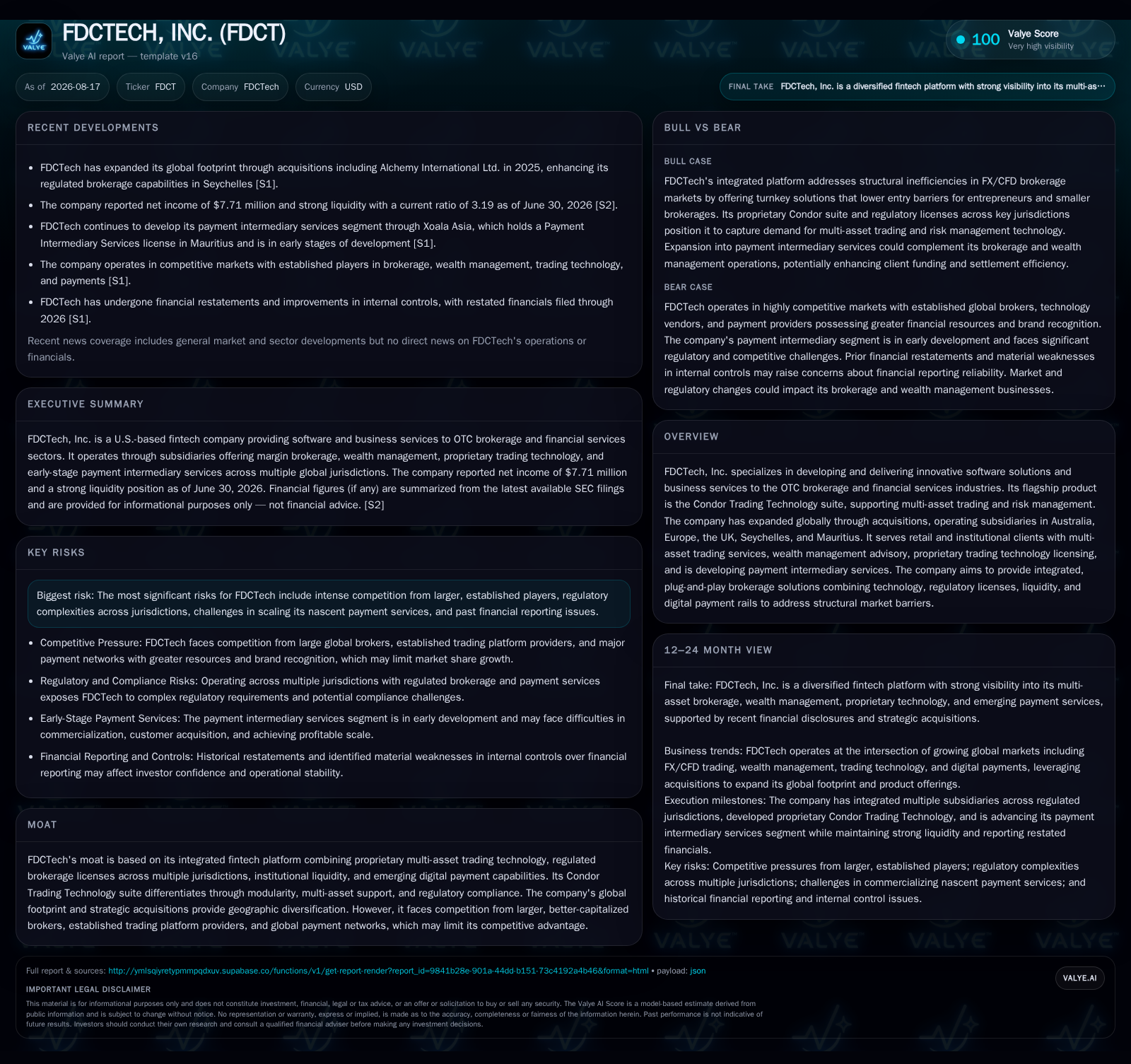
FDCTech is steadily expanding its fintech brokerage platform through strategic acquisitions across multiple jurisdictions, leveraging proprietary and third-party trading technology to serve retail and institutional clients globally. The latest 10-Q reveals ongoing integration progress, legal proceedings from prior acquisition diligence issues, and nascent development of payment intermediary services with inherent scale challenges. While its multi-asset margin brokerage and wealth advisory segments form a diversified revenue base, complexities from multi-jurisdictional compliance and competitive pressures moderate near-term growth visibility. Financially, FDCTech maintains a solid liquidity position with a strong current ratio supporting strategy execution.
Quarterly Operational Update Highlights Progress Amid Complexities
FDCTech’s latest Form 10-Q filing dated August 17, 2026 provides crucial visibility into the company's progress integrating its globally dispersed subsidiaries post several acquisitions completed between 2021 and 2025 [S2]. These subsidiaries operate under different regulatory regimes including Malta (MFSA-regulated Alchemy Markets Ltd.), the UK (FCA-regulated Alchemy Prime Ltd.), Seychelles (FSA-regulated Alchemy International Ltd.), Australia (ASIC-regulated AD Advisory Services Pty Ltd.), as well as Mauritius-based entities supporting Asian markets. This mosaic structure enables a broad customer reach spanning retail and institutional clients but elevates operational intricacies particularly around compliance harmonization.
The quarterly report also updated the status of ongoing legal proceedings stemming from the acquisition of Alchemy Markets Ltd. in Malta, where historical anti-money laundering failures have fed into a dispute about unpaid vendor loans affecting purchase price settlement [S2][S3]. This litigation is scheduled for trial in November 2026, underscoring persistent legacy risks from acquisition diligence gaps. Additionally, the company transitioned independent accounting firms following regulatory restrictions imposed on the previous auditor [S3], reflecting ongoing efforts to reinforce corporate governance controls.
Business Model Diversity Anchoring Revenue Streams Across Segments
FDCTech’s revenue generation rests primarily on its margin brokerage segment operated through wholly-owned regulated subsidiaries across Europe, UK, Seychelles, Australia, and Mauritius [S1]. These entities provide multi-asset trading services encompassing leveraged forex trades, CFDs on equities and commodities, traditional stock trading, bonds exposure, as well as increasingly digital assets. The company’s proprietary Condor Trading Technology suite supports this multi-asset offering with modular risk management features designed for scalability across asset classes and regions. Licensing portions of Condor technology alongside third-party software integrations diversify technology revenue streams.
Wealth management advisory services contribute recurring fee income managed by AD Advisory Services Pty Ltd., overseeing over $530 million in assets under advice through a team of 28 financial advisors regulated by ASIC in Australia [S1]. This segment offers stability by generating advisory fees less sensitive to market volume fluctuations compared to transactional brokerage income. Emerging payment intermediary operations through the Xoala Asia subsidiary represent a nascent growth vertical targeting merchant payments in Asian markets; however scaling this segment remains challenging given competitive dynamics [S1].
Revenue mechanics are complex: brokerage revenue derives mainly from spreads on leveraged transactions, commissions on trades executed via the platform, margin interest from lending to clients engaging in leveraged positions, licensing fees for software deployments including subscription/SaaS contracts for tech clients using Condor modules externally, while wealth management fees rely on percentage-based AUA charges. Payment intermediary income would emerge from transaction fees plus FX spread capture but currently represents a small portion of total revenues.
Global Footprint Supported by Regulatory Licensing: Benefits and Challenges
Strategic expansion into key global financial centers leverages FDCTech’s network of licensed subsidiaries:[S1] At the core is Alchemy Markets Ltd. based in Malta operating under MFSA oversight serving EU clients beyond the UK post-Brexit, while Alchemy Prime Ltd. maintains FCA licensing ensuring access to UK markets. The Seychelles-registered Alchemy International Ltd. focuses on Asia Pacific jurisdictions requiring offshore broker licenses often used for forex/CFD offerings. Australian ASIC-licensed AD Advisory Services provides wealth management advisory services domestically with regulatory stringency typical of mature developed markets.
This distributed regulatory footprint facilitates geographic diversification critical for fintech platforms seeking both retail volume growth and institutional sophistication across heterogeneous markets where local licenses act as barriers to entry for competitors [S1]. However, it concurrently amplifies compliance costs substantially—each jurisdiction demands tailored reporting protocols, anti-money laundering adherence measures, capital adequacy enforcement, periodic audits, workforce training programs aligned with local regulator expectations plus customer disclosures matching regional investor protection standards.
The recent acquisition-related AML deficiencies uncovered at Alchemy Markets Ltd. highlight the reputational exposure associated with integrating acquired entities’ historical compliance frameworks [S1]. Such issues demand dedicated remediation resources straining operating leverage especially as FDCTech attempts to grow earnings amid broadening geographical scope.
Competitive Landscape: Balancing Proprietary Tech Against Larger Peers
Within its value chain position as both a regulated broker and fintech solutions provider offering proprietary trading technology innovations through Condor Trading Suite—FDCTech occupies an intermediate niche competing with multi-jurisdictional brokers such as Interactive Brokers or Saxo Bank who command larger scale distribution networks and broader product sets.
Condor's platform modularity allows customized asset class coverage adapting rapidly to emerging market demands including digital assets where innovation velocity is key. This agility contrasts with more monolithic systems deployed by legacy brokers but faces competitive pressure from specialized trading technology providers like MetaQuotes or Trading Technologies that dominate certain forex or derivatives verticals within fintech brokerage software.
Pricing power is constrained by incumbent brokers' ability to subsidize narrower spreads with large volume flows while global payment networks such as PayPal restrict market penetration opportunities for FDCTech’s fledgling payment intermediary service due to their network effects advantage. Thus sustaining client acquisition profitability depends on differentiated user experience enhancements tied to API integration capabilities that enable seamless workflow automation for institutional customers alongside retail traders.
Emerging Payment Intermediary Services: Potential Upside Versus Scale Risks
Xoala Asia represents FDCTech’s first meaningful push into payment processing services focusing on Asian merchant acquiring markets [S1]. Payments industry economics differ fundamentally from brokerage fee models since competitive moats depend heavily on transaction speed reliability fraud prevention capabilities regulatory approval breadth plus established brand trust—areas where large incumbents like PayPal or Stripe have entrenched advantages.
Xoala’s reliance on third-party technology accentuates integration risk especially given FX spread compression prevailing among foreign exchange conversions within cross-border payments—a central revenue driver for intermediaries attempting margin capture [S1]. Moreover regulatory scrutiny continues tightening worldwide over AML/KYC obligations demanding costly compliance investments just as user adoption hurdles persist due to switching costs favoring existing platforms.
While the payment segment holds potential long-term upside diversifying beyond volatile trading volumes it presents a critical execution risk presently causing uncertain near-term contribution prospects pending merchant acquisition pace increases measured by volume processed metrics.
Growth Thesis Centered on Geographic Expansion and Platform Innovation
FDCTech’s principal growth vectors stem from continuous expansion of licensed jurisdictions enabling access to new retail/institutional client pools coupled with acquiring companies already operating established platforms under local licenses [S1][S2]. Growth levers include scaling active account numbers driven by marketing initiatives plus organic demand shifts favoring integrated multi-asset trading environments supporting leveraged FX/CFDs alongside equities/digital products.
Platform innovation focusing on modular architecture enhances product adaptability fostering higher client retention through customization options meeting sophisticated risk management demands of institutional investors while preserving simplicity valued by retail participants. Integrating payment intermediary functions tightly within trading workflows promises efficiency gains potentially boosting average revenue per user if realized effectively.
Monitoring metrics such as aggregate trading volume notional values combined with assets under management/advice expansions in wealth segments offers a quantifiable means to track success against this diversified growth strategy.
Risks from Regulatory Compliance, Competition, and Legal Proceedings
The multi-jurisdictional compliance burden inherently elevates complexity risking increased operational costs possibly diluting margins particularly if local regulators impose additional capital buffers or restrict certain product lines due to policy shifts [S1]. FDCTech’s layered licenses across Europe (Malta EU regime), UK FCA oversight post-Brexit divergence plus offshore regimes like Seychelles all require distinct protocols raising administrative overhead.
Competition intensifies both horizontally against larger global brokers equipped with scale benefits enabling aggressive pricing strategies plus vertically versus standalone fintech firms excelling in niche technologies potentially eroding market share or compressing spreads [S1]. New entrants face significant go-to-market challenges especially within payments where incumbents wield established networks difficult to displace
Legal uncertainties remain material given legacy AML-related fines linked to acquired entities along with ongoing court proceedings regarding disputed acquisition payments signaling reputational hazards that could constrain capital deployment flexibility [S2]. Failure to resolve these litigations swiftly or unfavorable outcomes may impair investor confidence affecting long-term valuation support structures.
What To Watch — Upcoming Trials, Regulatory Moves, Client Metrics Milestones
The November 2026 trial date concerning Alchemy Markets Ltd.’s contested purchase agreement will be pivotal for clarifying contingent liabilities impacting balance sheet strength [S2]. Additionally, monitoring progression toward securing further financial services licenses in strategically targeted jurisdictions will inform expansion momentum.
Operational milestones include monthly active account counts particularly segmented between retail versus institutional cohorts along with reported increases in traded volumes across leveraged forex/CFD products alongside gradual ramp-up metrics from Xoala Asia’s payment transaction volumes outlined in future filings.[S2]
Achievement of stable profitability within emerging segments like wealth advisory measured via assets under advice growth trajectories also represents key validation points advancing FDCTech’s integrated fintech platform thesis.
Financial Profile Discussion — Liquidity Cushion Supports Strategy Execution
As of June 30, 2026 FDCTech maintains cash and cash equivalents totaling approximately $18.2 million complemented by current assets aggregating roughly $48.2 million vis-à-vis current liabilities near $15.1 million yielding a strong current ratio estimated at 3.19 which evidences substantial short-term liquidity resilience conducive to funding ongoing organic investments plus potential bolt-on acquisitions without immediate refinancing pressures [F1][S2]
Total debt appears minimal relative to cash holdings based on best-effort data showing $550 thousand outstanding albeit last confirmed December 2022 suggesting conservative leverage usage consistent with smaller reporting companies navigating early scaling phases amidst volatile sector dynamics [F1]
This financial flexibility positions FDCTech favorably against peers managing multiple jurisdictional compliance costs while absorbing legal contingencies related to legacy AML exposures without jeopardizing core fintech platform development timelines or customer acquisition campaigns.
This analysis incorporates primarily SEC filings dated through August 2026 supplemented by industry context without extrapolation beyond verified disclosures. It does not constitute investment advice but aims to provide detailed insight into FDCTech's evolving fintech brokerage platform landscape capturing business model intricacies alongside sector-specific competitive dynamics.
Disclaimer: This is research-only, informational analysis and not investment advice. It may include AI-generated interpretation and general industry context. Always verify important details using primary sources.

Comments