
Fervo Energy Accelerates Geothermal Scale-Up with Cape Station Capital Deployment and Expanding GeoClusters
Fervo Energy progresses from demonstration to commercial geothermal power generation, advancing modular GeoBlock development amid intensive capital raises and permit milestones.
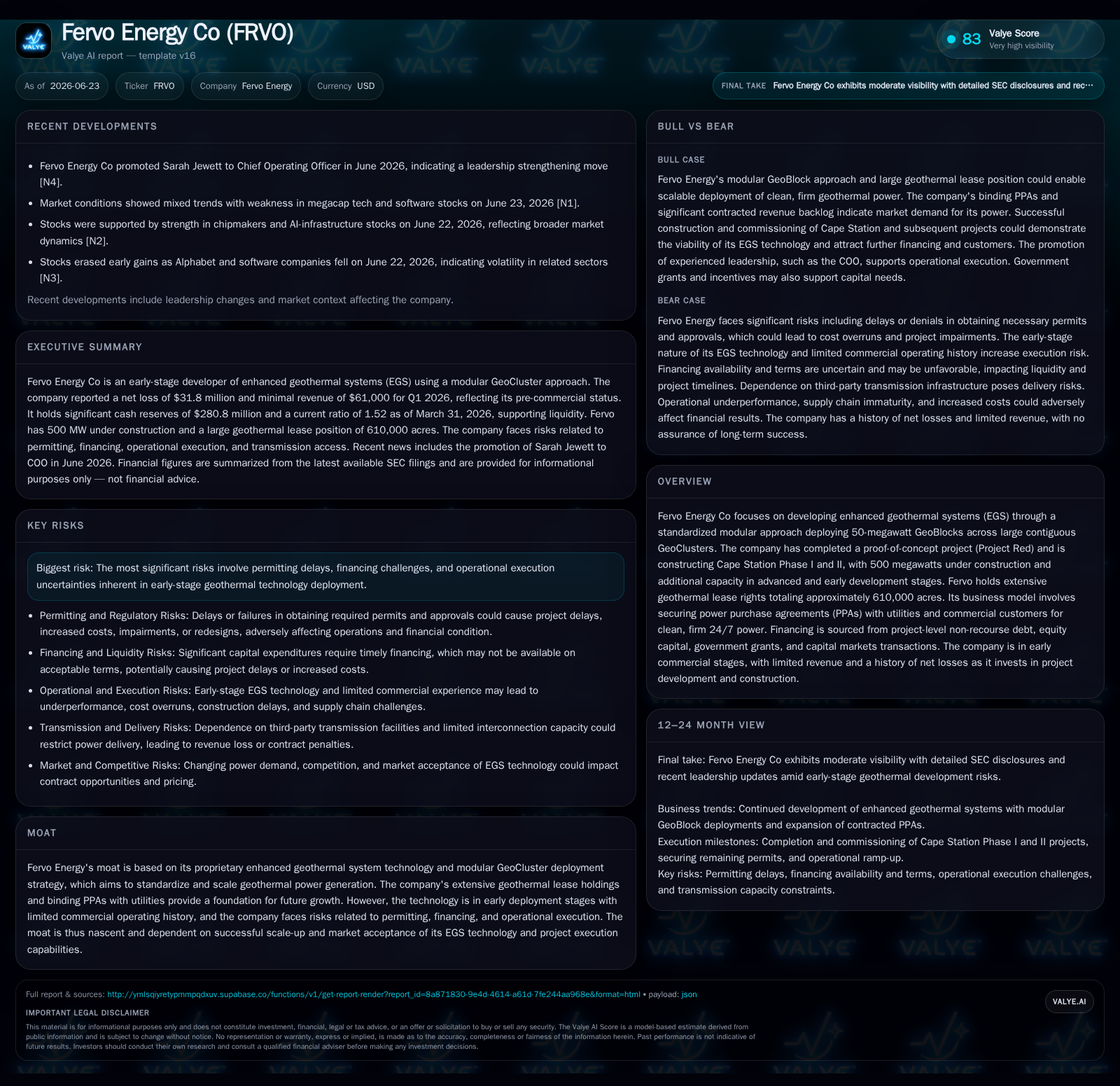
In its latest quarterly filing, Fervo Energy highlights critical steps toward commercializing its enhanced geothermal systems technology through construction milestones at Cape Station and expansion of modular GeoBlocks. The company reported a significant increase in capital expenditures driven by drilling, construction, and permitting activities, alongside rising employee costs to support project execution. With 500 MW under construction and a substantial development pipeline supported by binding power purchase agreements totaling over 650 MW, Fervo is navigating complex permitting processes while maintaining robust liquidity following its May 2026 IPO raise. Risks related to financing availability, permit finalizations, and operational scaling remain key watchpoints as the company seeks to deliver first power later this year and scale output to 500 MW by 2028.
Recent Operating Update
Fervo Energy’s latest quarterly report filed June 23, 2026 ([S2]) provides a pivotal lens into its transition from early-stage demonstration projects toward large-scale commercial geothermal power generation using enhanced geothermal systems (EGS). Following its May IPO ([S24]), which raised approximately $2.2 billion gross proceeds ([S11]), Fervo has accelerated capital deployment notably in the Cape Station development located in Milford, Utah — a flagship project comprising two phases poised to deliver first power later this year.
In Q1 2026 ending March 31, the company recorded capital expenditures of $172.8 million primarily allocated to wellfield drilling, completion activities, surface facilities construction, and associated infrastructure necessary for powering up initial GeoBlocks ([S12], [S13]). Concurrently, general and administrative expenses more than doubled (+121%), reflecting incremental public-company costs such as Sarbanes-Oxley compliance and insurance premiums post-IPO, alongside a sizeable increase in technical staff headcount (+82 employees) focused on project execution scaling ([S2]).
Importantly, permitting progress underscores near-term operational viability: for Cape Station Phase I — essentially a standalone GeoCluster module delivering ~50 MW per GeoBlock — Fervo has procured 79 of required 80 permits with the remaining application progressing without anticipated delay ([S24]). Phase II has made solid headway with approvals received on nearly half of the expected permits (82 out of 179), signaling active state- and local-level permitting engagement beyond federal National Environmental Policy Act (NEPA) reviews ([S24], [S25]). These bureaucratic milestones are critical given the specialized nature of geothermal drilling permits covering wells injection/production ensures reservoir efficacy.
Financially, the balance sheet as of March reflects $280.8 million in unrestricted cash with total debt obligations around $189.8 million resulting primarily from project-specific financing initiatives including the recently closed Project Granite Facility providing capital for Cape Station Phase I construction ([F1], [S6], [S7]). Undrawn credit lines total nearly $409 million combining corporate-level Mercuria Credit & Letter of Credit Facilities alongside project finance capacity ([S4], [S5]). Such liquidity depth is necessary given Fervo's forecasted capital requirements approaching $1.2 billion over the next twelve months focusing predominantly on Cape Station development while supporting multiple GeoClusters' early exploration stages across its expansive leasehold portfolio totaling approximately 610,000 acres ([S12]).
Revenue generation remains nascent at just $61,000 for the quarter — ancillary fees unrelated to power sales — consistent with continuing early commercial stage operations where large-scale capacity has yet to come online ([F1], [S12]). However, signed binding PPAs cover a substantial chunk of firm power acreage: commitments exist for approximately 658 MW representing roughly $7.2 billion in projected revenue backlog based on contracted pricing escalators over multi-decade terms ([S12]). An additional non-binding framework agreement signed with Google Energy for up to three gigawatts suggests strategic intent toward repeatable commercial deployment modeled on standardized modular GeoBlocks (50 MW units) aggregated into larger GeoClusters that enable scale economies.
Business Model Analysis
Fervo Energy operates within the upstream-to-midstream segments of the geothermal value chain: it acquires extensive geothermal resource leases securing exclusive rights; undertakes subsurface reservoir engineering via EGS techniques such as hydraulic fracturing combined with horizontal drilling; develops binary cycle Organic Rankine Cycle (ORC) plants; manages permitting and environmental compliance; constructs modular GeoBlock power plants; then sells electricity under long-term power purchase agreements—typically multi-decade contracts providing revenue visibility.
The company’s strategic differentiation lies in its patented modular approach deploying repeatable standardized units—each GeoBlock at 50 MW—aggregated into larger contiguous GeoClusters exceeding hundreds or even thousands of megawatts potential. This modularization is designed to reduce unit CapEx ($7,000/kW inclusive of wellfield plus plant equipment), de-risk drilling through standard geological characterization processes, and accelerate timelines through replicable regulatory approvals and financing packages tailored by project size ([S25], [S26]).
Revenue realization hinges critically on volume-driven electricity sales from operating plants under prevailing PPA tariffs coupled with ancillary revenues such as renewable energy credits or grid services if applicable. Margins depend on operational efficiency (plant capacity factor), maintenance costs per MWh delivered, capital cost amortization schedules relevant under GAAP depreciation policies ([S12]). Cash flow timing exhibits lag phases in ramp-up intervals given extensive drill-to-power startup durations characteristic of EGS technologies.
Fervo finances primarily via non-recourse project-specific debt that places lender risk exposure squarely on asset performance rather than recourse against the corporate entity—a common structuring choice among renewable independent power producers (IPPs). This structure preserves corporate financial flexibility but introduces dependencies on milestone-based drawdowns conditioned upon permitting attainment and reservoir confirmation ([S6], [S15]). Equity financing supplements growth capital needs alongside government grants targeting clean energy transitions.
Industry Structure & Competitive Position
Within renewable energy’s geothermal niche focusing on enhanced geothermal systems (EGS)—a segment exploiting engineered reservoirs absent natural permeability—competitors include Ormat Technologies (NYSE: ORA), AltaRock Energy (specialized EGS developer), Enel Green Power (global geothermal operator), and utility entities like Calpine but oriented more broadly.
Fervo’s substantial land position (~610k acres) armors it against competitor encroachment enabling scale deployment across multiple contiguous clusters—a tangible moat when coupled with binding off-take contracts from creditworthy utilities/ corporates supporting revenue predictability. Its proprietary horizontal fracturing methodology integrated into GeoBlock design potentially positions it advantageously vis-à-vis conventional hydrothermal-only developers reliant on naturally fractured reservoirs.
However, challenges remain among peers include permitting complexities at federal/state/local levels often unpredictable given environmental safeguards; supply chain bottlenecks especially around specialized drilling rigs; technology scale-up risks typical for EGS including reservoir stimulation efficacy; volatile capital market conditions impacting cost+availability of debt/equity; plus political/regulatory shifts influencing carbon credits or tax incentives.
Growth Drivers
Fervo's growth momentum stems principally from:
- Increasing demand globally for clean firm renewable energy sources mitigating grid intermittency issues posed by solar/wind.
- Modular GeoBlock approach enabling replicable project economics reducing localized drilling/permitting uncertainties while cutting design timelines.
- Robust PPA portfolio totalling over 650 MW already secured improving revenue visibility essential for capital raising.
- Vast geothermal leasehold expansion maintaining optionality across different geographies affording resource diversification benefits.
- Supportive government policies offering tax credits/grants geared toward advancing next-gen renewables including EGS technologies.
- Strategic alliances exemplified by Google Energy’s framework agreement intending gigawatt-scale delivery suggesting validation of business model scalability.
- Continued advances in reservoir stimulation/ monitoring technologies enhancing well success rates crucial for economic viability.
Risks and Constraints
Despite these positives there are notable risks:
- Permitting delays especially beyond NEPA scope involving multiple state/local processes may slow construction start timelines or impose restrictive conditions affecting productivity ([S24]).
- Financing risks heightened by recent interest rate inflation could challenge non-recourse debt pricing or force higher equity dilution/refinancing constraints impacting capital efficiency ([S5]).
- Operational uncertainties around reservoir reservoir heat extraction capabilities typical for early commercial EGS deployments may impact plant capacity factors diminishing cash flow generation reliability.
- Dependence on successful sequencing between drilling completion and plant commissioning under tight schedules imposes execution risk requiring precise project management capabilities amidst supply chain interruptions.
- Cash flow restrictions resulting from preferred equity structures with Catalyst/Centaurus requiring cumulative distribution waterfalls before parent dividend availability limit internal liquidity ([S11], [S23]).
- Emerging public company administration cost increments divert cash flow toward compliance/legal investor relations away from pure project development investment as noted in G&A expense increases ([S2]).
- Potential adverse changes in energy policy or clean energy incentives under shifting political climates could curtail future subsidies critical for competitive positioning relative to fossil alternatives.
What To Watch Next
Key upcoming milestones serving as demand signals and operational barometers include:
- Definitive commissioning dates delivering first power from Cape Station Phase I projected late 2026 validating commercialization timelines.
- Progression toward full buildout goals targeting ~100 MW operating capacity early next year expanding operating cash flows.
- Procurement updates regarding third-party ORC equipment orders confirming supply chain stability.
- Further permit issuances especially within Cape Station Phase II portfolios tracking regulatory timelines versus expectations.
- Updates on drawdowns against Project Granite Facility gauging capital deployment velocity supportive of construction acceleration.
- Additional PPA signings evidencing market reception beyond anchor deals reinforcing contract backstop coverage against project buildouts.
- Quarterly updates quantifying well success rates informing reservoir stimulation effectiveness crucial for sustaining long-term output profiles.
Financial Profile Overview
Liquidity remains ample post-IPO—with unrestricted cash balances at nearly $281 million alongside available undrawn credit approximating $409 million combining corporate and project-level facilities—providing runway sufficient to cover estimated near-term capex requirements (~$1.2 billion estimated over next twelve months largely allocated toward Cape Station phases I & II) ([F1], [S23]). Importantly, current ratio stands comfortable at approximately 1.52 reflecting sound working capital management during aggressive investment phase ([F1]).
Disclaimer
This analysis is based solely on information contained within publicly filed documents dated through June 23, 2026. It does not constitute investment advice or research views. All forward-looking statements reflect management estimates subject to uncertainties inherent in early-stage geothermal project development including permitting timelines, funding scenarios, technological performance variability, market dynamics affecting PPAs pricing/availability, and regulatory changes affecting renewable energy economics.
Disclaimer: This is research-only, informational analysis and not investment advice. It may include AI-generated interpretation and general industry context. Always verify important details using primary sources.

Comments