
Five Star Bancorp’s Regional Strength Fuels Expanding Profitability and Capital Growth
A focused commercial real estate lending strategy within Northern California powers Five Star Bancorp's recent earnings gains and capital expansion.
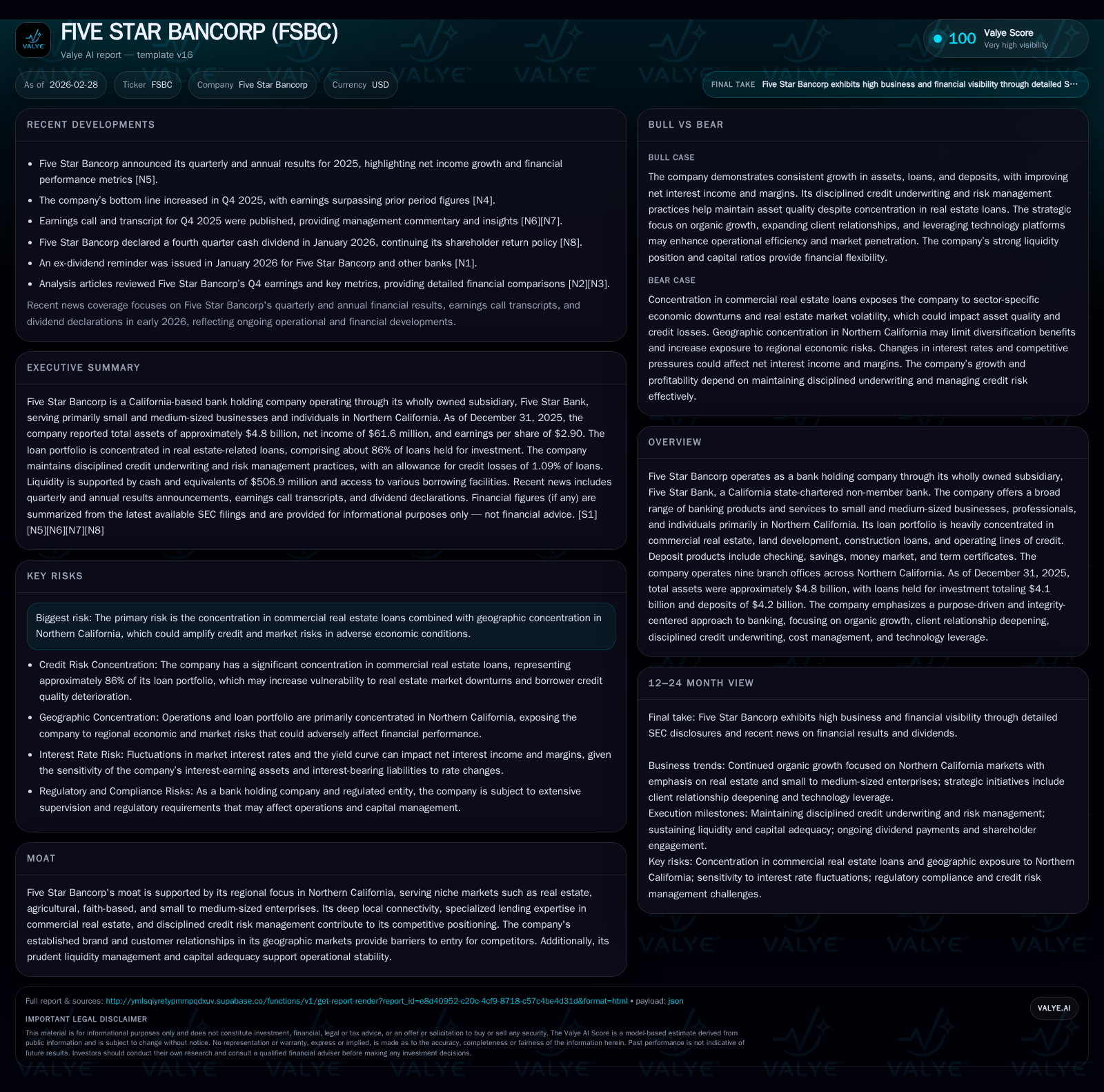
Five Star Bancorp has leveraged its regional concentration and niche expertise in commercial real estate lending to deliver strong net income growth, highlighted by a nearly 35% increase from 2024 to 2025. The company’s disciplined credit risk management and localized client relationships underpin stable returns amid rising interest rate volatility. Capital metrics exhibit robust shareholder equity growth and consistent dividend payouts without share repurchases. Going forward, growth prospects hinge on controlled loan portfolio expansion, prudent allowance for credit losses, and continued deposit base stability amid concentration risks intrinsic to its Northern California footprint.
Historical Growth and Earnings Momentum
Five Star Bancorp demonstrated impressive net income momentum through FY2025, posting $61.6 million or a 34.9% increase year-over-year from $45.7 million in FY2024 [F1][S1]. This uptick was supported by improved net interest margins arising from the firm’s ability to price commercial real estate loans effectively amidst fluctuating rate conditions while maintaining sound credit risk controls. Operating cash flow similarly surged by 40.2% to $72.6 million over the same period, underscoring consistent cash generation capacity [F1]. Capital expenditures also nearly doubled to $1.2 million, reflecting reinvestment into core systems and branch infrastructure aligned with measured growth ambitions [F1].
Historical performance (annual)
| FY | Net ($mm) | CFO ($mm) | Capex ($) | Net YoY |
|---|---|---|---|---|
| 2025 | 62 | 73 | 1197000 | +34.9% |
| 2024 | 46 | 52 | 628000 | -4.3% |
| 2023 | 48 | 39 | 653000 | +6.5% |
| 2022 | 45 | 46 | 481000 |
Source: SEC companyfacts cache [F1].
Capital returns and efficiency (annual)
| FY | Div ($mm) | FCF ($mm) | ROE% |
|---|---|---|---|
| 2025 | 17 | 71 | 13.8 |
| 2024 | 16 | 51 | 11.5 |
| 2023 | 13 | 38 | 16.7 |
| 2022 | 15 | 45 | 17.7 |
Source: SEC companyfacts cache [F1].
The steady upward trajectory of net income and operating cash flow reflects the firm’s prudent pricing power amidst competitive pressures and disciplined expense oversight reported in regulatory filings [S1].
Core Business Composition and Market Focus
Five Star Bancorp operates exclusively within the banking segment via its wholly owned Five Star Bank subsidiary based in Northern California [S4]. Its competitive edge lies in concentrated expertise serving specialized sectors—chiefly commercial real estate (CRE), agricultural operations, faith-based organizations, and small- to medium-sized enterprises [S4,S26]. At December 31, 2025, loans secured by CRE constituted approximately 86% of the bank’s loan portfolio — a figure that has remained relatively stable over recent years [S11,S13]. This steadfast focus allows the bank to maintain deep local connectivity, leveraging long-term client relationships which create elevated barriers to entry against regional competitors.
Within CRE lending, Five Star Bancorp applies granular concentration limits across various property types such as manufactured home communities and self-storage facilities [S13]. Such segmentation evidences a sophisticated risk-aware approach designed to contain losses within manageable bounds despite sector concentration risks.
The bank complements this with deposit products catering mainly to commercial clients but also municipalities and nonprofits within its geographic footprint [S11]. This alignment ensures funding source stability congruent with lending activities.
Navigating Interest Rate Dynamics and Credit Risks
The Federal Reserve’s monetary tightening cycles between early-2022 through mid-2023 elevated short-term funding costs significantly; however, the Fed shifted gears easing rates thrice annually through both 2024 and 2025—bringing the federal funds target range down to roughly 3.50%-3.75% entering FY2026 [S1]. The company's management conducted yield curve sensitivity analyses signaling that a steeper curve might marginally depress net interest income while maintaining stability under flat curve scenarios [S1]. This illustrates Five Star Bancorp’s exposure profile as somewhat buffered against abrupt rate volatility due to balanced asset-liability duration alignment.
Credit risk remains a focal concern given the predominant CRE loan concentration compounded by geographical concentration risks centered in Northern California—a market susceptible to economic cycles impacting property valuations [S20,S11]. Management employs a comprehensive loan grading model classifying credits along pass, watch, substandard, and doubtful categories with ongoing re-assessments semi-annually via top-down stress tests [S16,S18]. Allowances for credit losses (ACL) reflect CECL adoption as of January 1, 2023—a shift enabling expected loss-model provisioning consistent with evolving regulatory standards [S1]. As of December 31, ACL balances on loans have been maintained at prudent levels relative to portfolio size mitigating potential impairment spikes.
Capital Allocation: Dividends, Shareholders’ Equity, and Returns
The company has steadily grown shareholders’ equity from $252.8 million in FY2022 to $445.8 million in FY2025 through retention of earnings after dividend payments totaling $17.1 million in FY2025—a modest rise versus prior year’s $16.2 million payout [F1][N6][S7]. This strategy reflects a balanced capital return philosophy prioritizing organic growth capital buffers while rewarding shareholders via reliable quarterly dividends without pursuing share repurchases or additional subordinated debt issuance beyond existing Tier 2 notes [F1][S7][N6].
An approximate return on equity of about 13.8% in FY2025 signals efficient utilization of equity capital relative to net income generation confirming effective capital stewardship [F1]. Regulatory filings confirm compliance with Basel III standards positioning the Bank securely as well-capitalized under prompt corrective action criteria at fiscal year-end [S15].
Liquidity Profile and Funding Strategies
Robust liquidity management underpins operational flexibility with total available liquidity exceeding $2.3 billion as of December 31, 2025—comprised chiefly of cash equivalents ($506.9 million), unused borrowings capacity under Federal Reserve Discount Window ($957 million), Federal Home Loan Bank advances ($631 million), and correspondent bank lines (~$185 million) . Five Star Bancorp relies primarily on a diversified deposit base amounting to $4.2 billion that grew by approximately $643 million during FY2025 driven by core deposit inflows enhanced by both business clients and municipal accounts [S21,S24].
While brokered deposits form part of funding mix ($175 million maturing time deposits), management does not consider them core but supplementary liquidity sources given their potentially higher withdrawal sensitivities [S24,S28]. The firm anticipates timely renewal of sizable maturing time deposits ($553 million across short-terms) fueled by local relationship strength but monitors competing market dynamics closely.
Contingency financing options remain accessible through letters of credit issued against FHLB stock shares collateralizing borrowings—ensuring continued liquidity availability compatible with loan growth aspirations balanced against short- to medium-term funding mismatch risks intrinsic in banking operations focused on CRE portfolios [S21,S23,S27].
Growth Outlook and Credit Loss Allowance Evolution
Management commentary from recent earnings calls emphasizes cautious optimism regarding ongoing organic loan book expansion particularly within established Northern California corridors coupled with new footholds emerging via San Francisco Bay Area strategies [N4,N5,S1]. The adoption of CECL continues influencing provisioning accretions; however, credit loss allowances are calibrated conservatively reflecting macroeconomic outlooks intertwined with localized sector fundamentals.
Credence is given to differentiated underwriting protocols limiting single sector or borrower overstretching bolstered by semiannual stress testing encompassing varying rate scenarios—preserving balance between growth objectives and portfolio resilience against cyclical downturns or valuation corrections inherent in CRE exposures [S11,S16,N4].
Absent explicit forward guidance milestones in disclosures or transcripts, critical growth indicators will revolve around sequential loan originations versus repayments trends alongside emerging delinquencies or charge-offs as reflected in coming quarterly releases.
Key Milestones and What to Monitor Next
Key fiscal milestones include record net income achievements logged through FY2025 coupled with consistent upward dividend distributions underscoring sustained profitability trajectory [N3,N6,N8,S7]. Additionally noteworthy is the April 2024 public stock offering generating net proceeds near $81 million augmenting capital adequacy for strategic investments supporting growth platforms including IT upgrades—an indicator of management's commitment toward scalable infrastructure advancement [S5,S6,N3].
Looking ahead, market watchers should focus on:
- Delineations in CRE portfolio credit quality metrics especially regarding 'watch' or 'substandard' ratings potentially signaling early warning for impairment trajectories;
- Deposit stability and large relationship client retention given their sizable aggregate impact on funding cost dynamics;
- Reactionary impacts on net interest margin from potential further Fed rate adjustments or yield curve shifts;
- Continued compliance with regulatory capital buffers preserving “well-capitalized” status under Basel III frameworks.
In aggregate, Five Star Bancorp exemplifies well-managed regional banking execution blending targeted sector expertise with solid financial discipline reinforcing its standing amid challenging macro-financial environments.
This analysis is based solely on publicly available information as of February 28, 2026—including SEC filings ([S#]), financial data ([F1]), and company announcements ([N#])—and does not constitute investment advice.
Disclaimer: This is research-only, informational analysis and not investment advice. It may include AI-generated interpretation and general industry context. Always verify important details using primary sources.

Comments