
FTAI Aviation’s Rapid Growth Challenges Liquidity and Profitability Amid Strategic Capital Expansion
FTAI Aviation Ltd. accelerated revenue sharply in 2025 driven by portfolio expansion yet faces operating cash flow pressures while repositioning via third-party capital partnerships.
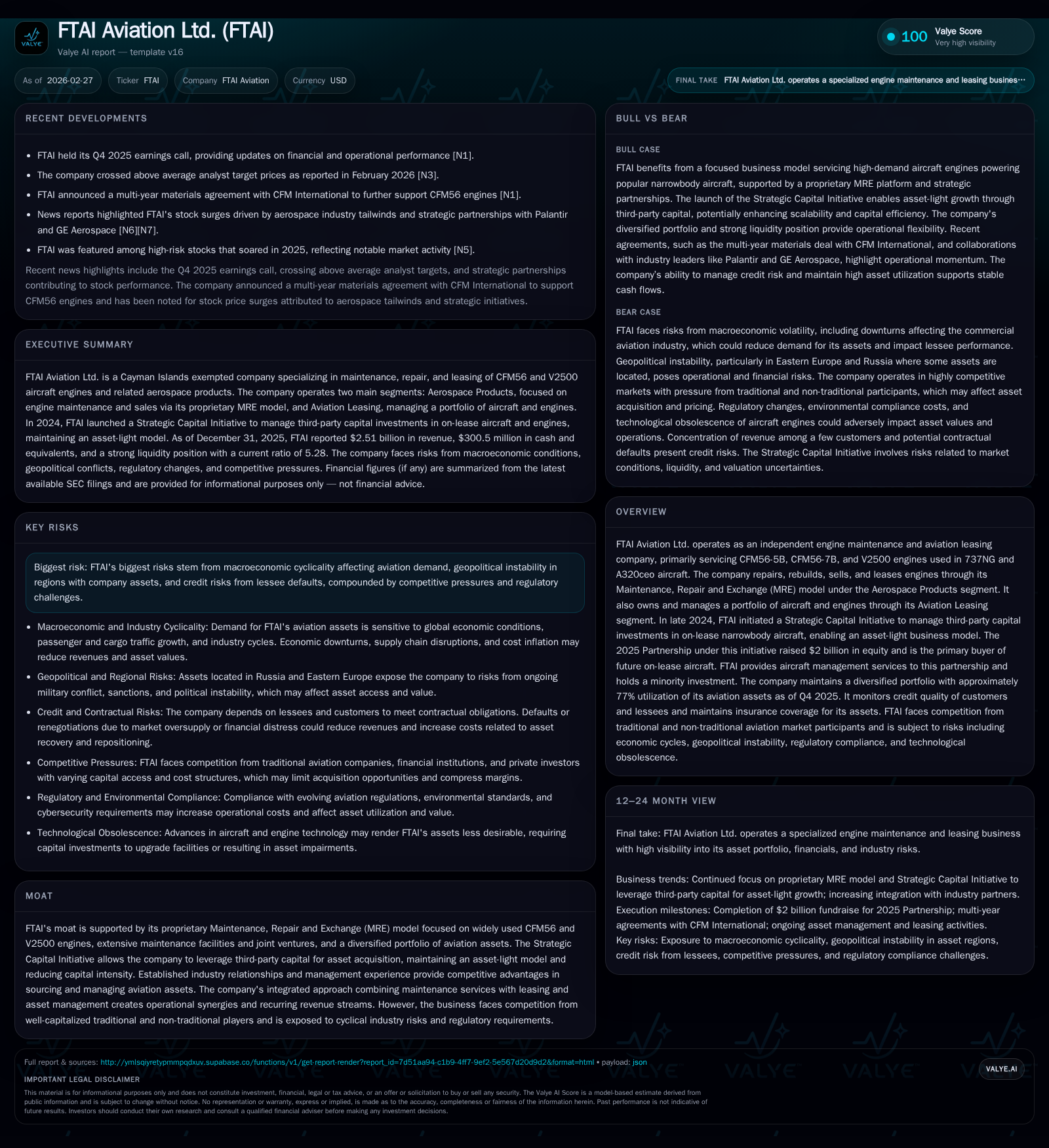
FTAI Aviation Ltd. reported strong topline growth of 44.5% in 2025 following strategic initiatives including its Strategic Capital Initiative launched in late 2024, which brought $2 billion of third-party equity to fund aircraft leasing. The company’s Maintenance, Repair and Exchange (MRE) business underpins a diversified engine portfolio focused on CFM56 and V2500 engines powering popular narrowbody jets. However, returns remain pressured with negative operating cash flows and an approximate -18% ROE in 2025, exacerbated by rising capital expenditures and integration costs from management internalization completed in mid-2024. Key risks arise from aviation cyclicality, geopolitical exposures, credit risk on lessees, and competitive aftermarket dynamics. FTAI’s shift toward an asset-light model via external funding partnerships is critical for scaling but adds complexity and execution risk. Monitoring free cash flow recovery and leasing utilization metrics will be essential to gauge earnings sustainability.
Company Overview
FTAI Aviation Ltd., a Cayman Islands exempted company trading under ticker FTAI, operates as a leading independent platform specializing primarily in maintenance, repair, and exchange (MRE) services for CFM56-5B/-7B and V2500 engines powering Boeing 737NG and Airbus A320ceo aircraft respectively [S12]. Complementing its Aerospace Products segment focused on engine servicing, the company also manages a sizable Aviation Leasing segment comprising commercial aircraft and engines leased globally.
The company's unique MRE business model revolves around repairing, rebuilding, selling, or leasing engines through an integrated service exchange framework that creates operational synergies between maintenance expertise and asset management [S12].
Historical Performance
FTAI reported accelerating revenue growth over the last three years with topline expanding from approximately $1.17 billion in 2023 to $2.5 billion by end-2025 — a compound annual growth rate exceeding 40% driven primarily by portfolio expansion in leasing assets alongside MRE service contracts [F1]. This notable growth aligns with strategic moves launched since late 2024.
Historical performance (annual)
| FY | Rev ($bn) | CFO ($mm) | Capex ($mm) | Rev YoY |
|---|---|---|---|---|
| 2025 | 2.5 | -311 | 28 | +44.5% |
| 2024 | 1.7 | -188 | 9 | +48.2% |
| 2023 | 1.2 | 129 | 6 | |
| 2022 | -21 | 144 |
Source: SEC companyfacts cache [F1].
Capital returns and efficiency (annual)
| FY | FCF ($mm) |
|---|---|
| 2025 | -338 |
| 2024 | -197 |
| 2023 | 123 |
| 2022 | -165 |
Source: SEC companyfacts cache [F1].
Despite this rapid revenue growth, operating cash flow trends deteriorated significantly from positive CFO in 2023 to negative $311 million in FY2025 reflecting a combination of internalization costs of management functions conducted mid-2024 and scaling investments across operations [F1][S7]. Correspondingly, capital expenditures more than tripled year-over-year pointing toward infrastructure buildout or fleet acquisitions needed to support expanded leasing activities.
Net income remains volatile with historical losses recorded; approximate ROE for FY2025 is negative at about -18%, demonstrating challenges translating top-line gains into profitable operations amid ongoing integration efforts [F1].
Strategic Capital Initiative Transforming the Asset Base
Critically shaping recent performance dynamics is FTAI's Strategic Capital Initiative launched December 2024 which introduced third-party institutional capital participation targeted at acquiring on-lease narrowbody aircraft within dedicated partnerships like the "2025 Partnership" which closed with $2 billion equity commitments in October last year [S6][S13]. This model supports FTAI’s transition towards an asset-light approach by outsourcing acquisition costs while retaining management fees through aircraft asset servicing contracts.
The partnership acquired approximately 45 narrowbody aircraft from FTAI during this period at ~$549 million net purchase consideration with FTAI providing exclusive replacement engines under MRE arrangements for the life of the partnership. Furthermore, FTAI holds minority investments alongside third parties within these structures enabling it to align incentives without concentrating capital deployment risk solely on its balance sheet [S6].
This strategic shift allows scaling asset ownership without proportionate increases in leverage but introduces operational complexity inherent to managing third-party funds amid fluctuating aviation market conditions.
Portfolio Composition & Utilization
As of December 31, 2025, the company owned a total of 290 aviation assets: specifically, a fleet of 47 commercial aircraft concentrated mainly in narrowbodies (42 units) alongside a sizable inventory of 243 engines including units currently off lease undergoing maintenance or located geographically sensitive locations such as Russia (eight aircraft and seventeen engines) [S14]. Approximately 77% utilization was achieved across active leasing assets over Q4’25 reflecting reasonable asset deployment despite some geopolitical headwinds.
The weighted average remaining lease terms approximate around three to four years for both aircraft (44 months) and engines (38 months), providing a moderate horizon for lease contract renewal or remarketing activities before asset turnover decisions need reevaluation [S14].
Competitive Position & Moat Considerations
FTAI’s competitive advantage stems largely from its proprietary MRE platform focusing on highly standardized yet heavily utilized CFM56 and V2500 engine types that power one of the world’s most prolific classes of commercial aircraft—the Boeing Next Generation series and Airbus A320ceo family—ensuring consistent demand for aftermarket services from airlines seeking cost-efficient engine maintenance solutions amidst fleet aging cycles .
Its extensive global maintenance footprint supplemented by joint ventures enhances scale efficiencies while the integrated maintenance-leasing business generates recurring revenue streams offering some insulation against pure market price competition in either segment alone.
However, the highly cyclical nature of commercial aviation driven by macroeconomic conditions exposes FTAI to variability in demand patterns often beyond company control including fuel price volatility, airline profitability cycles, geopolitical disruptions affecting regional flight operations (notably assets located in Eastern Europe/Russia), and regulatory compliance burdens impacting repair certifications or lease structuring [S16][S17][N1].
Competition has intensified not just from incumbent large lessors with deep pockets but also non-traditional private equity players aggressively pursuing aviation assets alongside OEM aftermarkets expanding their direct servicing capabilities leveraging digital tools—forcing constant innovation investment particularly under scenarios where pricing pressure can compress margins quickly [S10][S20].
Balance Sheet & Capital Allocation Observations
As of FY2025 end, total consolidated assets stood at approximately $4.4 billion versus equity of $334 million indicating significant leverage usage typical for capital-intensive leasing models though moderated under strategic shift toward third-party capital deployment partnerships reducing balance sheet growth requirements [F1][S6].
The company internally financed management function since May 2024 via upfront payment of $150 million cash coupled with share consideration replacing previous outsourced management fees aiming for long-term operational cost savings albeit pressure on short-term liquidity was evident during this transition phase [S7].
Cash & equivalents were robustly positioned at $300 million at year-end; however free cash flow remains negative largely due to continued investment spending outpacing operating cash inflows suggesting dividend policy faces sustainability debates going forward as distributions historically exceeded net cash provided by operations [F1][S15]. Debt agreements impose restrictive covenants limiting additional borrowings or share repurchases constraining financial flexibility despite currently manageable short-term obligations given current ratio north of five reflecting solid working capital buffers [F1][S15].
Outlook & Key Monitoring Points (Analysis)
Explicit forward guidance remains scant but key milestones revolve heavily around successful scaling of Strategic Capital Initiative vehicles like the ongoing 2025 Partnership's asset acquisitions along with stabilizing MRE margin improvements through process optimizations announced early this year including extension deals with CFM International securing materials supply into medium term [N12].
Watch points include:
- Trends in operating cash flow improvement reflecting successful integration post internalization;
- Leasing utilization rates sustaining or expanding beyond current ~77% threshold signaling resilient demand;
- Lessee credit quality developments amid tightening global credit conditions impacting collection performance;
- Regulatory adaptations particularly environmental compliance shifts given new emissions standards influencing asset valuations;
- Execution risks related to managing third-party capital investment vehicles affecting fee income stability;
- Capital expenditure trajectory aligning closer to depreciation enabling potential FCF positivity;
- Any signs of geopolitical escalation impacting accessible assets especially those positioned within Russian territory.
In summary, FTAI Aviation exhibits a growth profile enabled by strategic transformations valuing asset-light scalability balanced against near-term profitability challenges typical for firms evolving amid cyclical aviation recovery phases. The interplay between leveraging proprietary technical expertise in major aftermarket engine platforms while optimizing capital formation structures defines its differentiated but competitively contested niche within aerospace leasing markets.
Disclaimer: This analysis is based solely on publicly available information through February 27, 2026, including SEC filings and reputable news sources cited herein. It does not constitute investment advice or recommendations.
Disclaimer: This is research-only, informational analysis and not investment advice. It may include AI-generated interpretation and general industry context. Always verify important details using primary sources.

Comments