
FTC Solar Confronts Financial Covenant Hurdles in Tightening Solar Tracker Market
The company faces tightening financial covenants and tariff-related cost pressures that constrain its operational flexibility and growth outlook.
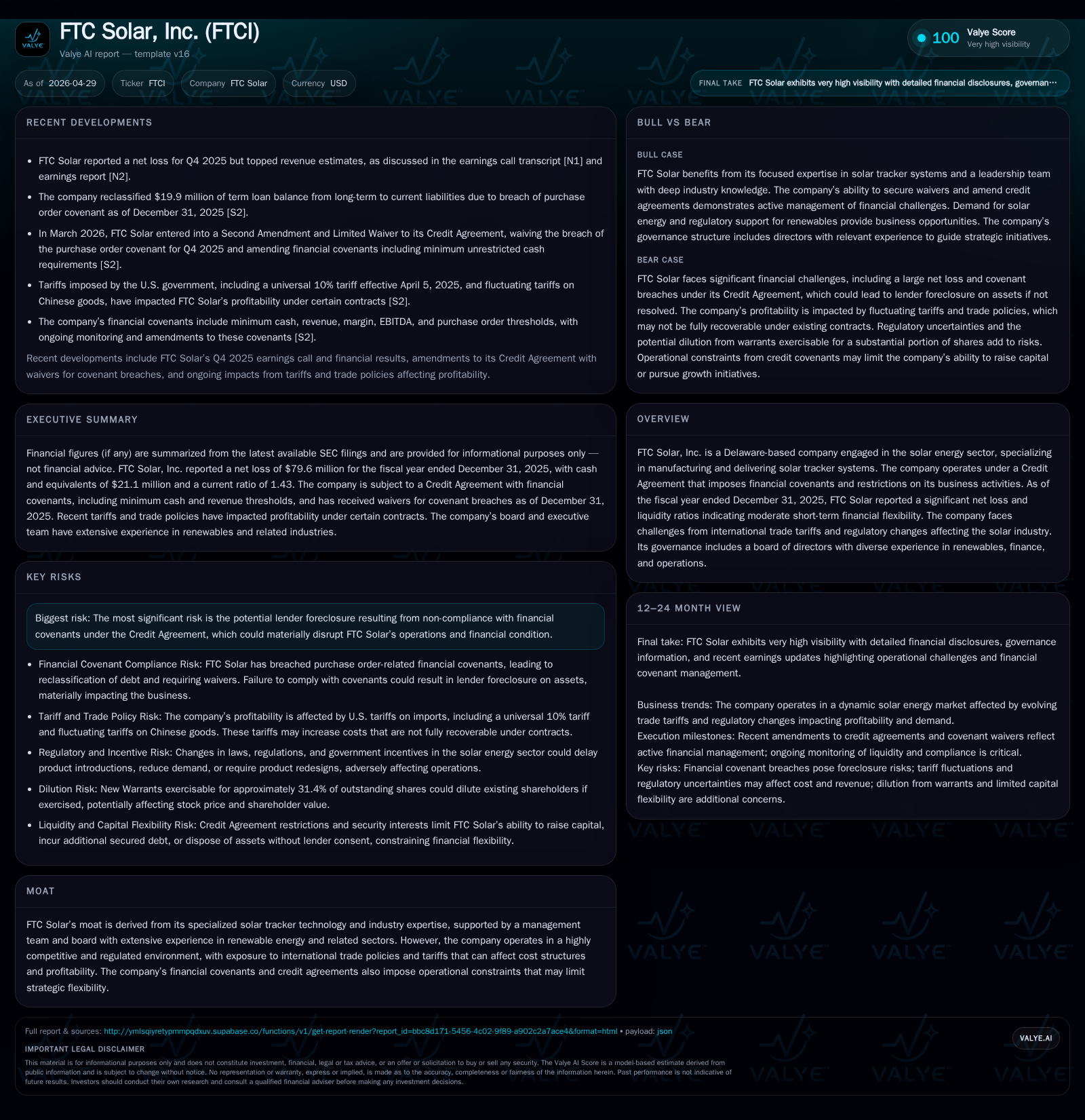
FTC Solar disclosed non-compliance with purchase order-related covenants as of end-2025, compelling the company to renegotiate terms in a March 2026 amendment that included covenant waivers and scheduled principal repayments. The firm’s specialized solar tracker business contends with increased tariffs on imported components, pressuring contract profitability amid a competitive and regulatory-intensive market. Future growth hinges on meeting tightened margin thresholds and restoring order inflows aligned with covenant requirements, though significant risks remain from potential lender foreclosure and limited capital flexibility. Key near-term monitoring points include quarterly margin targets starting Q1 2026 and purchase order minimums from Q1 2027 onward.
Latest Quarterly Update Reveals Covenant Non-Compliance and Strategic Implications
FTC Solar’s November 12, 2025 Form 10-Q revealed the company was not in compliance with a key purchase order-related financial covenant tied to its Credit Agreement dated July 2, 2025 [S2]. This breach triggered a material event leading to a Second Amendment signed March 23, 2026 [S3], granting a waiver for the December 31, 2025 quarter’s covenant default while postponing enforcement of new purchase order thresholds until the fiscal quarter ending March 31, 2027. Additionally, the amendment imposed structured principal repayments totaling $10 million across three installments throughout 2026.
Importantly, this amendment also introduced heightened financial covenant requirements for upcoming periods: minimum quarterly consolidated revenues rising progressively from $25 million in Q2 2026 to $75 million by Q4 2026; mandatory direct tracker margin thresholds applicable each quarter commencing Q1 2026; and consolidated EBITDA floors of $10 million for calendar year 2026 escalating to $25 million thereafter [S3]. These requirements frame a narrow corridor for operating performance under which FTC Solar must execute to avoid triggering events of default that could empower lenders to foreclose on secured collateral representing nearly all company assets [S2][S3].
The company’s strategic flexibility is now encumbered by stringent lender controls limiting asset dispositions or additional secured borrowing without consent [S2]. Such restrictions sharply reduce runway for tactical capital solutions absent improving operating metrics.
FTC Solar’s Business Model: Specialized Solar Trackers Navigating Cost Pressures
FTC Solar specializes in designing and manufacturing solar tracker systems—critical mechanical frameworks that optimize photovoltaic panel alignment relative to the sun throughout the day. These trackers significantly enhance energy yield compared to fixed-mount solar arrays, positioning FTC Solar's products as pivotal components in commercial-scale utility solar projects [S1]. The company's revenue model derives primarily from selling these tracking systems directly or through EPC (engineering-procurement-construction) contracts.
While product differentiation relies on proven engineering expertise and durable tracking technology enabling higher reliability and performance efficiency than some competitors, FTC Solar navigates acute supply chain sensitivities. A substantial portion of key inputs is sourced internationally—particularly steel components and electronics—that have become subject to increasingly complex US trade tariffs implemented during early-to-mid-2025 [S2][S16].
These tariffs impose incremental costs on imported tracker parts that cannot be fully recouped via existing contract price terms due to fixed-price agreements established pre-tariff escalations. Consequently, the company faces compressed direct margins on orders currently fulfilled under older contracts or those relying heavily on tariff-affected inputs. This dynamic challenges FTC Solar’s ability to sustain positive direct tracker margins without operational or sourcing adjustments [S2].
Competitive Dynamics and Industry Regulatory Environment
The solar tracker sector is intensely competitive with several reputable global manufacturers vying for contracts driven largely by project scale economics rather than brand premium. Pricing tends to be elastic given multiple substitute offers available to utility-scale developers. Tariff volatility further exacerbates this competitive tension by adding unpredictable cost inputs that suppliers like FTC Solar must either absorb or attempt partial pass-through—a challenge complicated by contractual constraints.
Regulatory uncertainty adds another layer of complexity. In addition to fluctuating tariff regimes influenced by evolving U.S.-China trade relations—including phased rollbacks oscillating from prior extreme levels (up to 145% tariffs on Chinese goods) down to current moderated rates (30%) as per recent agreements—there is ongoing federal scrutiny over trade law authority potentially altering tariff imposition mechanisms [S2].
Moreover, governance improvements evidenced by recent board appointments specializing in cybersecurity risk oversight hint at increasing regulatory expectations for robust operational controls within renewable infrastructure companies like FTC Solar [S1]. Compliance costs related to such regulations may continue pressuring margins albeit less visibly than trade policy impacts.
Growth Drivers: Toward Margin Improvement and Order Flow Recovery
Growth prospects for FTC Solar hinge critically on two intertwined levers: improving direct tracker margins from the challenged levels seen through late 2025 and achieving minimum purchase order inflows aligned with amended credit covenants beginning fiscal quarter ending March 31, 2027 [S3].
The requirement for direct tracker margins exceeding defined quarterly thresholds post-Q1 FY26 incentivizes management focus on cost reduction—whether via supplier negotiations, localization strategies reducing tariff exposure or production efficiency improvements.
Simultaneously, securing new purchase orders meeting or surpassing stipulated minimums is vital not only for revenue growth but also maintaining compliance status moving forward. The six-month tranche structure of purchase order measurement periods indicates a back-ended timeline emphasizing recovery progression through late FY26 into FY27 [S3].
Potential easing of trade tensions or favorable renegotiation of input agreements could act as positive catalysts enhancing both margins and order competitiveness. Conversely, tariff escalations would heighten cost pressures threatening both KPIs.
Risks and Constraints: Covenant Breaches, Tariff Volatility, and Capital Rigidity
The paramount risk disclosed pertains to lender rights triggered by continued non-compliance including foreclosure of first priority security interests covering substantially all FTC Solar assets [S2][S3]. Foreclosure would have devastating operational consequences.
Tariff fluctuations pose an ongoing external risk restricting pass-through pricing power given contract structures reflecting earlier cost bases—forcing margin compression absent effective countermeasures [S16][S21]. This volatility complicates forecasting cash flows critical for meeting debt obligations.
Credit agreement-driven operational limitations constrain FTC Solar’s capacity for capital raising activities including incurrence of additional secured indebtedness and asset divestitures without lender approval—which narrows strategic options when addressing liquidity challenges or pursuing opportunistic investments [S2][S3].
Additionally, issuer dilution risk arises from New Warrants exercisable for up to ~31% of shares outstanding held by lenders as part of financing arrangements—a factor potentially impacting shareholder value during warrant exercises [S2][S6].
Near-Term Catalysts: What to Monitor on Compliance and Order Metrics
Stakeholders should closely watch results against quarterly direct tracker margin requirements commencing Q1 FY26 as these benchmarks will indicate effectiveness of margin recovery initiatives outlined post-amendment [S3]. Any sign of failure here could escalate default concerns.
Order book developments supporting achievement of new purchase order thresholds starting March 31, 2027 will serve as tangible indicators of top-line health necessary for covenant satisfaction [S3]. Monitoring tender win rates, backlog expansions or notable customer engagements will be informative.
Scheduled principal repayments ($2.5M in March & May; $5M in September) set hard liquidity test points given constrained free cash flow profile; timely payment execution confirms operational cash generation credibility [S8].
Updates on U.S.-China trade policy negotiations influencing tariff levels remain critical external variables impacting cost base forecasts relevant for forward guidance considerations.
Current Financial Snapshot Supporting Strategic Assessment
As of December 31, 2025 financials demonstrate moderate liquidity with current assets comfortably above current liabilities (ratio approximately 1.43) but substantial leverage with net debt around $34 million after accounting for cash reserves [F1]. This financial posture provides limited buffer against adverse operational setbacks in light of tightening covenants requiring sustained improvements.
Disclaimer: This analysis is based solely on disclosed SEC filings and publicly available data up to April 29, 2026. It does not constitute investment advice or recommendations. Users should consider multiple information sources before forming any conclusions.
Disclaimer: This is research-only, informational analysis and not investment advice. It may include AI-generated interpretation and general industry context. Always verify important details using primary sources.

Comments