
Forefront Tech Holdings Advances SPAC Unit Separation and Tracks Key Merger Deadlines
After raising $103.7 million, Forefront Tech reports strong liquidity and introduces share-warrant separation, highlighting execution risks in completing its business combination within regulatory timeframes.
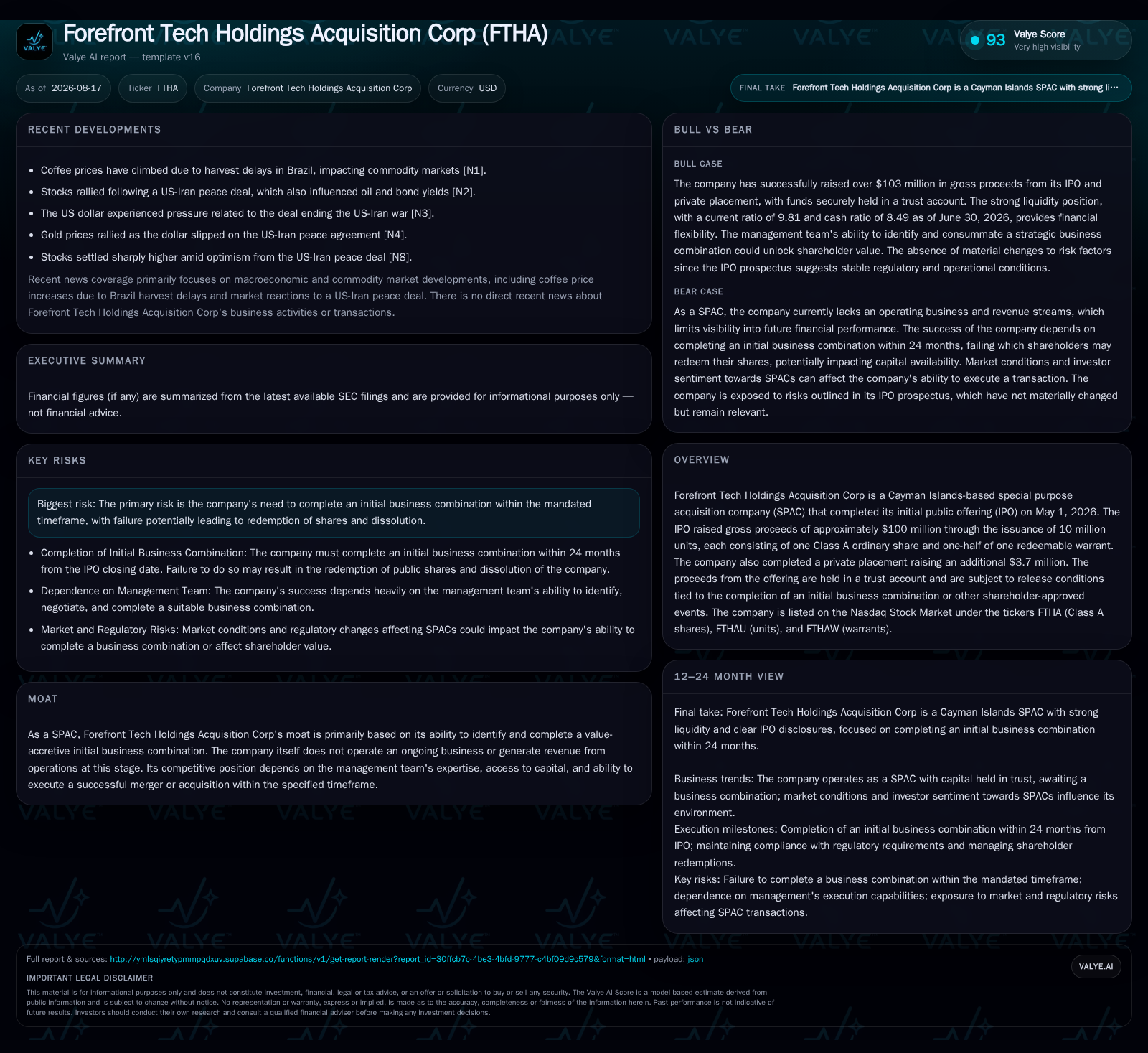
Forefront Tech Holdings Acquisition Corp completed a $100 million IPO in May 2026 with an additional $3.7 million in private placements, forming a SPAC vehicle holding proceeds in trust pending a business combination. Its August 2026 quarter-end report reveals strong liquidity and low operating expenses, while the June introduction of unit separation enhances market dynamics by allowing shares and warrants to trade independently. Forefront faces typical SPAC execution risks around deal completion deadlines and shareholder redemptions. Success depends on management’s ability to source attractive targets and close a merger or acquisition before mandated redemption periods, positioning it alongside mid-sized peers with comparable capital structures and sponsor incentives.
Quarterly Filing Highlights: Capital Structure and Operational Status Post-IPO
Forefront Tech Holdings Acquisition Corp's August 2026 quarterly report confirms its establishment as a SPAC following its May 1, 2026 IPO. The company raised approximately $100 million from issuing 10 million units—each consisting of one Class A ordinary share plus half a redeemable warrant—and supplemented this with $3.7 million from private placements concurrent with the IPO closing [S2], [S8]. As of June 30, 2026, cash and equivalents stood at roughly $1.04 million with total current assets near $1.2 million against current liabilities around $0.12 million, resulting in a strong current ratio of approximately 9.81 that indicates ample liquidity for administrative expenses prior to any business combination activity [F1]. Notably, starting June 22, unit holders were permitted to separate their units into standalone shares and warrants trading independently on Nasdaq under distinct tickers—FTHA for shares and FTHAW for warrants—enhancing secondary market flexibility beyond the original bundled structure [S3].
Understanding the SPAC Structure: Units, Warrants, Trust Account Mechanics
Forefront follows conventional SPAC capitalization where IPO units bundle equity shares with redeemable warrants—options enabling warrant holders to purchase shares at a fixed exercise price after deal closure. Here, each whole warrant is exercisable at $11.50 per share, offering potential capital inflows post-merger but also introducing dilution risk depending on exercise behavior [S3]. The IPO proceeds were placed into a U.S.-based trust account managed by Odyssey Transfer and Trust Company; these funds remain secured until either consummation of a business combination or authorized shareholder action releases them [S8]. This structure preserves deal funding integrity but limits operational spending flexibility during the pre-merger phase.
Redemption rights allow public shareholders to redeem their shares before merger completion if dissatisfied with terms or market conditions—a mechanism that can unpredictably reduce merger capital availability. This dynamic creates tension between sponsors aiming for optimal acquisition value and investors exercising redemption rights.
Timing Constraints and Capital Efficiency Challenges
SPACs typically have an SEC-mandated window—often between 18 to 24 months from IPO—to announce and complete an initial business combination or else liquidate by returning trust funds less expenses to investors. While Forefront’s exact deadline isn’t explicitly stated, this timeline applies implicitly given its May 2026 IPO date [S2]
The balance sheet’s substantial cash cushion relative to nominal liabilities suggests no immediate liquidity concerns for ongoing administrative or due diligence activities as Forefront seeks acquisition targets [F1]. However, capital erosion occurs gradually due to administrative/legal costs over time and can be materially impacted by shareholder redemptions that shrink available funds for closing.
Failure to complete a business combination within this period or raise sufficient additional financing (e.g., PIPE transactions) would force liquidation—an unfavorable outcome eroding sponsor promote incentives.
Peer Context: Mid-Sized SPAC Positioning
With gross proceeds around $100 million plus smaller private placements, Forefront situates itself among mid-tier SPACs such as Social Capital Hedosophia Holdings (IPOA) [S8]. These vehicles emphasize sponsor experience and institutional underwriting support without reaching mega-SPAC scale seen in entities like Pershing Square Tontine Holdings (PSTH). The presence of underwriters including BTIG LLC signals alignment with credible market practices that underpin structural integrity during formation
Sponsor reputation is key for attracting quality target pipelines amid competitive deal sourcing environments.
Key Risks: Redemption Impact, Deal Sourcing Pressure, Dilution Considerations
Forefront must manage shareholder redemption risk carefully since elevated redemptions reduce merger consideration pools available at closing. This pressure forces sponsors either to identify compelling targets that retain investor confidence or renegotiate terms—a challenging balance especially amid volatile equity markets or cooling investor sentiment toward SPACs.
Warrant economics introduce further complexity: exercising warrants at $11.50 per share injects fresh capital post-merger but dilutes existing shareholders unless transactions are accretive. Market pricing following unit separation influences exercise rates; if share prices linger below exercise levels, warrants may expire worthless reducing expected deal proceeds; conversely rising prices encourage conversion but increase share count dilution.
Unit Separation: Secondary Market Implications
The June 2026 change allowing holders to split units into separately tradable shares (FTHA) and warrants (FTHAW) enhances liquidity compared to bundled trading pre-separation. This facilitates differentiated investment strategies isolating equity upside from leverage embedded in warrants.
Separation tends to stabilize share price dynamics by decoupling warrant influence but introduces valuation nuances as fractional warrants do not trade separately—requiring rounding conventions that momentarily affect pricing metrics post-separation [S3], [S6], [S7]. Investor behavior in this environment will reveal confidence levels ahead of merger announcements.
What Investors Should Monitor Next
Key upcoming indicators include:
- Timing of initial business combination announcement within regulatory windows applicable to May 2026 IPO vehicles;
- Shareholder redemption patterns following unit separation reflecting investor conviction;
- Potential PIPE financing announcements that could bolster transaction feasibility;
- Management commentary on target pipelines and execution outlook. These factors collectively inform assessments of Forefront’s probability to transition successfully into an operating public entity post-merger.
Financial Profile Discussion
Disclaimer: This is research-only, informational analysis and not investment advice. It may include AI-generated interpretation and general industry context. Always verify important details using primary sources.

Comments