
Greenwich LifeSciences Advances GLSI-100 Amid Clinical Progress and Capital Needs
Greenwich LifeSciences moves forward with Phase III immunotherapy trials for breast cancer while managing development risks and funding challenges.
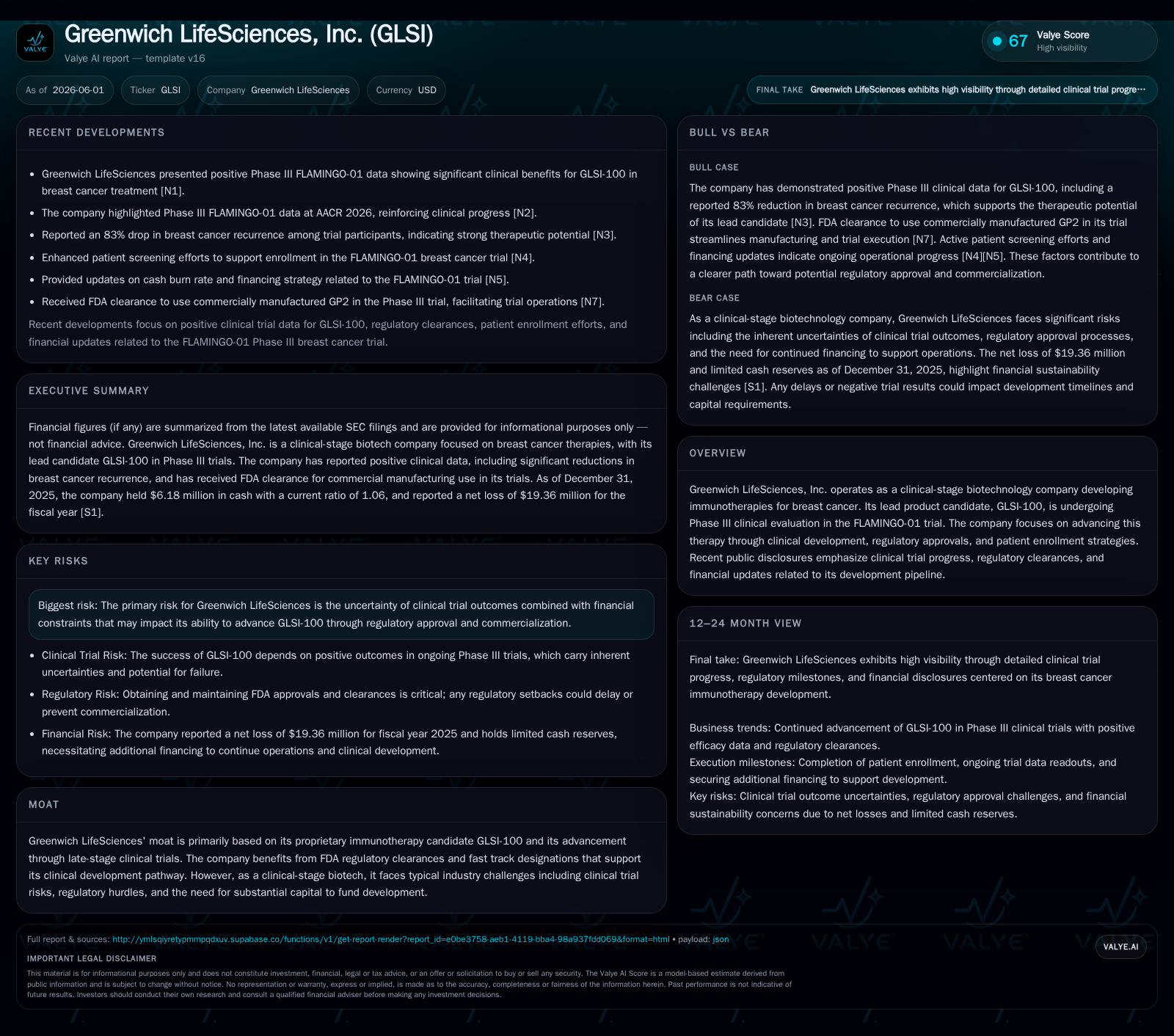
Greenwich LifeSciences, Inc. is a clinical-stage biotech focused on its lead immunotherapy candidate, GLSI-100 (GP2 peptide plus GM-CSF), targeting HER2/neu-positive breast cancer. The company’s recent filings confirm ongoing Phase III trial progress with global site expansion and positive interim results highlighted in mid-2026 presentations. However, it continues to operate at a substantial loss without revenue, requiring additional funding to advance towards commercialization. The company’s value proposition depends heavily on the successful completion of the FLAMINGO-01 trial and eventual regulatory approvals amid a competitive oncology immunotherapy landscape.
Recent Operating Update: Clinical Progress Anchors Near-Term Outlook
Greenwich LifeSciences’ latest Form 10-Q filed November 14, 2025 ([S2]) maintains that there have been no material changes in previously disclosed risk factors. While this implies steady operational footing, the filing underscores ongoing needs to secure additional financing during continued investment in clinical trials for its lead asset GLSI-100. The subsequent annual report filed June 2026 ([S1]) offers deeper insights into company strategy and operational challenges.
The company positions itself squarely on advancing GLSI-100—comprising the GP2 peptide combined with GM-CSF—in the FLAMINGO-01 pivotal Phase III trial aimed at preventing recurrence in HER2/neu-positive breast cancer patients who have undergone neoadjuvant plus adjuvant trastuzumab therapies. Notably, Greenwich has announced plans to expand this trial into Europe with up to 150 sites globally, signaling confidence in feasibility but also increasing operational complexity. Positive Phase III data presentations earlier in 2026 ([N1], [N2]) reinforce patient enrollment progress and preliminary efficacy signals, crucial steps toward eventual regulatory filings.
Business Model: Clinical-Stage Development Focused on Immunotherapy Innovation
Greenwich LifeSciences operates as a pure-play clinical-stage biotech entity without any approved products or revenues as of mid-2026. Its commercial strategy is still nascent; the company acknowledges there is currently no sales or marketing infrastructure ([S1]). Future commercialization may involve strategic partnerships or building internal sales forces in key regions including the U.S.
Revenue hinges entirely on successful clinical development milestones converting into regulatory approvals followed by either product sales or partnership income streams. GLSI-100’s mechanism involves GP2—a 9-amino acid peptide derived from the HER2/neu transmembrane region—which stimulates an immune response specifically against tumor cells expressing various levels of HER2/neu antigen. This targeted mechanism aims at minimal collateral damage to normal cells unlike traditional chemotherapy.
GM-CSF serves as an immunoadjuvant to potentiate the vaccine effect by enhancing antigen-specific cytotoxic T-cell activity. However, it remains dependent on a single-source FDA-approved manufacturer for GM-CSF supply—a notable supply-chain consideration as production scales post-approval ([S1]).
Industry Structure and Competitive Position
In the oncology therapeutics arena, the field of immunotherapy is highly crowded with multiple modalities such as checkpoint inhibitors (e.g., PD-1/PD-L1 inhibitors), antibody-drug conjugates, CAR-T therapies, and therapeutic vaccines vying for clinical impact. Greenwich LifeSciences’ focus on a peptide vaccine format combined with GM-CSF situates it in a niche where durable T-cell immune memory could complement existing treatments if successfully demonstrated.
The company’s moat centers fundamentally on proprietary technology embodied by GLSI-100 and its progression through rigorous late-stage trials supported by regulatory incentives like fast track designations ([S1]). However, competitive pressure from broadly validated immuno-oncology agents approved for HER2-positive cancers (e.g., trastuzumab deruxtecan) elevates bar for commercial success.
Moreover, regulatory hurdles are acute given prior failures or mixed outcomes associated with cancer vaccine approaches historically; thus robust Phase III outcomes will be needed to differentiate GLSI-100 in safety/tolerability profiles and durable efficacy endpoints.
Growth Drivers: Clinical Trial Expansion and Regulatory Pathway Validation
The immediate growth driver is clearly FLAMINGO-01’s progression toward full enrollment completion across an expanding global footprint—a complex endeavor given stringent patient eligibility criteria involving residual disease or high-risk pathologic complete response after standard-of-care therapies ([S1], [N1]). Successful recruitment pace along with interim data releases exhibiting favorable benefit-risk balance could unlock pivotal catalysts such as accelerated regulatory review or licensing deals.
Post-market approval growth would depend heavily on adoption among oncologists treating early-stage HER2-positive breast cancer patients seeking relapse prevention options beyond current treatments. Additional expansion potential lies in exploring GP2’s applicability across other HER2-expressing solid tumors if initial indications validate immune activation mechanisms.
Strategic alliances with larger pharma or biotech firms could provide necessary commercialization muscle internationally while alleviating capital expenditure burdens for market rollout—an acknowledged pathway per management commentary ([S1]).
Risks and Growth Constraints: Capital Intensity and Clinical Outcome Uncertainty
As a pre-revenue entity burning through cash steadily ($19.4 million operating loss in 2025 [F1]), Greenwich faces existential risks tied to its ability to secure additional financing required to complete late-stage studies and develop manufacturing/commercial capabilities. Its cash reserves stood at approximately $6.18 million at end-2025 against nearly $5.8 million in current liabilities ([F1]), delivering only limited short-term liquidity cushion.
Clinical development risks are paramount: failure to meet primary efficacy endpoints or identify safety signals during FLAMINGO-01 could halt progress entirely given absence of alternative approved assets owned internally. Regulatory delays or more onerous post-marketing commitments would amplify financial strain.
Dependence on outsourced suppliers for GM-CSF introduces supply risks that could disrupt trial continuity or initial commercial launch timing ([S1]). Competitive dynamics may erode potential market share especially if next-generation HER2-targeted therapies yield superior efficacy or dosing convenience.
Heightened federal reporting requirements under healthcare laws like the Affordable Care Act add compliance costs and potential penalties related to physician payments disclosures that Greenwich must manage carefully ([S1]).
What to Watch Next: Clinical Milestones, Capital Raises, and Commercial Strategy Detail
Near-term developments to monitor include progress updates from FLAMINGO-01 enrollment metrics and interim/final data presentations expected around industry conferences within 2026–27 timeframe ([N1], [N2]). These clinical signals will be crucial validation points impacting strategic partnership interest.
Further capital raising activities—whether via equity offerings or collaborations—will be essential given limited liquidity reserves highlighted in the latest financial snapshot ([F1]). Investors should watch for management disclosures regarding timing, size, and use of proceeds for upcoming financings.
Additionally, any disclosures clarifying future commercialization plans—such as intentions to build direct sales forces versus partnering models—and manufacturing scale-up readiness will shed light on execution capabilities once regulatory greenlights are achieved.
Financial Profile: Sustained Losses Reflect Typical Clinical Stage Dynamics
Historical performance (annual)
Capital returns and efficiency (annual)
Greenwich LifeSciences reported operating losses totaling $19.45 million for fiscal year ended December 31, 2025—a deterioration from prior year’s $16 million loss marking an incremental increase tied largely to intensifying R&D spending supporting expanded Phase III trials ([F1]). Net loss correspondingly widened to $19.36 million.
Operating cash flows remained negative at nearly $9.9 million reflecting ongoing investment burn without offsetting revenues; this trend reflects standard clinical-stage biotech economics where upfront capital intensity precedes any commercial revenues.
Balance sheet liquidity presents a marginal current ratio near parity at 1.06—indicating working capital constraints underlining urgent need for new funding rounds ([F1]). Shareholders’ equity contracted further due partly to net losses without replenishing capital influx during the period.
Overall financial dynamics underscore typical near-term challenges facing biotechs entrenched at pivotal late-stage clinical junctures but devoid of recurrent revenue streams.
This analysis integrates publicly available filings up to June 2026 without providing investment research views or valuation opinions. The company's future trajectory critically hinges on clinical success and execution against multiple funding and operational constraints typical within innovative oncology biotech development frameworks.
Disclaimer: This is research-only, informational analysis and not investment advice. It may include AI-generated interpretation and general industry context. Always verify important details using primary sources.

Comments