
Physical Bullion Backing Fuels GLTR’s Remarkable Financial Surge and Market Position
GLTR’s physically backed structure underpinned a dramatic net income growth in 2025 while positioning it as a transparent, low-credit-risk precious metals ETF.
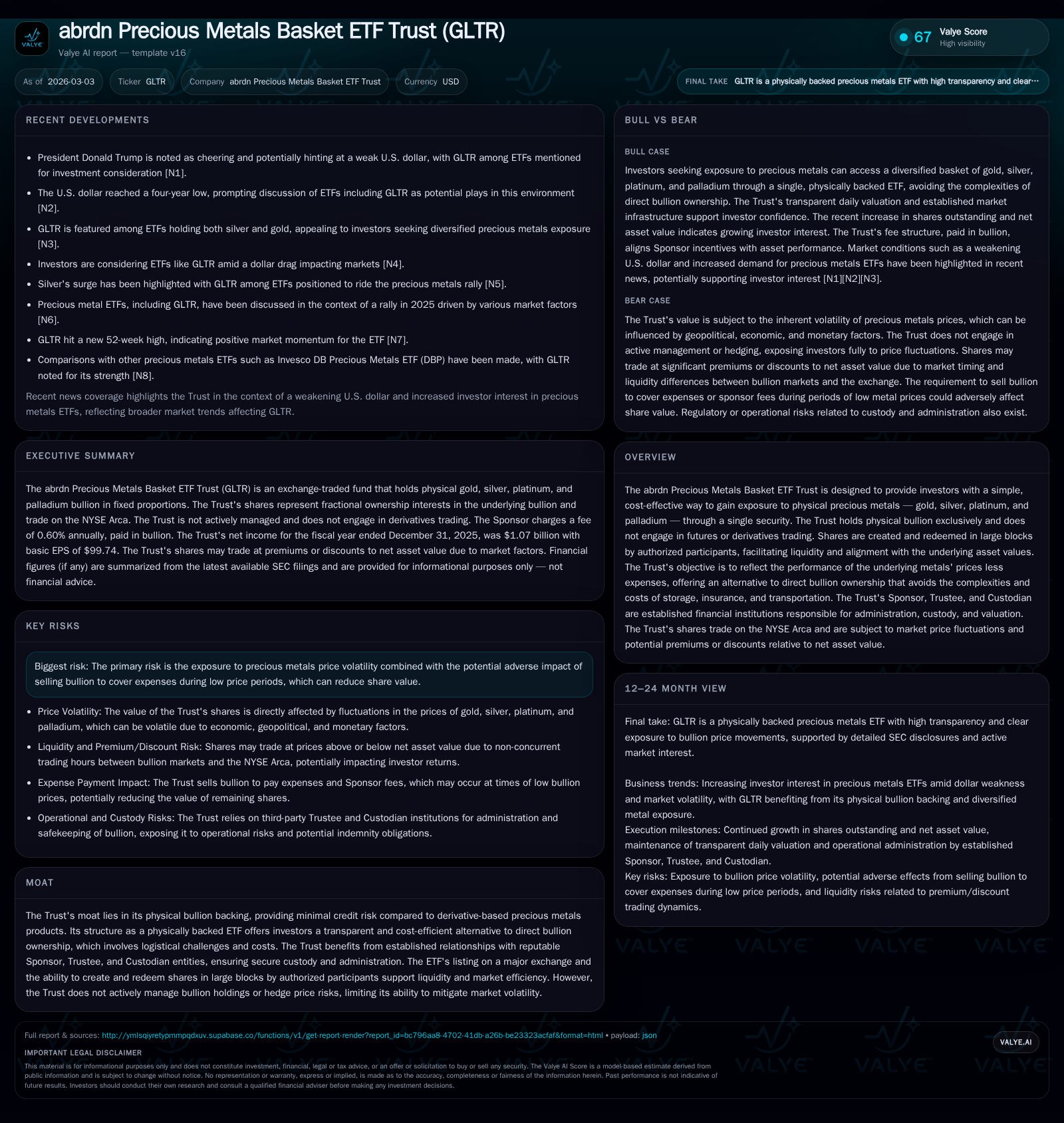
The abrdn Precious Metals Basket ETF Trust (GLTR) reported net income exceeding $1.06 billion in 2025, a 526% increase driven by bullion price appreciation and increased shares outstanding. The Trust holds physical gold, silver, platinum, and palladium bullion without derivatives exposure, minimizing credit risk and providing investors a cost-efficient alternative to direct bullion ownership. Key risks remain tied to bullion price volatility and the necessity to liquidate metals to cover expenses during downturns. Sponsor fees rose with asset growth; the Trust does not pay dividends or repurchase shares, reflecting its pass-through nature.
Record Growth Driven by Precious Metals Price Movements and Share Issuances
The abrdn Precious Metals Basket ETF Trust (GLTR) delivered exceptional financial performance in fiscal year 2025 with net income reaching approximately $1.07 billion, up from $170 million in FY2024 — a year-over-year increase of more than 526% [F1]. This surge primarily reflects strong appreciation in underlying precious metals prices alongside a significant rise in shares outstanding.
Equity nearly doubled from around $1.04 billion at the end of 2024 to roughly $2.58 billion at December 31, 2025, corresponding with an increase in total shares outstanding from 9.5 million to 12.5 million shares during the same period [F1][S1]. The growth in shares results from authorized participants creating new baskets — blocks of 25,000 shares each — backed directly by physical bullion infusions into the Trust.
Rather than relying on derivative exposure or futures contracts common among competitor products, GLTR's financial results closely track spot bullion price movements across gold, silver, platinum, and palladium held proportionally within its basket [S1]. Net income growth is attributable to favorable market pricing rather than operational leverage.
Understanding GLTR’s Physically Backed Structure and Its Investor Appeal
GLTR is fully backed by physical bullion without engagement in commodity futures or derivatives trading [S1], a key structural distinction with important investor implications.
The Trust holds allocated gold, silver, platinum, and palladium stored securely by ICBC Standard Bank Plc as Custodian within London vaults conforming to LBMA Good Delivery standards [S4][S16]. Bullion ownership occurs through allocated accounts representing whole bars or ingots rather than unallocated claims except transiently during creation/redemption processing phases [S28].
Authorized Participants — institutional brokers and financial institutions registered with the Depository Trust Company (DTC) — transact directly for baskets of shares by delivering or receiving proportional amounts of underlying metals [S9][S27]. This creation/redemption mechanism ensures GLTR shares trade close to their net asset value (NAV), maintaining market efficiency.
This custody arrangement eliminates most counterparty credit risk typical with derivative-based ETFs since GLTR shareholders have a pro rata undivided beneficial interest directly in physical precious metal bars rather than contractual exposures subject to counterparty default risk [S7]. Transparency is enhanced by daily NAV reporting using benchmark London Bullion Market prices administered by ICE Benchmark Administration (IBA) [S17].
Risk Management: Exposure to Bullion Price Volatility and Structural Limitations
While GLTR’s physical backing reduces certain credit risks prevalent in synthetic ETFs or futures-based products, its main investment risk is intrinsic bullion price volatility. Fluctuations in gold, silver, platinum, and palladium prices are highly sensitive to macroeconomic factors such as inflation expectations, interest rate differentials relative to borrowing costs for bullion holders, currency exchange rates—particularly USD strength—and shifts in investor sentiment including speculative trading approaches [S1][S3].
The Trust offers no active management or hedging strategies against these price swings; shareholders experience direct proportional changes in share value net of expenses. During periods when bullion prices decline significantly yet expenses persist, the Trust may be required to liquidate portions of holdings to cover fees not absorbed by the Sponsor — potentially exerting additional downside pressure on NAV per share [S9][S23].
Residual credit risk arises mainly from holdings temporarily maintained as unallocated bullion accounts at the Custodian level; these are not segregated from Custodian assets and thus theoretically exposed if custodial insolvency occurs [S28]. However, stringent operational controls mitigate this concern relative to derivative structures facing explicit counterparty risks.
Capital Deployment: Sponsor Fees, Expenses, and Trust Liquidity Framework
Capital flows within GLTR are straightforward due to its passive structure holding solely physical assets without generating operating profits beyond expense management spread across metal valuations.
Sponsor fees rose alongside asset base expansion — from approximately $6.06 million in FY2024 to $9.54 million by FY2025 — consistent with growing assets under management driven by rising share counts and higher metal prices [F1][S9]. These fees represent the primary expense load reducing returns.
Payment mechanics require selling underlying metals when expenses exceed amounts covered by Sponsor assumptions; such sales constitute taxable events for shareholders reflective of their pro rata ownership interests [S9][F1].
Liquidity is maintained via creation/redemption baskets processed only through authorized participants who must deliver or receive equivalent quantities of metals alongside transaction fees set at $500 per order facilitating administration costs without traditional cash distributions [S6][S14][S9]. Notably absent are dividends or share repurchase programs typical for corporate issuers; capital return features reflect pure pass-through benefits from metal appreciations less costs rather than discretionary surplus allocation decisions.
Outlook Insights: Monitoring Metal Prices, New Basket Issuance, and Market Trends
Future performance drivers hinge fundamentally on precious metal price trajectories influenced heavily by broad macro trends amid complex geopolitical economic environments. Recent news highlights scenarios of dollar weakness—which historically correlate positively with precious metal valuations given their inverse relationship with USD strength [N1][N2].
Investor appetite for combined gold-silver exposure ETFs has increased amidst uncertainty over which single metal offers superior protection leading some toward diversified basket offerings like GLTR that simultaneously capture gold plus platinum group metals plus silver exposure [N3]. Regulatory stability regarding custody arrangements supports efficient market functioning though evolving oversight regimes may affect long-term operational cost structures.
Absent explicit company forecasts within filings, attention should focus on:
- Monthly updates of LBMA benchmark prices used for daily valuations,
- Announcements regarding additional basket creations evidencing sustained demand,
- Expense ratio changes potentially compressing realized returns,
- Macro developments influencing inflation expectations and interest rate shifts affecting metal valuations.
Historical Financial Performance Snapshot: Income and Equity Trajectory
Historical performance (annual)
| FY | Net ($mm) | Net YoY |
|---|---|---|
| 2025 | 1066 | +526.2% |
| 2024 | 170 | +518.4% |
| 2023 | 28 | +202.9% |
| 2022 | -27 |
Source: SEC companyfacts cache [F1].
Capital returns and efficiency (annual)
| FY | ROE% |
|---|---|
| 2025 | 41.4 |
| 2024 | 16.4 |
| 2023 | 2.9 |
| 2022 | -2.7 |
Source: SEC companyfacts cache [F1].
Net income reflects realized appreciation net of expenses with equity growth fueled primarily through contributions correlated with new share creations tied directly to physical metal additions.
Precious Metals Market Dynamics Impacting Future Fund Behavior
GLTR’s sensitivity profile warrants understanding how fundamental bullion market drivers translate into NAV movement:
- Interest rate differentials affect opportunity costs between yield-bearing instruments versus non-yielding metals; higher rates tend to pressure precious metal prices negatively.
- Supply-side conditions include mine production volumes along with recycling flows influencing overall availability; sudden supply disruptions can trigger price spikes.
- Speculative attitudes among hedge funds and commodity traders can inject additional volatility through increased short-selling activities or hedging behaviors suppressing spot prices temporarily.
- Global political-economic uncertainties including inflation fears historically drive safe-haven demand lifting metal values.
- As GLTR tracks actual spot prices without derivatives overlays its performance closely mirrors these collective influences minus internal trust expenses.
This dynamic underpins GLTR’s moat founded on simple transparent linkage to physical assets held securely without layers of counterparty complexity seen elsewhere but also means limited tools for mitigating sudden downside volatility inherent in raw commodity exposure.
Disclaimer: This report is prepared for informational purposes only and does not constitute investment advice or recommendations. All financial figures are sourced explicitly from official filings referenced herein without extrapolation beyond stated data points.[F1][S#][N#]
Disclaimer: This is research-only, informational analysis and not investment advice. It may include AI-generated interpretation and general industry context. Always verify important details using primary sources.

Comments