
How Grocery Outlet’s Entrepreneurial Model Shapes Its Profitability and Expansion
Grocery Outlet’s distinctive model of flexible buying combined with independent store operators fuels revenue growth but complicates margin stability amid rising costs and regulatory challenges.
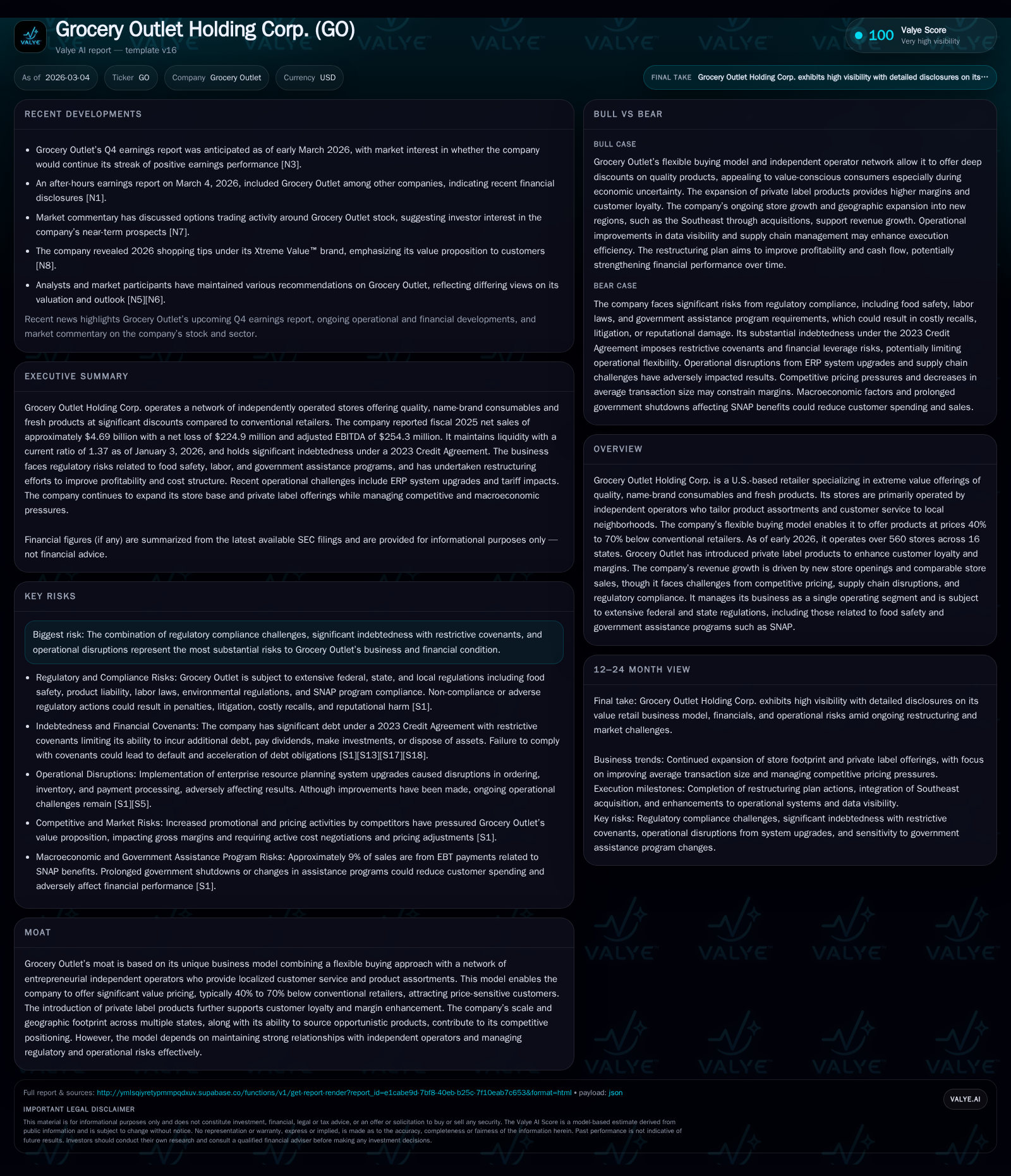
Grocery Outlet Holding Corp. reported strong top-line growth driven by new store openings and comparable store sales yet faced a severe operating income reversal in fiscal 2025. The company’s entrepreneurial structure, anchored in independent operators tailoring local assortments and leveraging opportunistic buying, remains central to its competitive strength and geographic expansion across 16 states. However, escalating impairments, restructuring charges, regulatory complexities related to private labels, and inflationary pressures on labor and tariffs eroded profitability. Despite the net loss, Grocery Outlet generated healthy operating cash flow, invested heavily in capital expenditures, particularly new store development, and maintained robust liquidity though it suspended share repurchases in fiscal 2025.
Financial Turnaround Interrupted: FY2025 Operating and Net Income Collapse
Historical performance (annual)
| FY | Net ($mm) | CFO ($mm) | OpInc ($mm) | Capex ($mm) | Net YoY |
|---|---|---|---|---|---|
| 2025 | -225 | 222 | -222 | 198 | -669.9% |
| 2024 | 39 | 112 | 78 | 187 | -50.3% |
| 2023 | 79 | 303 | 126 | 169 | +22.1% |
| 2022 | 65 | 186 | 95 | 130 |
Source: SEC companyfacts cache [F1].
Capital returns and efficiency (annual)
| FY | Div ($) | Buybacks ($mm) | FCF ($mm) |
|---|---|---|---|
| 2025 | 0 | 0 | 24 |
| 2024 | 0 | 81 | -75 |
| 2023 | 15000 | 6 | 134 |
| 2022 | 105000 | 3 | 55 |
Source: SEC companyfacts cache [F1].
Grocery Outlet Holding Corp.’s fiscal year ending January 3, 2026 (fiscal 2025) marked a stark reversal from prior years' profitable momentum into a substantial operating loss of $222 million—a decline of approximately 383% year-over-year as operating income swung from a $78 million gain in fiscal 2024 to a negative result [F1][S1]. Net income deteriorated even more sharply by nearly 670%, sliding into a loss of $225 million after recording $39 million profit the prior year. This dramatic earnings volatility stemmed largely from sizeable goodwill impairment charges totaling $149 million alongside impairments on long-lived assets of $114 million and restructuring expenses increasing to $46 million from around $16 million the year before [S1]. These one-time or non-recurring costs overshadowed underlying operating trends.
The impairment expenses primarily related to underperforming store assets or corporate infrastructure adjustments necessary given shifts in operational priorities and economic headwinds faced throughout the year. Interest expense also increased modestly by 24% to approximately $27 million due to higher debt levels or rising interest rates under their credit facilities [S1]. The tax position swung favorably given the pre-tax losses.
This disruption contrasts with prior years where Grocery Outlet had steadily improved margins despite inflationary pressures, illustrating how external shocks combined with aggressive investment decisions can materially impact profitability outcomes in the short run.
Top-Line Growth Drivers: New Store Expansion and Comparable Sales Trends
Despite earnings turmoil, Grocery Outlet advanced top-line growth effectively with net sales increasing by 7.3% to nearly $4.69 billion driven predominantly by new store openings alongside positive comparable store sales gains [F1][S1]. As of early calendar 2026, the company operated over 560 stores distributed across sixteen states including California, Washington, Oregon, Pennsylvania, Tennessee, Maryland among others—showcasing continued geographic footprint expansion [S1].
New stores contributed significantly to net sales growth as Grocery Outlet deploys an aggressive leasing strategy with initial terms usually spanning ten to fifteen years plus renewal options that provide both flexibility for operators and predictability for corporate overhead allocation [S1]. The number of stores grew quarter-to-quarter during fiscal year 2025 with leased properties primarily operated by independent operators (IOs), extending local reach.
Comparable store sales metrics include stores after their first thirteen full months or following acquisition remodeling—and exclude disruptions such as temporary closures—which gives investors insight into underlying organic traffic performance separated from openings or acquisitions impacts. This organic lift was partially offset by decreases in average basket size influenced by consumer spending behavior shifts amid inflationary cost burdens.
Distinctive Business Model: Independent Operators Fuel Localized Merchandising
At the core of Grocery Outlet’s success is its entrepreneurial network model where independent operators run individual stores with autonomy over customer service nuances and product assortment decisions tailored tightly to neighborhood preferences [S1][S2]. This decentralized control leverages local insights unlike centralized retail formats that standardize operations nationally. Independent operators are incentivized via commission arrangements tied closely to gross profits providing alignment on retail execution.
The company's flexible buying system exploits opportunistic bulk purchasing often sourced through closeout deals or overstocks enabling price discounts ranging broadly from 40% to as much as 70% below prices found at conventional grocers [S1]. This creates a unique value proposition attracting price-sensitive demographics seeking branded consumables at steep discounts—especially relevant during economic uncertainty phases when discretionary incomes are constrained.
While this model confers agility in inventory management allowing rapid responsiveness to supply fluctuations or market changes, it also relies heavily on maintaining strong operator talent capable of executing complex merchandising strategies under variable supply conditions—a potential operational risk if management underperforms locally or if support systems lag behind rapid scale.
Macroeconomic and Regulatory Pressures Limiting Profitability Gains
The company faced significant headwinds from external macroeconomic forces throughout fiscal 2025 that exerted pressure on margins beyond impairment-related costs detailed above. Inflationary increases extended across labor markets—with IOs struggling against tight staffing environments leading to higher wage demands—and utility expense hikes impacting store-level profitability deeply given thin retail grocery margins [S1][S2].
Tariffs imposed on various imports including fresh meat items and general merchandise materials required for both product supply chains and store construction added unpredictable cost layers that management must negotiate through supplier relationship adjustments or potential price pass-throughs limited by market competitiveness [S1][S20].
Regulatory compliance complexity intensified specifically around food safety requirements amplified by Grocery Outlet’s ramp-up of private label products which elevate exposure not only due to labeling laws but also product liability risk linked with recalls or adverse consumer events [S20]. Such regulatory scrutiny demands ongoing investment in quality assurance measures increasing operational overhead.
Moreover, diminishing average transaction sizes reflecting cautious consumer spending patterns have weighed on unit economics despite stable foot traffic according to management commentary.
Enhanced Margins Through Private Label but Offset by Rising Operating Costs
Grocery Outlet introduced exclusive private label brands aiming both at fostering customer loyalty through differentiated offerings and capturing better margin profiles than purely opportunistic sourced branded goods [S9][S10]. Private label initiatives typically bring higher gross margins attributable partly to vertical integration elements or reduced intermediary costs.
Nevertheless, growing these private categories involves elevated risks: compliance with stringent labeling standards can expose Grocery Outlet to costly litigation or recall events if safety thresholds are inadvertently breached; ongoing investments in inventory controls are required; plus potential reputational damage if quality issues arise adversely affecting consumer trust over time [S20].
Furthermore, impairments related partially to inventory valuation adjustments reflect how operating cost escalation has curtailed raw margin expansion expected from private label rollout efforts.
Capital Allocation Review: Cash Flow Strength Amid No Dividends or Buybacks
Despite net losses reported for fiscal 2025, Grocery Outlet demonstrated robust cash generation capability showcased by approximately doubling its operating cash flow (CFO) year-over-year from about $112 million in FY2024 to roughly $222 million in FY2025 [F1]. After subtracting capital expenditures focused heavily on new store openings plus upgrades amounting close to $198 million (up ~6% versus prior year), free cash flow remains positive near $24 million supporting basic liquidity needs without external fundraising dependency.
Notably, no dividends were paid during fiscal 2025 nor were any share repurchases executed marking a pause after deploying approximately $81 million toward buybacks the prior year; nonetheless, corporate governance approved an authorized repurchase program still retaining roughly $100 million capacity unutilized as of early 2026 [F1][S17].
Balance sheet strength is indicated by a current ratio near 1.37 reflecting sufficient short-term assets exceeding liabilities comfortably; however substantial debt persists under revolving credit facilities drawn up to $220 million balanced against remaining capacity just shy of $175 million—secured loans bearing floating interest rates currently elevated over six percent—introducing refinancing considerations approaching maturity dates circa early 2028 ([F1],[S5],[S18]). Covenants restrict dividend payments/repurchases maintaining conservative capital discipline amidst earnings volatility.
Outlook: Growth Prospects and Risks in Light of Supply Chain and Tariff Uncertainty
Though explicit forward guidance has not been issued per filings reviewed,[N2],[N4] several key factors will dictate Grocery Outlet's near-term operational performance. Monitoring same-store sales trajectory remains critical as it signals whether personalized local merchandising efforts continue resonating amid evolving consumer preferences. Store opening cadence should be watched since incremental capacity addition underpins sustained sales growth but carries upfront capital commitments that pressure margins absent rapid ramp-up.
Tariff policy developments warrant close observation given their direct influence on input costs affecting pricing strategy capabilities. Meanwhile improving supply chain reliability could mitigate inventory shortages that otherwise constrain assortment variety reducing customer satisfaction. Ongoing regulatory scrutiny—particularly involving private label product claims—poses latent risk demanding vigilance alongside strong compliance frameworks.[N2],[N4],[S20]
Legal challenges surrounding system transitions remain unresolved but are unlikely to create material liquidity constraints per disclosures.[S20]
Ultimately the interplay between entrepreneurial IO execution prowess supporting localized retail adjustment backed by centralized financial prudence will define Grocery Outlet’s trajectory balancing expansion aspirations against profitability restoration objectives.
This analysis synthesizes publicly available SEC filings and recent news reports up to March 2026 without speculative extrapolation beyond documented information. It aims solely for informational insights without offering investment recommendations.
Disclaimer: This is research-only, informational analysis and not investment advice. It may include AI-generated interpretation and general industry context. Always verify important details using primary sources.

Comments