
Alphabet Inc.: Navigating AI-Driven Growth Amid Competitive and Regulatory Complexities
Alphabet is leveraging its dominant advertising platform and cloud infrastructure to capitalize on AI innovation, while facing intensifying competition and regulatory scrutiny.
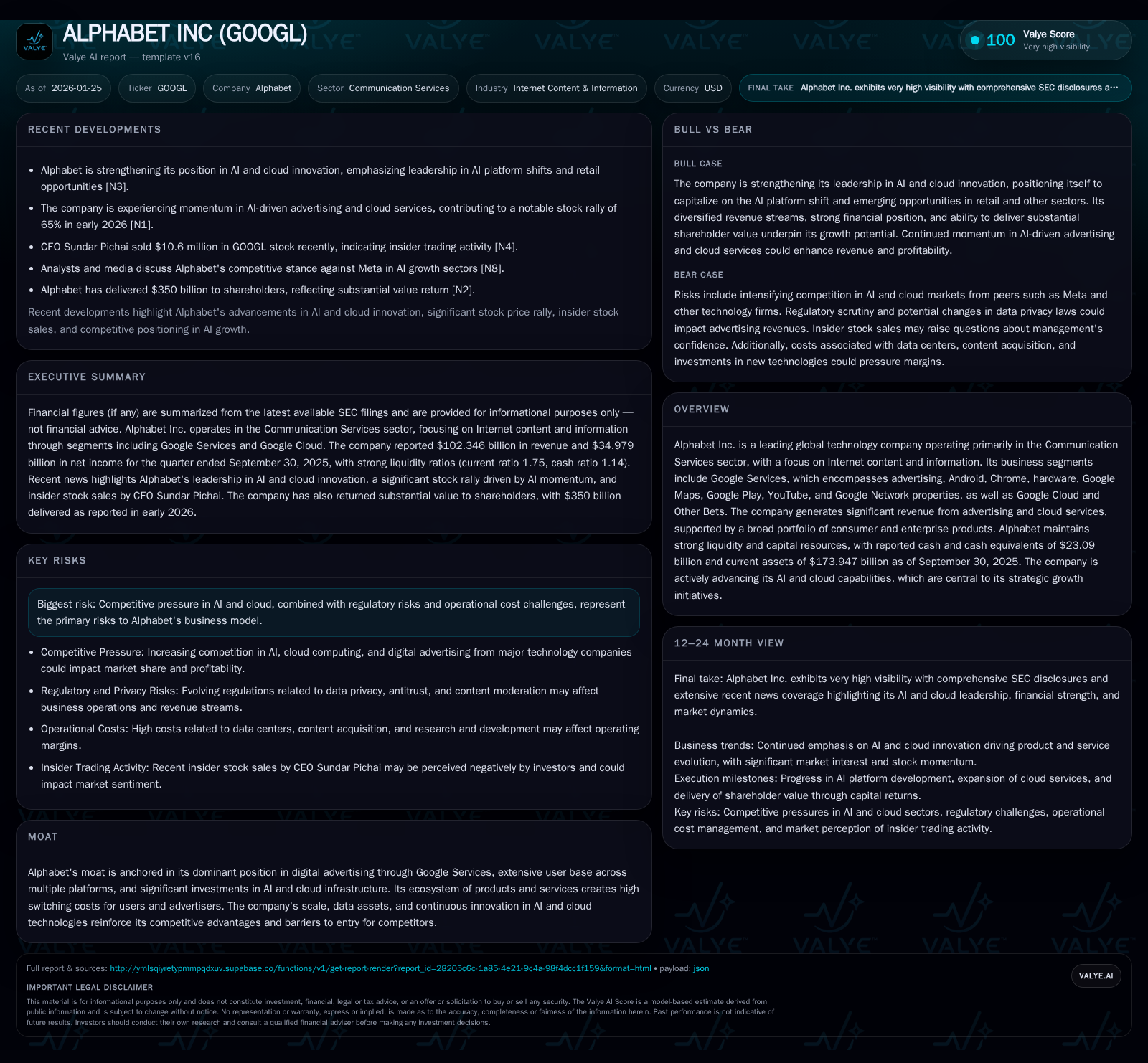
Alphabet Inc. continues to solidify its leadership in digital advertising and cloud services, driven by aggressive AI integration across its ecosystem. Recent developments highlight robust AI and cloud momentum contributing to potential earnings upside, yet competitive pressures from peers and evolving regulatory risks remain salient. The company’s expansive product portfolio and vast data assets underpin its moat, though operational costs and capital allocation decisions warrant close monitoring.
What Changed Recently
In the last 45 days, Alphabet Inc. has drawn significant market attention due to its ongoing AI and cloud momentum, which have positioned it for potential earnings surprises in Q4 2025. Analysts from multiple outlets pointed to robust performance drivers beyond just AI hype, highlighting strong advertising demand and Google Cloud expansion as core contributors [N1, N2, N3]. The company’s CEO, Sundar Pichai, sold approximately $10.6 million in shares, a move that has sparked discussion on insider confidence or portfolio diversification strategies [N8, N10]. Meanwhile, Alphabet publicly reinforced its commitment to AI and cloud innovation, emphasizing these areas as central to future growth and competitive positioning [N9, N13]. Concurrently, broader market narratives frame this period as a pivotal moment reminiscent of the mid-1990s tech surge, underscoring Alphabet’s role in shaping the next wave of technology transformation [N6].
Business Model as a System
Alphabet’s operations are segmented into three primary divisions: Google Services, Google Cloud, and Other Bets [S1, S3]. Google Services is the largest contributor, encompassing advertising platforms, Android OS, Chrome browser, YouTube, Google Maps, hardware devices, and Google Play. Advertising revenue derived from search and display ads on Google’s vast network remains the backbone of the company’s income, benefiting from scale, data-driven targeting, and network effects. Google Cloud serves enterprise customers with infrastructure-as-a-service (IaaS), platform-as-a-service (PaaS), and increasingly AI-enhanced solutions, reflecting the trend of digital transformation and cloud migration. Other Bets include experimental and longer-term projects such as Waymo and Verily, which currently contribute less materially but offer optionality for future growth.
The business model operates as a synergistic ecosystem: consumer-facing platforms generate massive user engagement, which fuels advertising demand, while cloud services leverage AI capabilities developed internally to serve enterprise needs. Capital allocation flows prioritize AI R&D and data center expansion to support this integration. Costs are structured with a significant fixed component in data centers and content acquisition (notably for YouTube), alongside variable advertising costs linked to revenue share agreements with partners [S4]. This creates operating leverage; however, the model requires continuous innovation to maintain advertising relevance and cloud competitiveness.
Industry Map & Competitive Battlefield
Alphabet occupies a dominant position in digital advertising, controlling a large share of search and video ad markets, supported by its unparalleled data assets and user reach. Competitors in advertising primarily include Meta Platforms and Amazon, each carving out segments in social and e-commerce advertising, respectively. In cloud computing, Alphabet competes fiercely with Microsoft Azure, Amazon Web Services (AWS), and to a lesser extent IBM and Oracle. Cloud competition centers on scale, service breadth, AI integration, and industry-specific solutions.
The AI landscape has intensified with major investments from these competitors, driving rapid innovation cycles and new product introductions. Meta’s AI focus on generative content and Microsoft’s integration of AI into productivity tools add layers of complexity. Regulatory pressures also shape the battlefield, with Alphabet facing antitrust scrutiny and data privacy regulations that influence product features and market access. The interplay of technological innovation, customer lock-in, and regulatory constraints define the strategic dynamics Alphabets must navigate.
Where the Economics Become Real
Alphabet’s unit economics are anchored in high-margin advertising revenue, which benefits from strong pricing power and efficient customer acquisition via Google’s search engine and YouTube platform [S1, S7]. Revenue share models with content creators and partners represent a significant cost, particularly in YouTube, where content acquisition costs scale with subscription and advertising revenue [S4].
Cloud economics are more capital intensive and currently less profitable than advertising. Data center buildouts, AI infrastructure investments, and customer acquisition costs weigh on margins, though economies of scale and software-as-a-service (SaaS) pricing models provide a path to improved unit profitability [S13]. Operating leverage is visible in fixed-cost absorption in data centers and R&D, but these investments require sustained high growth to justify capital deployment.
Liquidity metrics are robust; as of September 30, 2025, Alphabet held $23.09 billion in cash and equivalents with a current ratio of 1.75, indicating strong short-term financial flexibility [S8]. The balance sheet supports continued investment in AI and cloud, as well as share repurchases or strategic acquisitions.
Diligence Questions / Disconfirming Signals
- How sustainable is the recent AI-driven earnings upside, and to what extent is it already priced into market expectations?
- What are the key competitive differentiators that protect Google Cloud’s growth trajectory against entrenched AWS and Azure incumbents?
- How materially could evolving regulatory frameworks—particularly in the EU and US—impact Alphabet’s advertising model or data usage?
- What are the internal cost trends in AI and cloud infrastructure, and how might these affect operating margins going forward?
- Does CEO Sundar Pichai’s recent share sale imply any internal concerns about near-term valuation or capital allocation priorities?
- How scalable are the Other Bets, and what is management’s capital allocation philosophy toward these longer-term ventures?
- What are the risks related to content acquisition costs on YouTube, particularly as competition for creator monetization intensifies?
Conclusion
Alphabet Inc. remains a pivotal player in the communication services and internet content industry, leveraging a diversified portfolio to capture growth opportunities in AI, cloud computing, and digital advertising. Its business model’s integration of user engagement, data monetization, and enterprise solutions creates a durable moat, albeit in a landscape marked by aggressive competition and regulatory challenges. The company’s capital resources and operational scale provide a strong foundation for innovation, but vigilance on cost management and regulatory developments will be critical to preserving its competitive edge.
This analysis is based on publicly available information as of January 2026 and is intended for informational purposes only, without providing investment advice.
Disclaimer: This is research-only, informational analysis and not investment advice. It may include AI-generated interpretation and general industry context. Always verify important details using primary sources.

Comments