
GeoVax Targets Orthopox Vaccine Supply with GEO-MVA Phase 3 Launch in H2 2026 Amid Financial and Manufacturing Challenges
GeoVax's clinical-stage biotech pipeline centers on MVA-based vaccines addressing global mpox/smallpox supply shortages while advancing oncology and COVID-19 immunotherapy programs under capital constraints.
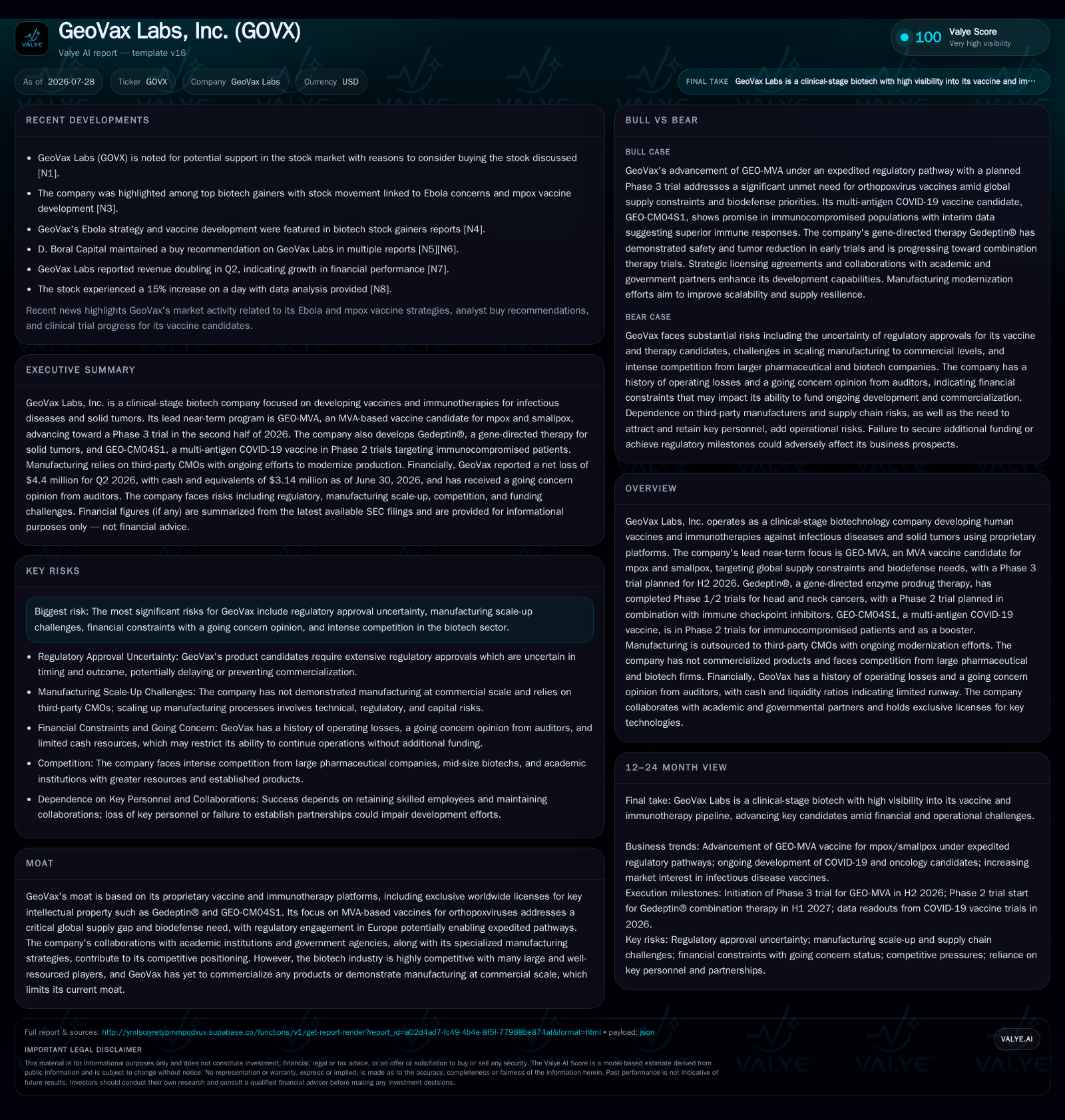
GeoVax Labs, Inc. reported continued investment in advancing its lead GEO-MVA vaccine for orthopoxviruses, with a pivotal Phase 3 trial planned for the second half of 2026 targeting global shortages and biodefense needs. The company’s oncology candidate Gedeptin® and multi-antigen COVID-19 vaccine GEO-CM04S1 also progress through clinical stages, supported by expanding scientific advisory boards. GeoVax relies entirely on outsourced manufacturing with ongoing modernization efforts, which creates scale-up risks typical of small biotech firms. Financially, GeoVax reported a $21.5 million net loss in 2025 and holds approximately $3.1 million in cash as of mid-2026 amid a going concern opinion, underscoring reliance on additional capital raises and grant funding to sustain operations.
Recent Operating Update and Why It Matters
GeoVax Labs' latest quarterly filing dated July 27, 2026 confirms the company’s strategic focus on advancing GEO-MVA, an MVA (Modified Vaccinia Ankara) vaccine candidate targeting mpox, smallpox, and other orthopoxviruses [S2]. This focus reflects urgency driven by recent mpox outbreaks in 2022 and 2024 which depleted global MVA vaccine stockpiles including U.S. Strategic National Stockpile reserves concentrated with a single foreign manufacturer [S1]. Notably, GeoVax plans to initiate a pivotal Phase 3 trial for GEO-MVA in the second half of 2026 under an expedited regulatory pathway primarily pursued in Europe [S1]. This timing places GeoVax at a potential inflection point where clinical validation could unlock biodefense contracts or public health deployment opportunities during a significant global supply gap.
Beyond infectious disease vaccines, GeoVax continues development of Gedeptin®, its gene-directed enzyme prodrug therapy (GDEPT) for solid tumors. Having completed Phase 1/2 trials in head and neck cancers, the company plans a Phase 2 trial combining Gedeptin® with immune checkpoint inhibitors (ICIs) starting early 2027 [S1]. Simultaneously, GEO-CM04S1—a next-gen multi-antigen COVID-19 vaccine—is undergoing two Phase 2 trials: one as primary vaccination for immunocompromised patients including hematologic cancer populations, and another as a booster in chronic lymphocytic leukemia (CLL) patients where interim data showed superior immunogenicity versus mRNA vaccine boosters [S1]. These programs demonstrate GeoVax’s emphasis on niche high-risk patient groups underserved by current vaccines.
Business Model and Revenue Mechanics
GeoVax operates as a fully clinical-stage biotechnology company without commercialized products or product revenue to date [S1]. Its value creation centers on proprietary biologic platforms enabling development of preventive vaccines and immunotherapies. Intellectual property underpins this model; GeoVax holds exclusive worldwide licenses on key technologies such as its MVA platform and Gedeptin® [S1]. Revenue typically derives from milestone payments linked to clinical trial progress or regulatory approvals as well as government grants supporting biodefense-oriented research—both important given the company's current pre-commercial status.
Importantly, GeoVax outsources its biologics manufacturing exclusively through contract manufacturing organizations (CMOs), reflecting standard biotech practice given capital intensity and regulatory complexity of own-brand GMP facility establishment [S1]. The company highlights ongoing CMO modernization efforts aimed at scaling production capacity while maintaining regulatory compliance—highly material given that effective manufacturing scale-up is often a gating factor preceding potential commercialization or partnership expansion.
Margins at this stage are negative due to heavy investment in research & development (R&D), clinical operations, and general administration without offsetting product sales. Cost drivers include expensive clinical trial enrollment across geographically distributed sites especially for specialized indications like solid tumors or immunocompromised cohorts.
Industry Structure and Competitive Position
GeoVax participates in the biotechnology segment known for long lead times between discovery/commercialization accompanied by high technical risk alongside significant regulatory and financing hurdles. Peers span from established vaccine innovators like Moderna and BioNTech—companies exemplifying scalable mRNA platforms—to smaller specialist biotechs such as Inovio Pharmaceuticals focusing on DNA vaccines or Adaptive Biotechnologies working within immuno-oncology.
Within the orthopoxvirus vaccine niche targeted by GEO-MVA, supply constraints highlighted during recent outbreaks reveal structural demand unmet by incumbent suppliers predominantly located overseas [S1]. GeoVax’s domestic positioning offers competitive leverage amid U.S. government initiatives emphasizing reshoring biopharmaceutical capabilities [S24]. However, competition involves complex factors such as manufacturing scale reliability, intellectual property breadth against generic or biosimilar entrants, regulatory pathway navigation challenges especially emerging expedited European routes, and cost-effectiveness vis-à-vis existing licensed vaccines.
In oncology immunotherapy via Gedeptin®, the field is heavily crowded with multiple immune checkpoint inhibitor combinations approved or under study. Success hinges on demonstrating additive or synergistic efficacy alongside acceptable safety profiles through carefully designed clinical endpoints advised by an expanded Oncology Scientific Advisory Board added in February 2026 [S1]
Growth Drivers
The most immediate growth catalyst resides in GEO-MVA’s Phase 3 progression targeted for H2 2026 initiation [S2]. Positive pivotal data could enable regulatory submissions potentially satisfying U.S. biodefense stockpile replenishment tenders as well as civilian public health orders worldwide. The European expedited approval strategy both accelerates timelines and may minimize development costs compared to traditional FDA pathways.
Additional growth vectors include:
- Expansion of indications beyond mpox/smallpox leveraging MVA platform versatility.
- Data readouts expected for GEO-CM04S1 boosters suggesting differentiated immune response versus established mRNA platforms—which could drive partnerships or licensing deals focused on vulnerable patient segments.
- Planned initiation of combination Gedeptin® + ICI therapy trials addressing unmet need for first-line curative intent treatment options in head and neck squamous cell carcinoma starting H1 2027 bolsters longer-term oncology pipeline prospects.
Government grant funding tied to biodefense initiatives remains critical not only financially but also strategically enhances validation from authoritative entities aligning incentives around preparedness priorities [S24].
Risks and Watchpoints
GeoVax faces acute financial sustainability challenges. Despite R&D advances, it reported substantial operating losses totaling approximately $21.5 million for full year 2025 [F1] with net cash reserves around $3.1 million at June-end 2026 [F1]. Its auditors have issued a going concern opinion signaling severe liquidity risk absent new capital infusion or partnership monetization events [S1], [S2]. Given typical biotech burn rates augmented by costly late-stage trials including planned large-scale Phase 3 testing of GEO-MVA, the horizon for operational continuity appears narrow.
Manufacturing scale-up remains another significant risk vector given full dependence on third-party CMOs [S1]. Quality control lapses or capacity constraints could delay clinical timelines or inflate costs materially impacting investor confidence and regulatory engagement.
Clinical development risks persist including possible failure to meet safety/efficacy endpoints that would prevent approval across all three lead candidates. Regulatory uncertainties—particularly evolving frameworks governing accelerated approvals coupled with increasing healthcare policy pressures around drug pricing—could extend timelines or erode future reimbursement potential. Intense competition from large pharma firms possessing deep pockets can hamper market penetration post-launch if commercialization execution is delayed or inadequate.
Intellectual property disputes remain possible given crowded patent landscapes especially around COVID-19 antigens where major industry players actively prosecute extensive portfolios potentially overlapping with GEO-CM04S1 technology components [S10].
What to Watch Next
Several specific milestones demand close monitoring:
- The initiation timing of GEO-MVA pivotal Phase 3 study in H2 FY26: enrollment pace and interim safety/immune response data will be early indicators of progression probability.
- Data readouts from ongoing Phase 2 booster studies of GEO-CM04S1 expected within first half of calendar year 2026 as noted [S1], which may influence partnering discussions or grant renewals.
- Commencement of Gedeptin® combination trials targeted H1 FY27 will test translational efficacy hypotheses substantiated by modified protocols developed with Oncology SAB guidance.
- Evidence relating to CMO scale-up effectiveness including batch release efficiency—all tied closely to regulatory inspection outcomes—will confirm operational readiness preparing GeoVax’s platform for eventual commercialization scaling.
- Capital raising activities over next quarters: given current cash runway projections into mid Q2 FY26 based on filings [F1], successful financing execution will be an essential enabler enabling continued development momentum.
Financial Profile Discussion
As of June 30, 2026, GeoVax held approximately $3.1 million in cash & equivalents against current liabilities near $2.7 million resulting in a current ratio of roughly 1.54 indicating limited short-term liquidity cushion [F1]. Total debt levels are negligible relative to cash reserves which alleviates immediate solvency threats unrelated to operating cash burn but underscores dependence on equity or grant funding inflows moving forward. The company recorded net losses totaling around $21.5 million for calendar year ending December 31, 2025 driven entirely by sustained R&D expenditure outlays associated with advancing multiple clinical assets simultaneously without any product-generated revenues yet realized [F1], [S1].
This financial profile mirrors typical patterns common among clinical-stage biotech firms heavily reliant on external capital markets or strategic partnerships until achieving late-stage validations that permit commercialization launch or out-license deals generating milestone payments alongside royalties. Continued ability to raise funds under acceptable terms constitutes a key operating risk factor documented explicitly via the auditor’s going concern disclaimer given limited current cash runway projections bounded into mid-second quarter FY26 without further financing completed [S1], [S2].
Conclusion
GeoVax Labs positions itself within a strategically compelling segment focusing on orthopoxvirus vaccines while concurrently progressing oncology gene-directed therapies and niche COVID-19 immunomodulators suited for vulnerable populations unmet by prevailing standards-of-care vaccines. The impending start of its pivotal Phase 3 trial for GEO-MVA represents a crucial near-term inflection point potentially enabling first-in-country approvals needed to capture meaningful biodefense contracts addressing structural supply gaps exacerbated over recent outbreak cycles.
Nonetheless, persistent financial fragility characterized by sizeable accumulated losses paired with constrained cash balances temper enthusiasm pending visible market validation signals from upcoming data readouts combined with demonstrable manufacturing scale-up success overseen through third-party CMOs — all amid competitive pressures from far larger pharmaceutical incumbents capable of investing greater resources into parallel vaccine innovations. Regulatory pathways pursued primarily through Europe aim at expedited review processes enhancing time-to-market prospects though uncertainties remain inherent along this complex journey.
Overall, success depends critically upon meeting enrollment timelines plus safety/efficacy endpoints across multiple diverse indications coupled with timely infusion of financing resources underwriting further operations at least until definitive pivotal outcomes materialize within forecasted windows spanning late calendar year 2026 into early 2027 horizon periods.
This analysis is based solely on publicly filed SEC documents as of July 27–28, 2026.
Disclaimer: This is research-only, informational analysis and not investment advice. It may include AI-generated interpretation and general industry context. Always verify important details using primary sources.

Comments