
Green Plains Inc.: Navigating the Low-Carbon Ethanol Frontier Amid Market Volatility
An in-depth analysis of Green Plains’ strategic positioning, technology adoption, and risk factors in the evolving renewable fuels industry.
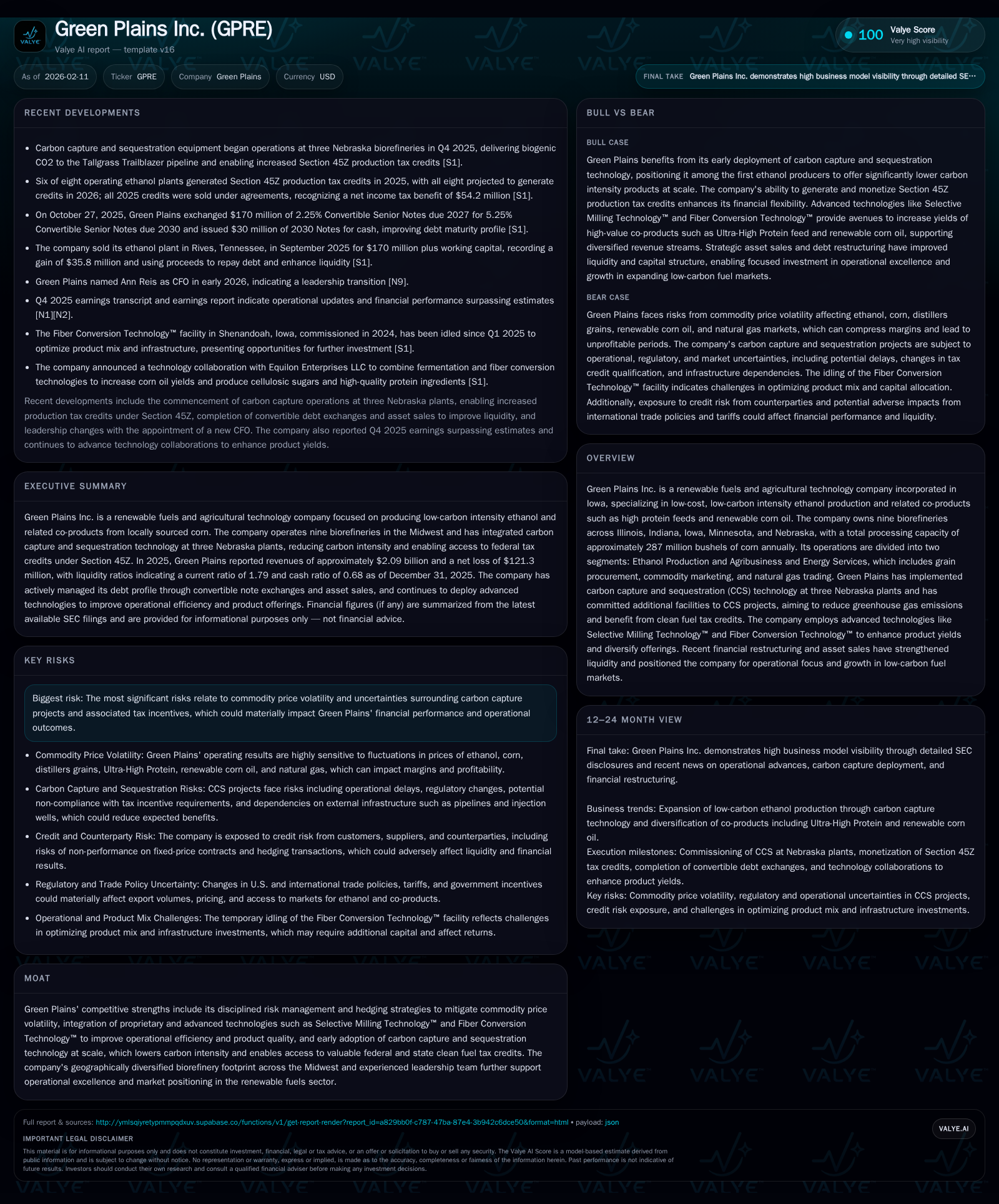
Green Plains Inc. operates nine biorefineries across the U.S. Midwest, producing low-carbon ethanol and co-products with progressive carbon capture technologies enhancing its competitive edge. The company’s disciplined operational execution and diversified footprint position it to benefit from expanding sustainable fuel incentives, though it faces significant commodity price volatility and uncertainties around carbon capture project risks and regulatory tax credit frameworks. Recent leadership changes and strategic asset sales underscore a focused pivot toward operational excellence and long-term carbon intensity reduction.
Company Overview
Green Plains Inc., headquartered in Iowa, stands as a prominent player in renewable fuels with a deep-rooted focus on producing low-cost, low-carbon intensity (low-CI) ethanol derived from locally sourced corn. Established in 2004, it has grown steadily to operate nine biorefineries spread strategically across Illinois, Indiana, Iowa, Minnesota, and Nebraska. At full operational capacity, these plants process roughly 287 million bushels of corn annually — producing an estimated 850 million gallons of ethanol alongside key co-products including distillers grains with high protein content and renewable corn oil used in biodiesel blends.
Their business is segmented into two main lines: Ethanol Production—which encompasses the transformation of corn into ethanol plus storage/transport—and Agribusiness & Energy Services—covering procurement of raw grain inputs, commodity marketing efforts for co-products, and active natural gas trading. This dual structure offers some operational flexibility while integrating different points along the value chain.
Strategic Positioning & Technology
A pivotal source of Green Plains’ moat lies in their advanced technologies aimed at operational efficiency gains and improving product quality. Their Selective Milling Technology™ enhances starch extraction from corn kernels prior to fermentation, helping improve yields; complementary Fiber Conversion Technology™ extracts cellulose fibers for added coproduct streams such as Ultra-High Protein feeds. These innovations underpin cost leadership within highly competitive commodity markets.
Moreover, Green Plains was among the early adopters of carbon capture and sequestration (CCS) within the ethanol sector. Three Nebraska plants have already integrated CCS connected to the Trailblazer CO2 pipeline infrastructure. In addition to these active sites, four other Midwestern facilities are committed to Summit Carbon Solutions projects for future deployment. This investment lowers their carbon intensity metrics substantially—critical for qualifying under Section 45Z production tax credits introduced by recent legislative measures such as the Inflation Reduction Act (IRA). Post-2029 when these credits sunsetted there remains eligibility for Section 45Q tax credits linked to CCS operations lasting up to twelve years after construction.
The importance of reducing CI cannot be overstated as government mandates ramp up demand for cleaner transportation fuels; ethanol today accounts for approximately 10% of U.S. gasoline supply by volume with potential expansion via higher blends such as E15 or E85. Additionally, renewable corn oil produced as a coproduct feeds into Sustainable Aviation Fuel (SAF) supply pathways through Alcohol-to-Jet (ATJ) conversions—underscoring multiple avenues for low-carbon product demand growth.
Financial Overview & Operational Challenges
According to the latest SEC filings [S1][F1], Green Plains generated revenues exceeding $2 billion for fiscal year 2025 but reported a net loss approximating $121 million during that period. Several factors contributed including elevated input costs like corn prices which cannot be fully passed downstream owing to ethanol’s fuel market competition with petroleum-derived gasoline.
They maintain a sound liquidity position reflected by cash & equivalents near $182 million and a current ratio around 1.79—important buffers given commodity price swings inherent to their industry segment.
A recurring challenge emphasized in risk disclosures relates to volatile spreads between corn feedstock prices plus natural gas energy inputs versus ethanol and coproduct selling prices. Market fluctuations driven by weather variability affecting crop yields globally, geopolitical trade tensions impacting export volumes (notably tariffs on U.S. ethanol exports imposed by Canada or Mexico), crude oil price shocks influencing fuel demand dynamics all combine to create earnings unpredictability.
Carbon Capture Risks & Regulatory Environment
Green Plains’ ambitions centered on CCS come tethered with meaningful project execution risks [S1]. For operating Nebraska plants actively capturing CO2 linked through third-party pipeline networks there remains exposure to facility operational setbacks that could delay or reduce capture volumes—thereby diminishing expected tax credits and environmental benefits.
Furthermore regulatory frameworks establishing tax incentive qualifications involve compliance with prevailing wage rules or apprenticeship requirements which increase cost risks if not met comprehensively. There is also uncertainty regarding future policy shifts at both federal and state levels that might alter eligibility or incentive magnitude.
Voluntary carbon credit markets add another layer of complexity since prices are susceptible to reputational shifts within verification standards or fluctuating buyer appetite—potentially undermining revenue expectations tied to captured emissions monetization.
Meanwhile trade policy uncertainties loom large—the evolving agricultural export landscape can inhibit access especially given recent history where tariffs were imposed on U.S. ethanol exports by major neighboring markets [S2]. These contingencies highlight the non-operational dependencies influencing strategic outcomes beyond Green Plains’ direct control.
Leadership & Corporate Actions
Recent corporate maneuverings signal proactive governance aimed at stabilizing capital structures and enhancing administrative capacity.[N5] The appointment of Ann Reis as CFO reflects continued efforts toward financial rigor amid difficult industry conditions.[N6] Additionally targeted asset disposals executed under new leadership helped reduce long-term leverage burdens positioning Green Plains better for subsequent investment cycles focused on technology adoption and decarbonization strategies.[N1]
Forward-looking while cautious about market risks Green Plains emphasizes continuous improvement—operational discipline supported by hedging programs designed to mitigate direct commodity exposures remains central to their resiliency approach.
Industry Context & Competitive Landscape Analysis
Analysis: The renewable fuels space has seen considerable regulatory tailwinds but fierce competition among producers both domestic and international especially as feedstock costs remain cyclical globally. Green Plains competes with producers not only based on price but increasingly on product carbon intensity scores which determine eligibility for premium blending or SAF feedstock markets.[N11]
Compared with peers who may not yet deploy CCS at scale or whose geographic footprints are less diversified across Midwestern corn-belt states constrained by local crop supply dynamics – Green Plains’ combination of proprietary milling tech, breadth of processing assets plus early CCS integration provides differentiated positioning albeit not insulated from macroeconomic headwinds.
Summary Reflection
Green Plains Inc. exemplifies a midstream biofuel producer embracing innovation-driven cost efficiencies combined with aggressive carbon capture deployments aiming to capitalize on transforming transportation fuel demands worldwide towards sustainability goals. While fundamental exposure to commodity price sensitivity remains challenging along with execution risks associated with novel CCS infrastructures their commitment toward operational excellence coupled with strategic financial actions creates a foundation for navigating an uncertain but potentially rewarding low-carbon fuel sector transition.
Disclaimer: This report provides informational analysis based on publicly available data as of February 2026 without conveying investment advice or recommendations.
Disclaimer: This is research-only, informational analysis and not investment advice. It may include AI-generated interpretation and general industry context. Always verify important details using primary sources.

Comments