
GitLab Inc Advances Unified DevSecOps Platform in Q1 Surpassing $950M Revenue
GitLab’s latest quarterly results demonstrate robust revenue growth fueled by its AI-integrated DevSecOps platform amid operational scaling challenges.
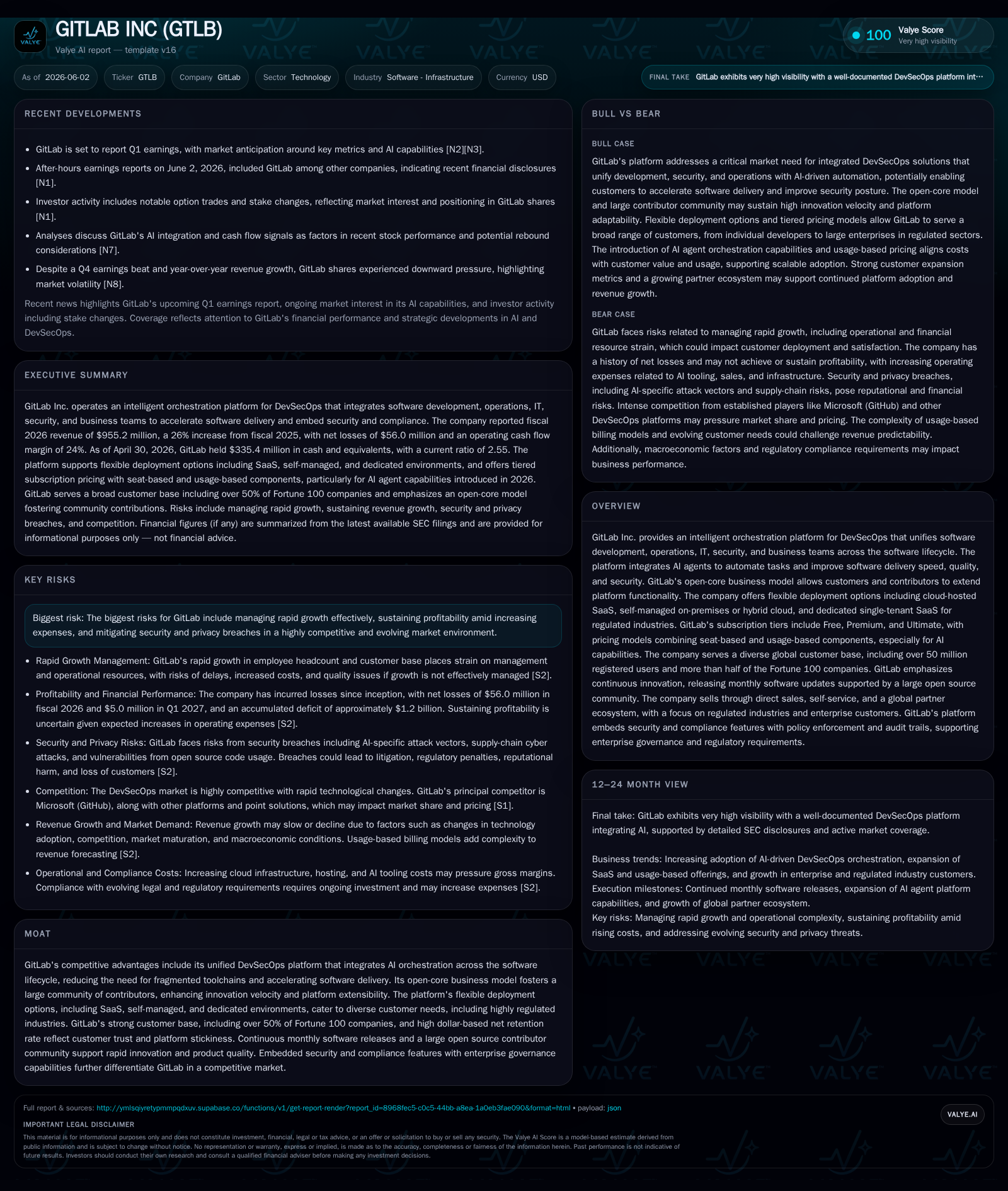
In its fiscal first quarter ending April 30, 2026, GitLab Inc reported revenue of $264.2 million, reflecting a 23% year-over-year increase and extending its strong annual revenue run past $950 million. The company’s unified DevSecOps platform, augmented by AI orchestration capabilities and an open-core model, continues to attract a growing customer base, now exceeding 10,800 paying organizations with increasing seat and usage expansions. However, while operating cash flow margins improved substantially to 24% for the trailing fiscal year, GitLab faces challenges managing rapid headcount growth and operational complexity as losses widen. Its flexible deployment options and high retention underline competitive strengths in serving regulated enterprise customers. Upcoming restructuring initiatives aim to align scale with strategic priorities.
First-Quarter Results Highlight: Growth Maintains Momentum
GitLab disclosed its fiscal Q1 results for the period ending April 30, 2026, showing continued robust expansion with revenues reaching $264.2 million—a 23% increase from $214.5 million during the same quarter a year earlier [S2][F1]. This performance contributed momentum towards an annual revenue figure surpassing $950 million for fiscal year 2026, marking accelerated growth compared to the previous year’s total of $759.2 million [S1]. The number of Base Customers—organizations with ARR above $5,000—increased from 10,104 to over 10,800 during the same timeframe [S2], emphasizing successful customer acquisition and seat expansion.
Despite topline growth and an improving operating cash flow margin that expanded from negative 8% to a positive 24% on an annual basis [S1], GitLab’s net loss widened to approximately $56 million due primarily to ongoing investments required for scaling operations and product development [F1]. These figures underscore the tension inherent in balancing aggressive expansion with profitability ambitions.
Unified DevSecOps Business Model Fuels Customer Expansion
GitLab monetizes a unified DevSecOps platform that integrates development, security, IT operations, and business workflows into a single intelligent orchestration environment [S1][S12]. The company employs a subscription pricing architecture primarily based on per-seat licensing tiers—Free, Premium, Ultimate—with incremental usage-based fees centered on AI agent consumption via GitLab Credits for enhanced automation tasks [S1]. This hybrid pricing enables flexibility: customers pay for baseline access and scale their costs alongside actual AI-driven usage.
GitLab’s Base Customer metric is particularly instructive as it filters out low-revenue users by counting only paying entities generating at least $5K ARR—a measure signaling the depth rather than just breadth of engagement [S1]. The rise in this cohort combined with reported strong dollar-based net retention (above 118%) reflects healthy upselling tendencies within existing customers adopting more complex or extensive DevSecOps use cases [S12].
Flexible deployment options—encompassing cloud-hosted SaaS on public/private clouds, self-management on-premises/hybrid setups, and single-tenant dedicated SaaS tailored for regulated sectors—help GitLab capture diverse industry segments where compliance rigor varies widely [S1]. This multi-modal approach distinguishes GitLab from competitors that are predominantly SaaS-only.
AI-Driven Orchestration: Catalyst for Software Delivery Acceleration
A core differentiator emphasized in GitLab’s strategy is embedding AI capabilities across the software delivery lifecycle to orchestrate workflows autonomously [S1]. Unlike fragmented toolchains relying on standalone AI agents with limited coordination ability, GitLab leverages its unified data model to enable cross-functional AI orchestration that reduces bottlenecks between planning, coding, testing, security scanning, deployment, and monitoring phases.
The “AI Catalog” allows customers’ teams to automate routine tasks intelligently while maintaining governance controls necessary for secure software release cycles [S1]. As enterprises increasingly seek tools that reduce manual effort without compromising compliance or security postures—especially important given rising software supply chain risks—GitLab’s embedded AI workflow augmentation offers both operational speed gains and risk mitigation benefits.
Open-Core Framework Enhances Innovation Velocity and Community Engagement
GitLab operates under an open-core business model where both customers and external developers contribute code enhancements or extensions into the core platform or its add-on catalogs [S1]. In calendar year 2025 alone, external contributors submitted more than 6,500 merge requests augmenting continuous integration/continuous delivery (CI/CD) tooling alongside AI capabilities [S1][N1]. This large-scale collaboration accelerates GitLab's innovation pipeline beyond what internal R&D alone could achieve.
The open-core approach builds trust by making product roadmaps transparent and allowing extensibility that aligns development efforts directly with user needs [S1]. By fostering this ecosystem effect among over 50 million registered users—including more than half of Fortune 100 firms—the company maintains a high velocity of releases (monthly updates) which supports continuous improvement in reliability and feature set relevancy.
Competitive Positioning in a Robust Infrastructure Software Market
Within the competitive landscape of DevSecOps platforms and developer productivity tools, GitLab distinguishes itself through comprehensive lifecycle coverage coupled with integrated security governance baked into workflow automation [S1][N14]. While other vendors may focus narrowly on CI/CD pipeline construction or source code management (SCM), GitLab’s platform spans planning through deployment including application security testing contexts.
Additionally noteworthy is GitLab’s support for self-managed deployments appealing heavily to regulated industries such as finance or government entities where data residency and control are paramount—a differentiation rare among peers who predominantly offer multi-tenant SaaS solutions lacking this granularity [S1]. The combination of scale (over half Fortune 100 coverage), flexible delivery modes, integrated AI orchestration features, plus an established partner ecosystem consisting of major hyperscalers like Google Cloud and AWS fortifies GitLab’s market position.
Growth Drivers: Expanded Use Cases, Enterprise Penetration, and Deployments
Key growth vectors involve increased penetration by enabling expanded use cases through maturing AI functionalities within the Duo Agent Platform which scales automation across customer development teams [S12][S27]. Usage-based revenue—channelled via GitLab Credits—is becoming an increasing component signaling deeper adoption intensity as clients invoke AI agents more frequently.
Further gains derive from enhanced investment in security & compliance modules responding to rising audit demands faced by enterprises globally; GitLab stresses audit-ready governance that logs work across planning-to-release activities reducing manual bureaucracy while preserving compliance coverage [S1]. Geographic expansion efforts combined with partner network scaling offers additional avenues for growth beyond established markets.
Operational Challenges and Risks Amid Rapid Scaling
Rapid growth strains operational bandwidth. GitLab acknowledges significant challenges managing headcount expansion (with recent workforce reductions planned impacting ~14% of global staff) alongside consolidating international presence—exiting approximately 22 countries leading to ~37% team-member geographic footprint reduction—to optimize execution against strategic priorities [S26].
Widening losses despite improved cash flow margins underscore ongoing expenses related to scaling infrastructure including information technology improvements supporting security/compliance standards demanded by enterprise clients [S2][S7][S8]. Failure to manage complexity effectively risks degraded customer satisfaction or delayed deployment cycles possibly impeding retention momentum
Additional risks include exposure to cybersecurity vulnerabilities given increased attack surfaces associated with cloud environments containing sensitive proprietary code bases; compliance with evolving regulatory regimes remains another focal area especially considering U.S./international anti-corruption laws or export controls that might affect global operations [S4][S25]. Legal proceedings completed successfully have mitigated some class-action exposures but lingering reputational sensitivities remain relevant.
Upcoming Catalysts: Product Roadmap Milestones and Financial Guidance
Recent filings reaffirm guidance aligned with maintaining top-line growth trajectories complemented by phased restructuring effects yielding operational cost optimization visible from Q2 onwards [S3][N2][N3]. Critical near-term milestones will revolve around uptake metrics for premium AI offerings embedded within continuous monthly release cadence plus improvements in operating leverage ratios as headcount rationalization bears fruit.
Success in further expanding large customer additions—particularly complex multi-tier enterprise accounts leveraging advanced security/compliance toolsets—and growing usage-based payment contributions stand as key indicators validating GitLab's evolving monetization strategy.
Financial Health Overview: Cash Position and Operational Efficiency
At quarter-end April 30, 2026, GitLab held cash and equivalents totaling approximately $335.4 million coupled with total current assets of $1.64 billion against current liabilities near $643 million yielding a healthy current ratio near 2.55 indicating ample short-term liquidity support for ongoing investments [F1][S2]
This analysis is based solely on publicly available SEC filings and Nasdaq news sources without any investment research views or forward-looking opinions beyond clear factual interpretation. Financial data cited reflect most recent quarterly disclosures as of June 2026.
Disclaimer: This is research-only, informational analysis and not investment advice. It may include AI-generated interpretation and general industry context. Always verify important details using primary sources.

Comments