
Goldenwell Biotech Q2 2026: Product Development Complete, License Expiry Risk Emerges
Goldenwell Biotech has finalized product development and production setup for its five biotechnology products but faces significant near-term risks from the expiration of a key exclusive license agreement.
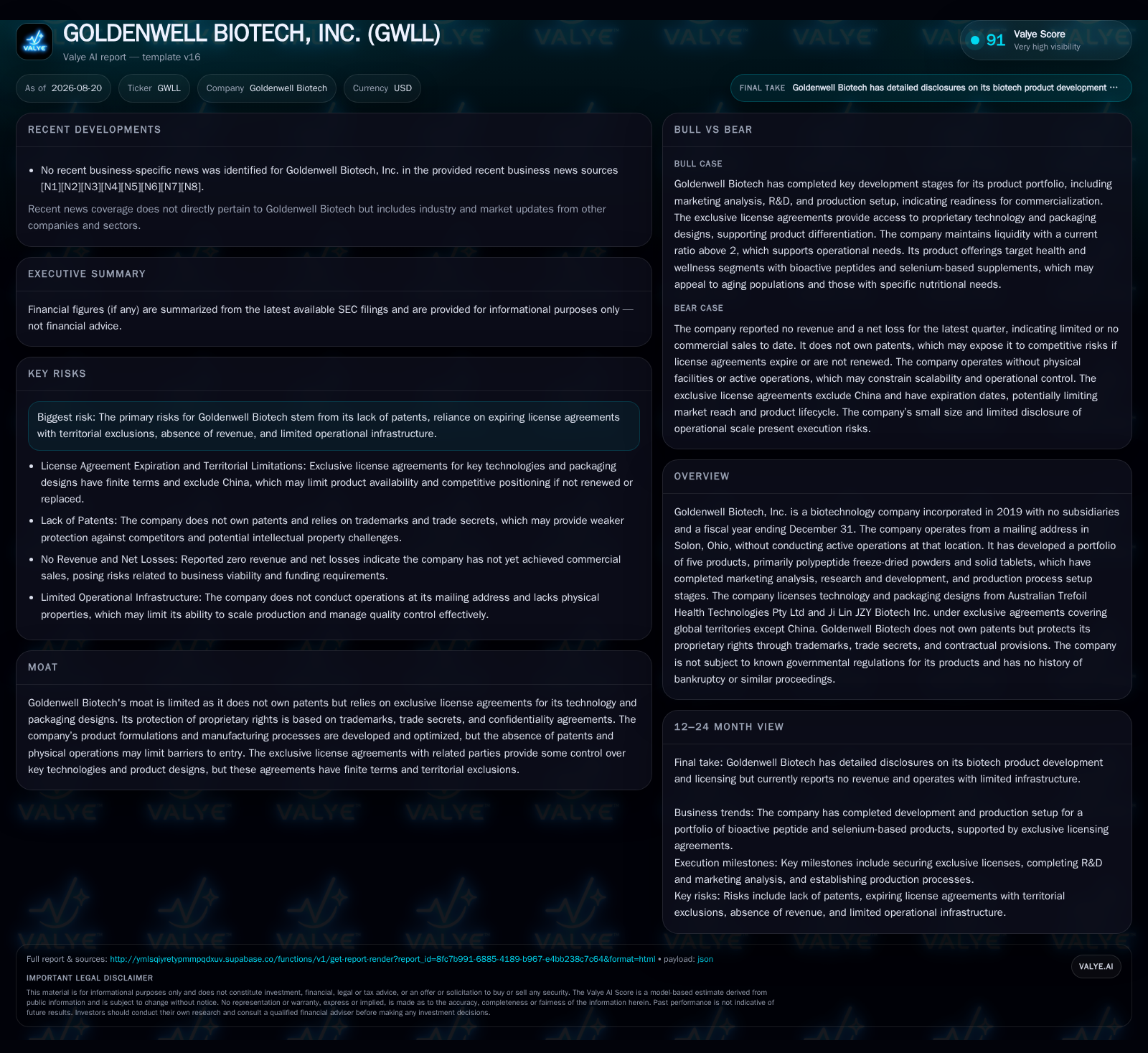
As of Q2 2026, Goldenwell Biotech remains a pre-revenue company with completed research, development, and production process establishment for its portfolio of five products. The company relies on exclusive license agreements for its technology and packaging designs, notably with Australian Trefoil Health Technologies Pty Ltd and Ji Lin JZY Biotech Inc. However, the Australian Trefoil license expired in November 2025, creating uncertainty around the company’s ability to maintain exclusive rights critical to commercialization. Goldenwell Biotech operates with minimal infrastructure, no patents, and reported current liabilities of $100,000 at quarter-end without generating revenue or operating cash flow. The company’s future prospects hinge on license renewals or replacements and successful transition to commercial sales.
Latest Quarterly Operating Update
Goldenwell Biotech, Inc. reported in its Q2 2026 10-Q filing dated August 14, 2026, that it has completed critical stages of product development and production readiness for its portfolio of five biotechnology products [S2][S12]. These products primarily consist of polypeptide freeze-dried powders and solid tablets with proprietary formulations and packaging designs. The company finalized its initial marketing analysis, research and development activities—including raw material selection, product formulation, laboratory testing, and quality assurance/control studies—and established production processes, including technology optimization and equipment selection. While a production site has been located and equipment installed, no specialized manufacturing equipment is required beyond what is commercially available. The workforce needed for production is expected to require only general training without specialized expertise.
Despite these operational milestones, Goldenwell remains pre-revenue, with no reported sales or operating cash flow as of June 30, 2026 [F1][S2]
Intellectual Property and License Agreements
Goldenwell Biotech’s business model relies heavily on exclusive license agreements for the underlying technology and packaging designs of its products. The company holds two key licenses: one from Australian Trefoil Health Technologies Pty Ltd and another from Ji Lin JZY Biotech Inc. Both licenses cover global territories excluding China. The Australian Trefoil license, which underpins technology used in products such as Sugar Master and DNA Repair, expired on November 15, 2025 [S1][S5][S12]. The Ji Lin JZY Biotech license remains valid until January 11, 2035.
The company does not own any patents and instead depends on trademarks, trade secrets, confidentiality provisions, and contractual protections to safeguard its proprietary rights. This reliance on licensing agreements and trade secrets, rather than patent ownership, is less common in the biotechnology sector and may limit barriers to entry and competitive protection [S1][S12].
Notably, the Q2 2026 filing does not disclose any renewal or extension of the Australian Trefoil license beyond its November 2025 expiration date, leaving Goldenwell’s continued exclusive rights to that technology uncertain [S1][S5]
Financial Position and Liquidity
As of June 30, 2026, Goldenwell Biotech reported current liabilities totaling $100,000 with no disclosed current assets to offset these obligations, indicating negative working capital [F1][S2][S6]. The company has no reported revenue or operating cash flow, consistent with its pre-commercial stage. It also does not own physical production facilities or real estate and operates with a minimal infrastructure consisting of three non-employee officers managing operations remotely.
The absence of revenue and cash flow highlights the company’s early-stage financial position, with ongoing liabilities and no disclosed capital expenditures or investments beyond maintaining product development and license agreements [S2][F1]
Business Model and Competitive Positioning
Goldenwell Biotech’s future revenue depends on commercializing its portfolio of five biotechnology products, which include polypeptide freeze-dried powders and solid tablets formulated with proprietary technology and packaging. The end customers or distributors would pay for these products upon successful market entry. Currently, the company generates no revenue as it remains in the development and production setup phase.
Margins and cash conversion potential will ultimately depend on manufacturing efficiency, raw material costs, and licensing fees [S1][S5][S12]. However, the company’s lack of patent ownership and reliance on finite-term exclusive license agreements with territorial exclusions—particularly the expired Australian Trefoil license—pose competitive constraints. Intellectual property protection is limited to trademarks, trade secrets, and contractual provisions, which may not provide strong barriers against competition in the biotechnology industry.
Risks and Forward-Looking Scenarios
A key risk facing Goldenwell Biotech is the expiration of the Australian Trefoil license in November 2025, which covers critical technology and packaging designs for some of its products [S1][S5]. Without explicit disclosure of renewal or replacement, the company’s ability to maintain exclusive rights and proceed with commercialization is uncertain. Loss or non-renewal could expose Goldenwell to competition or require renegotiation of terms, adversely affecting future product sales and competitive positioning.
One plausible base scenario is that Goldenwell successfully renews or replaces the expiring Australian Trefoil license and progresses to commercial sales within the next 12 to 24 months [S1][S5][S12]. The company’s completed product development and active license with Ji Lin JZY Biotech support this possibility. Confirmation would come from future filings disclosing license renewals, first commercial sales, or operational updates regarding manufacturing and partnerships.
Conversely, a bear scenario involves failure to renew the Australian Trefoil license, inability to commercialize products, and prolonged pre-revenue status [S1][S5][F1]. Given the company’s minimal operational infrastructure and lack of patents, this could lead to liquidity challenges and potential financial deterioration. Evidence supporting this scenario would include disclosures of license termination, continued absence of revenue, and no progress toward commercialization or partnerships.
Conclusion
Goldenwell Biotech’s completion of product development and production process setup for its five biotechnology products positions it to potentially enter commercialization. However, the company remains in an early stage without revenue, manufacturing facilities, or significant operational infrastructure. The expiration of the Australian Trefoil license in November 2025 introduces material uncertainty regarding the company’s ability to maintain exclusive rights critical to its products.
The company’s reliance on licensing agreements and trade secrets rather than patent ownership constrains its competitive positioning in the biotechnology sector. Moving forward, key watchpoints include disclosures of license renewals or replacements, announcements of first revenue or commercial sales, changes in financial liabilities or liquidity, and updates on manufacturing capabilities or strategic partnerships. These developments will be critical to assessing Goldenwell Biotech’s transition from a pre-revenue development stage to a commercial biotechnology enterprise.
Disclaimer: This is research-only, informational analysis and not investment advice. It may include AI-generated interpretation and general industry context. Always verify important details using primary sources.

Comments