
Rectitude Holdings Declares First Cash Dividend Amid Revenue and Profit Growth
Rectitude Holdings initiates its first-ever cash dividend following a year of strong revenue and net profit increases, reflecting a potential shift in capital allocation.
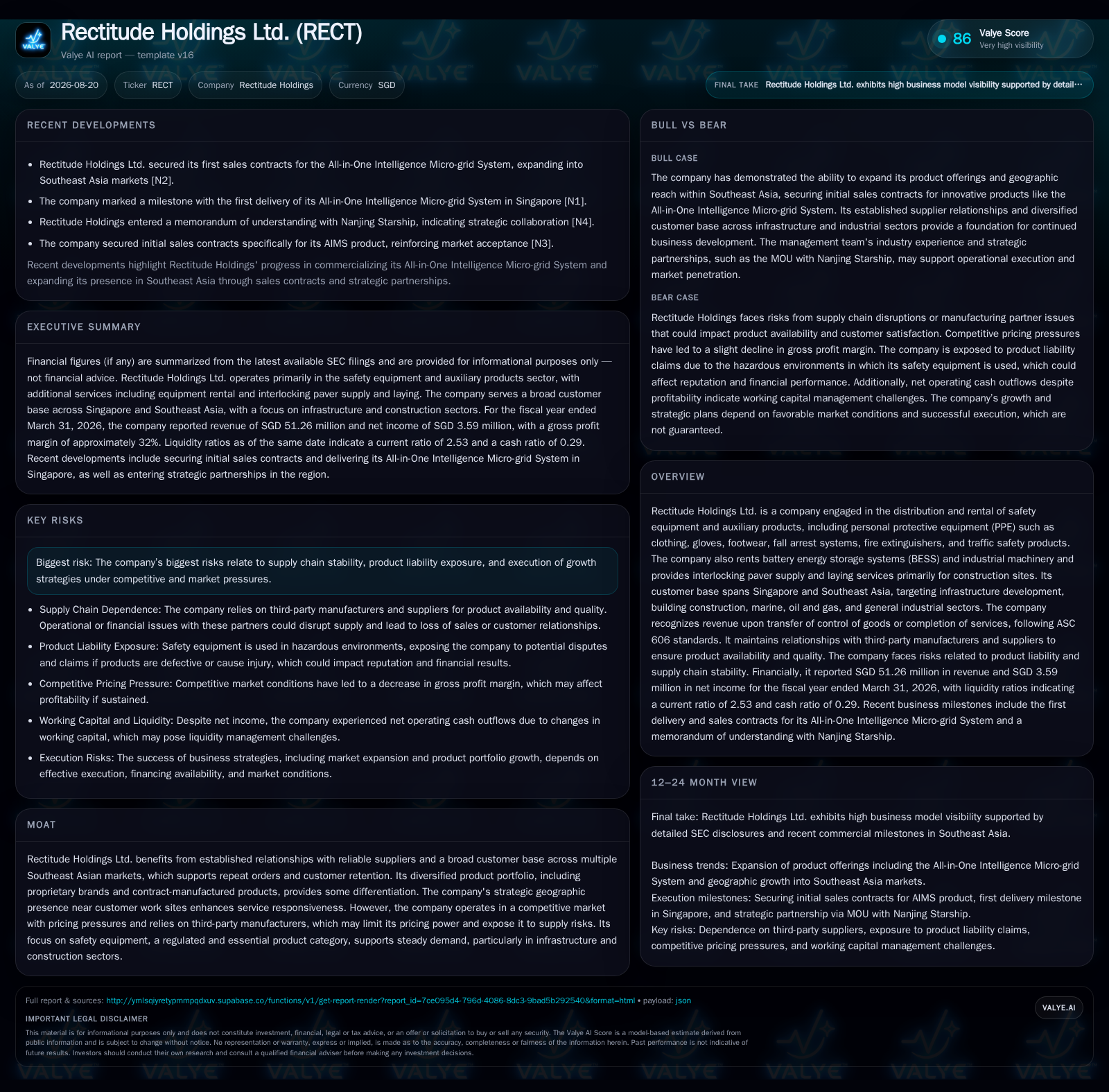
Rectitude Holdings Ltd. announced a $0.10 per share cash dividend in August 2026, marking the first dividend in its history. This follows a fiscal year ended March 31, 2026, characterized by a 17.1% revenue increase to S$51.3 million and a 60.5% rise in net profit to S$3.6 million. The company’s solid balance sheet, with a current ratio of 2.53 and manageable debt of approximately $3.1 million, underpins this capital return. However, ongoing competitive pressures and supply chain risks in the safety equipment market pose challenges to sustaining growth and dividend payments.
Dividend Declaration and Capital Allocation Shift
In August 2026, Rectitude Holdings Ltd. declared a cash dividend of $0.10 per ordinary share, the first dividend in the company’s history [S3]. This milestone marks a significant change in the company’s capital allocation approach, indicating a move toward returning capital to shareholders. The dividend declaration follows a year of strong financial performance, signaling management's confidence in the sustainability of cash flow and profitability improvements. Rectitude held current assets of approximately $26.7 million against current liabilities of $10.6 million, resulting in a current ratio of 2.53, which indicates ample liquidity to support both operational needs and dividend payments [F1]. Total debt stood at around $3.1 million, a manageable level relative to the company’s asset base [F1]. This solid balance sheet provides financial flexibility for sustaining dividends while also allowing for potential growth investments.
The initiation of dividend payments represents a material shift in Rectitude’s capital allocation policy. Historically, the company had not distributed dividends, likely prioritizing reinvestment and growth. The decision to pay dividends now suggests a strategic move to return capital to shareholders. This growth was driven by increased demand for safety equipment and auxiliary products, particularly in Singapore and the broader Southeast Asian region. Net profit rose by 60.5% to S$3.6 million compared to the prior year, indicating not only higher sales but also improved profitability [S1]. The disproportionate increase in net profit relative to revenue suggests margin expansion or operating leverage, possibly due to effective cost management despite rising costs of revenue.
The cost of revenue increased from S$29.1 million in FY2025 to S$34.8 million in FY2026, reflecting higher input costs or expanded sales volume [S1]. The company’s balance sheet as of March 31, 2026, shows a current ratio of 2.53 and total debt of approximately $3.1 million, supporting its ability to sustain operations and fund dividend payments [F1].
This financial momentum underpins the dividend declaration and signals operational strength. However, the absence of explicit cash flow figures for the period following the dividend announcement means that ongoing cash generation must be monitored closely to confirm dividend sustainability.
Business Model and Market Position
Rectitude Holdings operates primarily in the industrial safety equipment and services sector, offering a comprehensive range of products and services. Its portfolio includes personal protective equipment (PPE) such as safety footwear, hand gloves, personal fall arrest systems, portable fire extinguishers, and traffic safety products like rubber speed humps and wheel stops [S1]. The company also provides rental services for AIMS battery energy storage systems (BESS) and industrial machinery, as well as interlocking paver supply and laying services for construction sites.
The company’s customer base spans infrastructure development, building construction, marine, oil and gas, and general industrial sectors, predominantly in Singapore, which accounted for approximately 96% of revenue in FY2026 [S1]. Expansion efforts into Southeast Asia, including Malaysia, Indonesia, Vietnam, and Thailand, are ongoing, aiming to diversify geographic revenue sources and capture growth opportunities in emerging markets.
Margins and cash flow are influenced by product mix, pricing strategies, supplier cost stability, operational efficiency, and rental utilization rates [S1]. Rectitude’s competitive advantages include strong brand recognition, established supplier and customer relationships, and strategic geographic presence near customer work sites, which facilitate repeat business and customer loyalty [S1].
However, the company faces constraints from pricing pressure in a highly competitive market and dependence on third-party contract manufacturers. This reliance exposes Rectitude to supply chain risks, including potential disruptions and cost volatility, which can limit pricing power and margin expansion.
Risks and Competitive Challenges
Despite the encouraging financial results and dividend initiation, Rectitude operates in a challenging environment. The safety equipment market is highly competitive, with rivals possessing greater financial and marketing resources that may exert pricing pressure [S1]. Maintaining product quality, an up-to-date product range, and effective pricing strategies are critical to securing repeat orders and acquiring new customers.
Supply chain stability remains a material risk. The company relies on third-party manufacturers and suppliers for its product portfolio, and any operational or financial issues faced by these partners could disrupt product availability, leading to potential loss of sales or damage to customer relationships [S1]. Additionally, rising input costs have already increased the cost of revenue, which could compress margins if not managed effectively.
The geographic concentration of revenue in Singapore also poses a risk, as economic or regulatory changes in this market could disproportionately affect the company’s performance. While expansion into Southeast Asia offers growth potential, it also introduces risks related to market entry, competition, and operational complexity.
Given these factors, competitive pressures and supply chain risks remain material constraints on future margin expansion and growth sustainability, despite the strong recent financial performance.
Scenario Analysis and Outlook
To frame investor expectations, three plausible scenarios can be considered:
Bull Case: Rectitude successfully leverages its established supplier relationships and geographic presence to expand market share in Southeast Asia, sustaining revenue growth and margin expansion. This enables continued dividend payments and potential increases. This scenario is supported by strong FY2026 financial results and strategic regional expansion efforts, with the stable balance sheet providing financial flexibility [S1][S3][F1]. Confirmation would come from future quarterly revenue and profit growth, dividend increases, and geographic diversification. Refutation would include declining revenue, dividend suspension, or supply chain disruptions.
Base Case: The company maintains stable revenue and profitability with modest growth, managing competitive and supply risks effectively. This supports ongoing dividend payments but limits expansion. Confirmation would be flat to moderate revenue growth, stable dividends, and consistent margins. Refutation would be significant revenue decline, dividend suspension, or margin compression.
Bear Case: Intensified competitive pressures and supply chain instability lead to margin erosion and revenue decline, forcing dividend suspension and potential financial strain. This scenario is plausible given competitors with greater resources and reliance on third-party manufacturers, where supply disruptions or pricing pressures could materially impact results [S1]. Confirmation would be declining revenue and net profit, dividend suspension, and increasing debt or liquidity constraints. However, the company continues to face significant competitive pressures and supply chain risks that could constrain future margin expansion and growth sustainability [S1].
These factors will be critical in assessing whether Rectitude can maintain its recent financial momentum and dividend payments amid a challenging business environment.
Disclaimer: This is research-only, informational analysis and not investment advice. It may include AI-generated interpretation and general industry context. Always verify important details using primary sources.

Comments