Huntington Bancshares' Strategic Expansion Amid Margin Pressures and Credit Risks
Exploring Huntington Bancshares' ambitious regional growth through acquisitions, balanced by financial headwinds and integration complexities in 2025-2026.
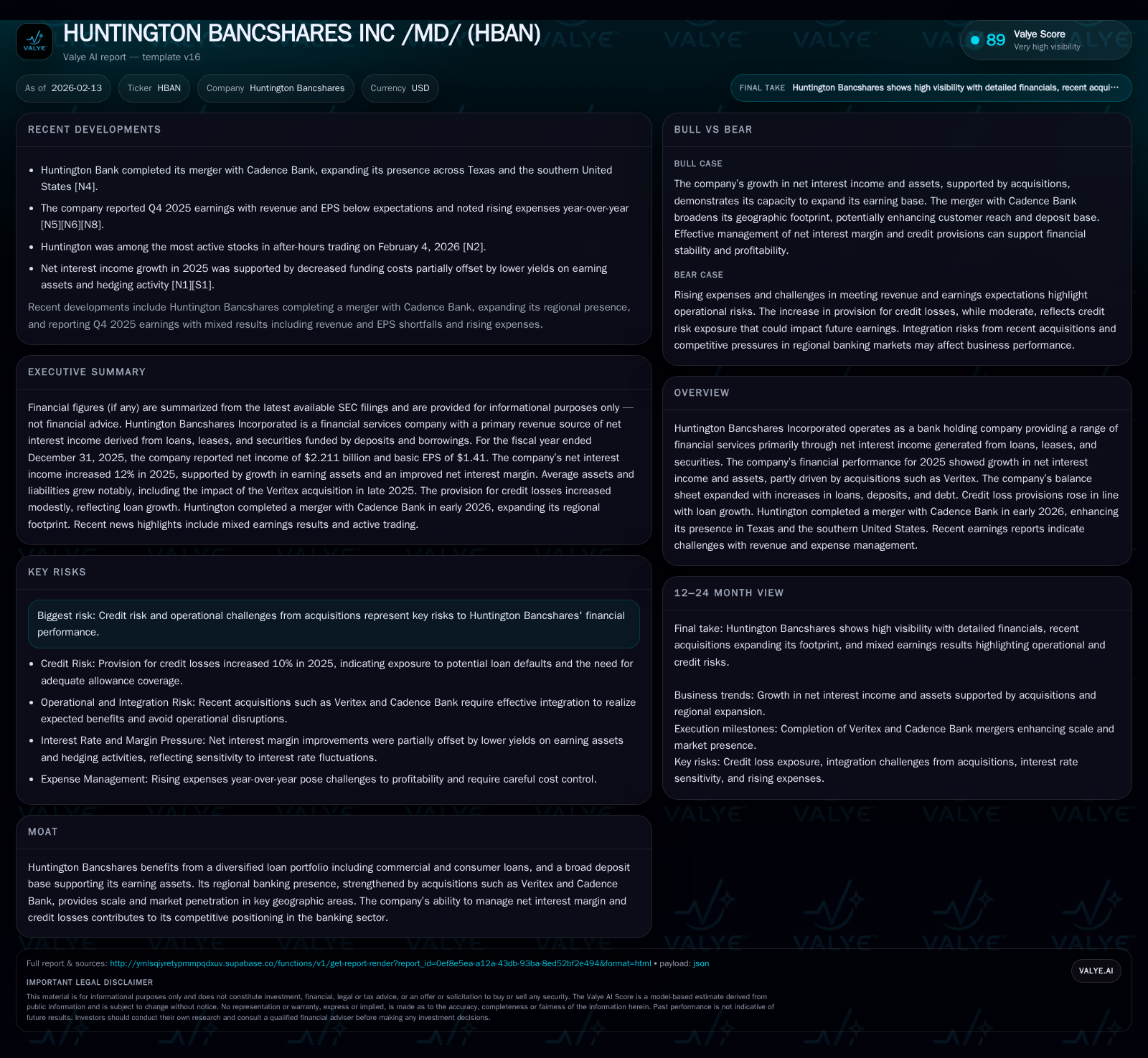
Huntington Bancshares has pursued aggressive regional expansion through acquisitions like Veritex and Cadence Bank, significantly boosting its loan portfolio and geographic footprint. Despite growth in net interest income fueled by these transactions, the bank faces margin compression and rising credit loss provisions amid a larger, more complex balance sheet. Operational expenses have escalated post-merger, challenging earnings momentum. Looking ahead, Huntington’s competitive moat relies on disciplined credit risk management and scaling efficiencies as it navigates integration risks and market pressures.
Setting the Stage: Huntington's Regional Ambitions and Recent Growth Trajectory
Huntington Bancshares Incorporated stands out as a dynamically scaling regional bank holding company whose core business model centers on generating net interest income through loans, leases, and securities. In recent years, its trajectory has been decisively shaped by strategic acquisitions designed to broaden both its asset base and geographic reach. A key development was the acquisition of Veritex Holdings in 2025, which added roughly $9.3 billion in loans — notably commercial real estate and industrial loans — sparking an approximate 15% increase in total loans year-over-year to $149.6 billion as of December 31, 2025 [S1]. This momentum continued with the completion of the merger with Cadence Bank in early 2026 [N8], which notably expanded Huntington's footprint throughout Texas and across the Southern United States.
This combination of organic growth plus acquisition-fueled expansion reflects a clear corporate agenda: elevating scale to compete robustly across fast-growing regional markets. The bank’s diversification across commercial industries alongside consumer lending provides it with dual engines fueling growth while supporting its earning asset base [S1]. However, these aggressive moves simultaneously created a more complex operational landscape requiring effective integration management.
Financial Performance Deep Dive: Net Interest Income Gains Amid Margin Compression
Huntington's financials for 2025 illustrate intriguing contrasts. Net interest income (NII), the primary revenue driver, rose primarily due to higher average earning asset balances supported by loan growth from acquisitions and internal origination efforts. According to SEC filings, average loan volumes rose significantly year over year, particularly within commercial & industrial loans that grew by $9 billion [S1]. This increase propelled total NII higher even as yields on certain asset classes eroded slightly.
Yet this rise was accompanied by net interest margin (NIM) compression — a classic tension point for banks expanding through acquisitions when newly acquired portfolios yield comparatively less or when funding costs rise. The reported NIM declined moderately because increased funding costs partially offset gains from asset growth [S1]. Moreover, shifts in loan mix toward lower yielding segments contributed to squeeze margins further.
Adding complexity were modest declines in yields on securities portfolios despite rising balances, highlighting ongoing challenges amid evolving interest rate environments [S1]. Analysts noted Huntington's fourth quarter earnings fell short of consensus estimates amid these margin headwinds alongside rising expenses [N2][N3]. These results underscore the challenge of sustaining profitability through scale while managing pricing pressures.
Acquisitions as Growth Engines: From Veritex to Cadence – Strategic Implications
The acquisitions of Veritex in 2025 followed by Cadence Bank early in 2026 serve as twin pillars underpinning Huntington’s strategy to build critical mass regionally. Veritex contributed a substantial loan portfolio mix featuring $4.2 billion of commercial real estate loans and $4.0 billion of commercial & industrial loans as of acquisition date [S1], enhancing Huntington’s exposure primarily in Texas markets where Cadence further solidifies presence.
The Cadence merger completion [N8] notably strengthens Huntington’s competitive position by granting access to new customer clusters across key southern metropolitan areas. Management framed this deal not simply as an addition of scale but as deeper market penetration enabling cross-selling opportunities across retail banking, commercial banking, and wealth services lines.
However, this rapid accumulation of assets carries implications beyond simple balance sheet expansion. Integrating credit cultures, aligning risk management frameworks, consolidating systems platforms, and harmonizing customer experience represent multi-year challenges that can constrain near-term financial performance.
Unpacking Credit Risk Management in an Enlarged Portfolio
Credit risk remains the fulcrum upon which Huntington balances growth ambitions against potential downside exposure. The company manages credit rigorously via independent credit administration functions connected tightly with risk monitoring controls aiming for moderate-to-low aggregate portfolio risk profile [S1]. Policies limit single borrower exposures based on perceived counterparty risk levels while controlling concentration through limits on loan type and industry sectors.
With loans growing 15% year-over-year to near $150 billion — driven heavily by commercial segments — the portfolio now carries elevated relative weightings in commercial real estate and industrial loans inherited from acquisitions [S1]. This places particular emphasis on early identification of problem credits while employing robust stress testing methodologies.
The firm also invests in technology-enabled quantitative risk measurement models incorporating external data sources along with internal stimulus testing scenarios simulating adverse macroeconomic conditions [S1]. Crucially, lending policies restrict extending additional credit to delinquent borrower accounts unless collateral coverage or repayment likelihood justifies exceptions.
These disciplined practices have historically allowed measured growth; however, sustaining this track record amidst rapid changes accompanying mergers remains a testing operational priority.
Expense Trends and Operational Challenges Post-Merger
Not all aspects of Huntington’s expansion story have been smooth sailing financially. The Q4 2025 earnings report highlighted rising operating expenses that pressured net income growth despite solid top-line trends [N3][N6]. Personnel-related costs swelled partly owing to onboarding staff from acquired entities alongside increased investments needed for systems integration.
Management candidly addressed these cost dynamics during their earnings call [N4], noting temporary elevations attributed largely to acquisition-related activities — IT platform consolidation, branch network rationalization efforts, compliance harmonization, and vendor contract alignments. They acknowledged these expenses weighed on quarterly results contributing materially to missing revenue and earnings per share consensus estimates reported earlier that week [N2][N3].
Beyond explicit cost increases lies the broader challenge inherent in realizing synergy targets promised at deal announcements: aligning organizational cultures at scale while maintaining day-to-day operational efficiency demands relentless focus.
Market Reaction and Investor Sentiment in Early 2026
Investor response following the fourth quarter earnings release illustrated the dynamic tensions between optimistic long-term prospects anchored by growth strategy versus short-term execution risks manifesting in missed metrics. HBAN exhibited notable volatility with elevated trading volumes persisting over several sessions post-release marking it among most active after-hours tickers multiple times between late January and early February 2026 [N10][N11].
The initial price reaction reflected dampened enthusiasm driven primarily by expense upticks combined with margin pressures flagged during investor calls [N2][N3]. Yet some market commentators contextualized this performance within industry-wide trends around regional banks grappling with similar post-merger expenditure cycles amidst flattening yield curves [N9]. The volume patterns signal investors carefully parsing management guidance on integration progress while weighing risks associated with expanded credit exposures.
The Moat Question: Competitive Strengths After Geographic Expansion
Notwithstanding near-term hurdles, Huntington’s underlying competitive advantages remain anchored by foundational strengths articulated clearly in its recent Valye report excerpt: a diversified loan portfolio spanning commercial & consumer segments; a broad deposit funding base supporting liquidity needs; and growing scale benefitting from strategic acquisitions enhancing regional market penetration [valye_report_excerpt].
By deepening geographic density especially within high-growth southern markets via Cadence Bank transaction plus bolstering existing franchise footprints internally complemented by Veritex asset addition earlier; Huntington reinforces barriers facing competitors seeking similar expansive reach without substantial capital outlays or time-consuming organic growth paths. This geographic scale additionally facilitates enhanced product distribution efficiency along with improved pricing flexibility within core lending categories.
Such assets form a moat around the business potentially insulating against competitors focusing narrowly on consumer-only or limited commercial niches—particularly important against backdrop of evolving regulatory scrutiny driving consolidation across mid-tier banking players.
Risks Ahead: Credit Concentration and Integration Headwinds
As evident from SEC disclosures coupled with Valye risk assessments [S1][valye_report_excerpt], major risks shadow Huntington’s path forward include elevated credit concentration primarily in commercial real estate given sizable holdings absorbed through acquisitions. While concentration limits guide exposures prudently overall; stress scenarios remain relevant given macroeconomic uncertainties around interest rates inflationary pressures impacting occupier demand within CRE sectors.
Operational complexity stemming from integrating two large organizations—each featuring distinct legacy technologies, compliance frameworks, operational workflows—compounds challenge arriving at seamless unified bank operations swiftly enough to meet synergy timelines without excessive cost overruns or service disruptions.
Heightened regulatory oversight also looms as increased systemic importance demands rigorous adherence across expanded network alongside continuous evolution surrounding capital adequacy thresholds post-deal closure requiring judicious balance between growth investment versus capital retention.
In sum, effective mitigation will require sustained focus blending quantitative risk controls embedded into credit approval processes with qualitative cultural alignment fostering proactive issue detection early.
Looking Forward: Strategic Priorities and Outlook for Sustainable Profitability
Huntington’s leadership conveys a pragmatic yet optimistic stance emphasizing priorities that hinge critically on margin restoration paired with ongoing disciplined credit quality maintenance viewed as non-negotiable pillars for long-run success [valye_report_excerpt][N4]. Management underscored commitment during Q4 earnings discussions towards realizing anticipated cost synergies progressively over coming quarters whilst prudently managing pipeline for new lending products calibrated carefully amid competitive pricing environment.
Leveraging expanded platform affords opportunistic cross-selling potential targeted at new customer segments unlocked via merger-enhanced reach furthermore secular trends around digital banking adoption present avenues for efficiency improvements reducing future expense ratios structured around technology investments made recently [N4].
Overall Huntington aims to convert momentum created through acquisitions into durable profitability advancements backed by vigilant risk governance framework governing credit decisions prioritizing portfolio resilience against fluctuating macro backdrop complicated further by geopolitical volatility impacting economic outlook broadly affecting banking sector fundamentals [N12][N13][N14].
Disclaimer: This analysis is based solely on publicly available information as of February 13, 2026. It is intended for informational purposes only and does not constitute investment advice or recommendations.
Disclaimer: This is research-only, informational analysis and not investment advice. It may include AI-generated interpretation and general industry context. Always verify important details using primary sources.

Comments