
HCA Healthcare: Scale, AI Integration, and Debt Dynamics Shaping Competitive Position
An in-depth analysis of HCA Healthcare’s operational breadth, AI-driven innovations, and financial leverage within today’s complex healthcare landscape.
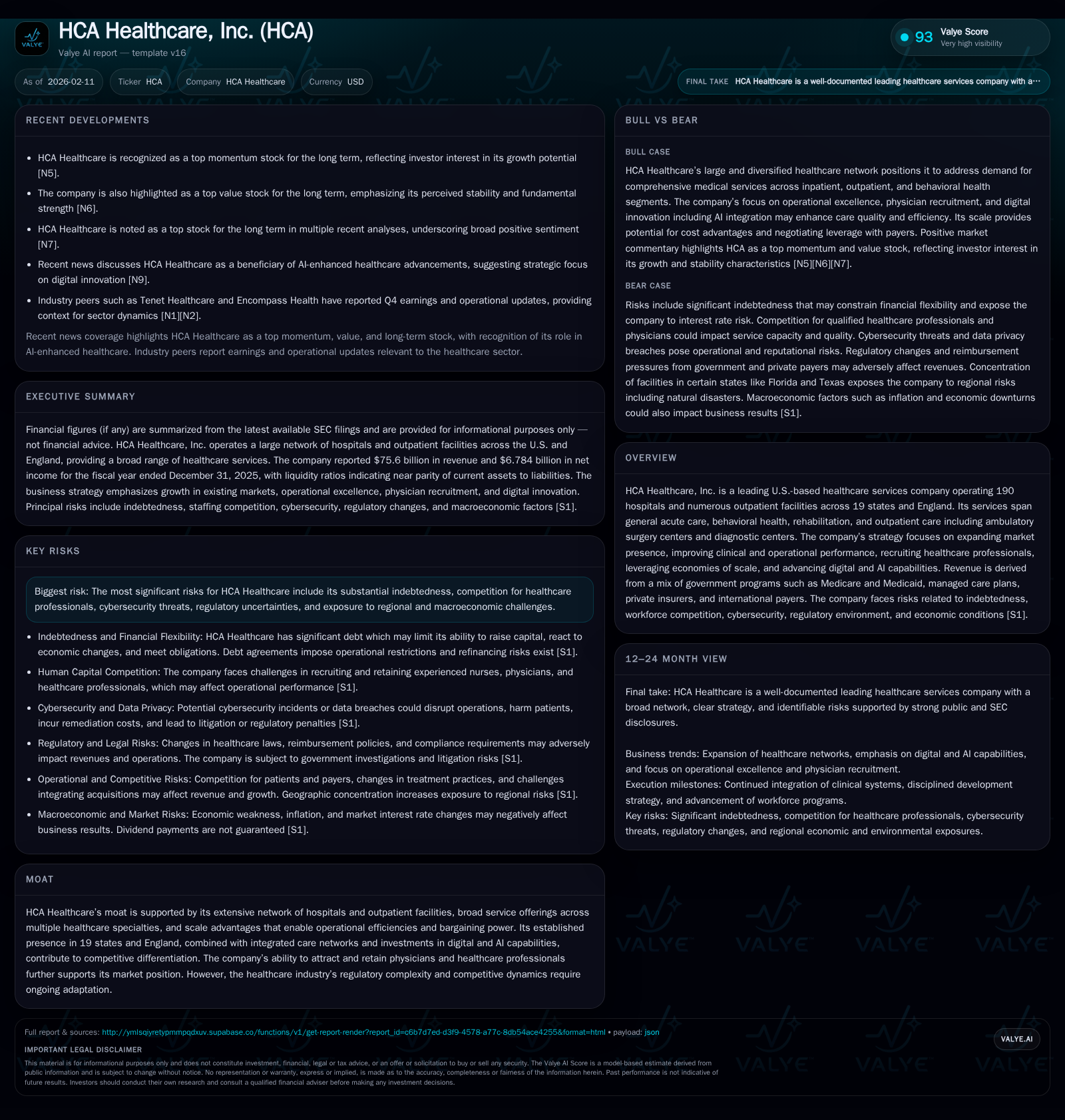
HCA Healthcare stands as one of the largest diversified healthcare providers in the U.S. and England with a vast network spanning 190 hospitals and multiple outpatient centers. Its strategic emphasis on digital transformation, particularly AI integration, marks it as an innovator among hospital operators. Nonetheless, its substantial indebtedness—exceeding $46 billion—casts a long shadow over its financial agility. The company navigates workforce competition and regulatory uncertainties while leveraging scale and technological investments to sustain its moat.
An Industry Titan’s Footprint: Network Scale and Service Breadth
HCA Healthcare’s operational footprint is a defining pillar of its competitive advantage. As of end-2025, it controlled an extensive network consisting of 190 hospitals—179 general acute care facilities alongside behavioral health and rehabilitation centers—spread across 19 states in the U.S. and continuing presence in England [S1]. This breadth spans critical healthcare specialties including cardiology, oncology, neurosurgery, orthopedics, and obstetrics supported by comprehensive diagnostic and emergency services.
Beyond inpatient care, HCA extends into outpatient domains operating 121 ambulatory surgery centers (ASCs) and 31 freestanding endoscopy centers. This diversified platform offers strategic integration enhancing patient convenience and driving operational synergies that deepen the company’s moat [S1]. With ancillary services from rehabilitation to home health agencies also woven into its ecosystem, HCA leverages scale economies not only to negotiate favorable payer contracts but also to maintain a formidable reach across care continuum sectors.
This wide-ranging infrastructure fortifies HCA's market positioning against regional competitors by enabling multi-site referrals and cross-service utilization—a concrete moat based on physical assets combined with service versatility.
Digital Transformation: AI Integration as a New Growth Vector
While physical scale underpins traditional strengths, HCA is pivoting decisively towards digital innovation as a differentiator within a maturing industry landscape. A recent deep-dive report hailed HCA as arguably the "real winner" in applying AI-enhanced technologies to healthcare services [N6]. This includes using machine learning algorithms for improved diagnostics accuracy, workflow optimization in emergency rooms, predictive analytics for patient outcomes, and automating administrative tasks.
The company’s official disclosures underscore investment not only in clinical AI applications but also broader digital tools that amplify operational efficiency and patient engagement [S1]. By modernizing data infrastructure across facilities within its integrated network, HCA creates scalable platforms for deploying cutting-edge solutions faster than less centralized rivals.
This strategic embrace of AI aligns with broader industry trends where providers seek to extract more value from patient data to raise care quality while managing costs—both critical levers for competitive differentiation that can sustain returns despite reimbursement pressures.
Financial Fortitude Under Pressure: Unpacking the Debt Load
Balancing innovation ambitions against financial realities is arguably HCA's most significant challenge given its substantial debt burden. As of December 31, 2025, total indebtedness stood at $46.492 billion—a towering sum accompanied by $5.779 billion availability under its senior unsecured credit facility after accounting for letters of credit [S1].
The ramifications are multifold: large interest payments require considerable cash flow dedication that could otherwise fund growth or cushion downturns; variable-rate exposure increases sensitivity to rising rates; refinancing risks loom amid volatile credit markets [S1].
Comparing debt with revenue gives perspective—HCA generated approximately $75.6 billion in revenue for fiscal year 2025 [F1] but maintains a current ratio below one (0.97), signaling thin short-term liquidity [F1]. This tight liquidity profile means operating cash flows must be carefully managed to meet obligations without compromising capital expenditures or acquisitions.
Additionally, repayment depends heavily on subsidiary cash flows which may face restrictions or external limits complicating intra-company fund transfers [S1]. Should refinancing terms deteriorate or economic headwinds intensify, the company would likely face hard choices around divestitures or curtailed investment.
Human Capital Dynamics: Navigating Talent Competition in Healthcare
Amid operational complexity lies the ongoing battle over human capital—a critical variable especially acute in healthcare. HCA openly acknowledges challenges in recruiting and retaining physicians, nurses, and specialized staff due to competitive pressures throughout the sector [S1].
This labor scarcity impacts not only service delivery but also clinical outcomes—a key metric influencing reimbursement rates under value-based care models.
HCA’s large-scale network provides some leverage in attracting talent through varied career opportunities and integrated employment models. Yet regulatory complexities around licensing, credentialing, and labor laws add friction that must be actively managed to sustain workforce robustness [S1]. Maintaining quality staff remains essential to underpin both brand reputation and execution of advanced digital care models.
Regulatory Crosswinds and Market Risks: An Uneasy Operating Climate
No analysis would be complete without acknowledging an ever-shifting regulatory landscape posing unpredictable risks. Medicare/Medicaid payment reforms frequently alter reimbursement parameters impacting margins directly [S1]. Additionally, cybersecurity threats grow more sophisticated targeting sensitive patient data repositories within HCA’s extensive digital systems.
Regional macroeconomic factors—from inflationary wage pressures to local policy shifts—introduce volatility across their geographic footprint [S1]. Despite benefits from scale diversification across states and England, these external variables require continual adaptive strategies to avoid financial disruption.
The combined effect of these market crosswinds means that even a titan like HCA must remain vigilant amid sector upheaval marked by policy uncertainty and cyber risk exposure.
Profitability and Cash Flow: Metrics Behind the Numbers
HCA’s financial performance reflects solid profitability standing amidst these challenges. For fiscal 2025 revenue totaled approximately $75.6 billion while net income reached $6.78 billion indicating robust margins for a hospital operator [F1].
However, scrutiny beneath headline profits reveals constrained liquidity—cash plus equivalents tally roughly $1 billion against current liabilities approaching $16.35 billion yielding suboptimal current ratio near 0.97 [F1]. This signals potential pressure points on working capital management requiring efficient receivable collections and inventory control.
Further complicating reinvestment potential is the need to allocate substantial cash flow toward servicing debt interest—which could limit capacity for strategic capital projects or acquisitions during tighter economic cycles [S1]. The company must thus prioritize disciplined cash flow management while pursuing growth avenues.
Peer Comparison: Positioning HCA Amidst Hospital Operators
When measured against peers in hospital operations space characterized by fluctuating patient days and pronounced earnings volatility (e.g., Tenet Healthcare facing patient day declines) [N1], HCA’s momentum stands out positively.[N8] Analysts highlight its blend of 'top momentum' with underlying fundamentals appealing both as growth-oriented and value stock given scale advantages coupled with ongoing efficiency gains [N9][N10].
Moreover, HCA's lead in integrating AI contrasts favorably against competitors slower to adopt advanced digital solutions offering potentially superior future clinical outcomes and cost structures [N6]. Its size creates barriers newcomers cannot easily surmount — making it a formidable incumbent within an industry experiencing margin compression elsewhere.
Yet this relative strength does not fully immunize HCA from systemic risks like workforce shortages or regulatory shocks common across providers — reiterating the importance of nuanced operational agility alongside sheer scale benefits.
Strategic Outlook: Opportunities, Challenges, and Adaptive Maneuvers
Looking ahead, HCA Healthcare's trajectory hinges on balancing ambitious initiatives with grounded risk management. The company targets expanding market presence more deeply through acquisitions or greenfield developments while intensifying AI/digital investments geared toward clinical differentiation [S1][N13]. These moves promise enhanced patient experiences coupled with operational optimization—a compelling formula amid increasing healthcare consumerism.
Concurrently though substantial debt demands vigilant financial discipline particularly around refinancing cycles amidst uncertain macroeconomic climates [S1]. Workforce retention efforts must evolve dynamically given labor market tightness threatening consistent service delivery quality.
Overall, HCA exemplifies a complex ecosystem where physical infrastructure advantages mix with technological innovation inside a framework constrained by leverage-induced caution—the quintessential duality modern hospital operators face when translating scale into sustainable competitive edge.
Disclaimer: This analysis is informational only and does not constitute investment advice or recommendations regarding HCA Healthcare securities or any other financial instruments.
Disclaimer: This is research-only, informational analysis and not investment advice. It may include AI-generated interpretation and general industry context. Always verify important details using primary sources.

Comments