
Huntington Ingalls Industries: Anchoring U.S. Naval Dominance with Shipbuilding Legacy and Advanced Defense Technologies
Exploring HII's strategic position as America's largest naval shipbuilder alongside its rising Mission Technologies segment amid evolving defense priorities.
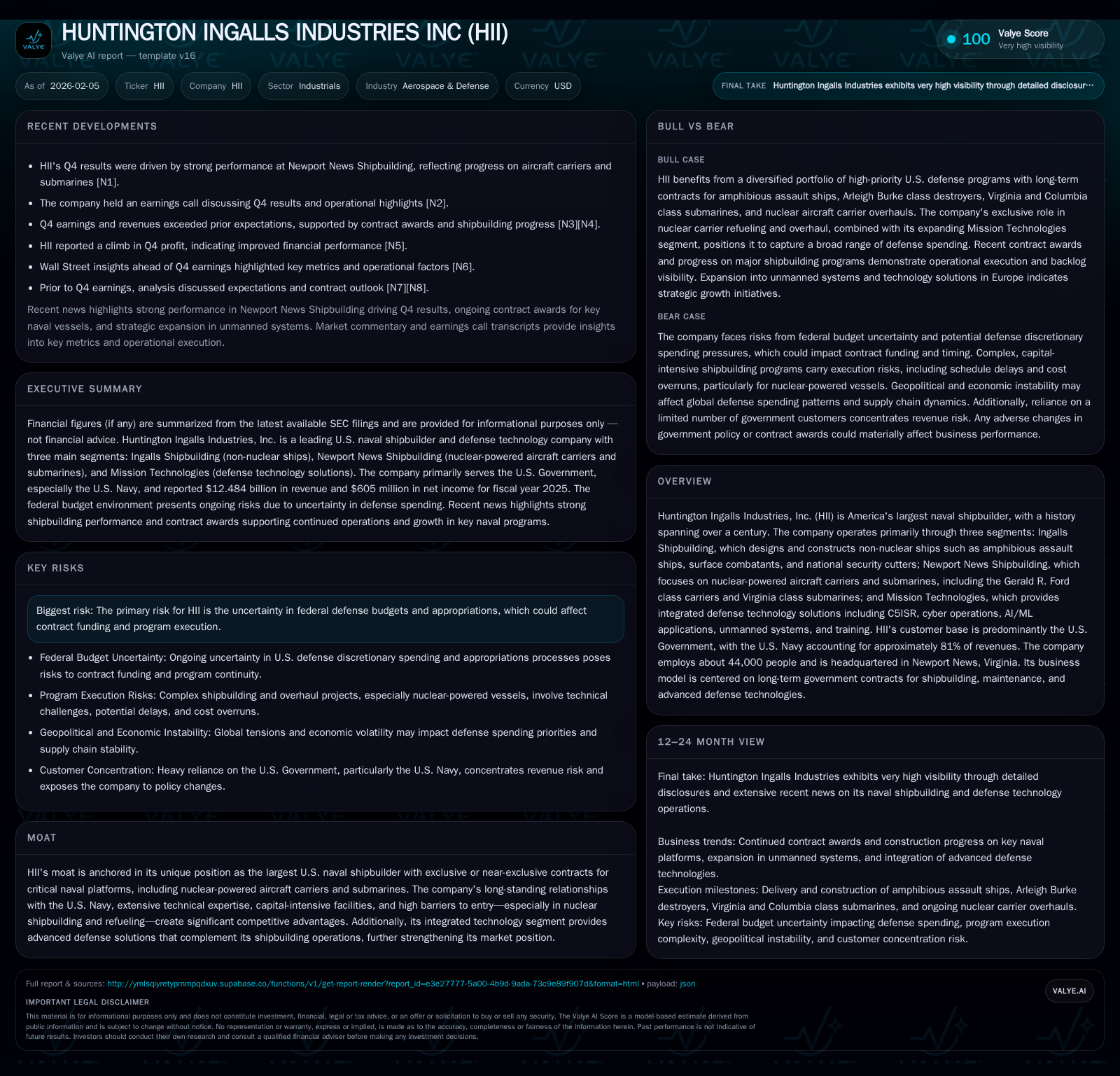
Huntington Ingalls Industries (HII) stands as a century-strong pillar of American naval power, uniquely positioned through its dual shipbuilding segments—Ingalls for non-nuclear and Newport News for nuclear vessels—and an emerging footprint in integrated defense technology via Mission Technologies. Despite a turbulent 2025-2026 political and economic environment, including inflationary pressures and supply chain challenges, HII reported solid Q4 2025 financials driven by strong Newport News performance. Its moat is deeply entrenched in high barriers to entry, exclusive government contracts, and a skilled workforce, although fiscal uncertainties and policy shifts remain ongoing risks. The company is navigating these headwinds while aligning with federal priorities that favor domestic production and technological innovation.
Forging America’s Naval Power: HII’s Century of Shipbuilding Excellence
Tracing its roots back over a hundred years, Huntington Ingalls Industries is emblematic of America’s sustained commitment to maritime supremacy. The company’s stature as the largest U.S. naval shipbuilder arises from an expansive portfolio that spans more ship types than any competitor. This pedigree anchors the company's unrivaled expertise in crafting both non-nuclear vessels like amphibious assault ships under the Ingalls banner, and nuclear-powered leviathans at Newport News such as aircraft carriers and submarines[S1].
HII's headquarters at Newport News, Virginia serve as the operational heart for this capital- and labor-intensive endeavor where skilled craftsmanship meets complex engineering challenges. The company employs approximately 44,000 people committed to sustaining the U.S. Navy’s global presence through delivery excellence[F1]. This legacy is not merely historical but forms the foundation of a business model distinctly tailored to meet evolving national security imperatives.
Dual-Track Growth: Synergies Between Ingalls and Newport News Segments
HII’s operations exhibit a complementary dual-track growth engine balancing Ingalls’ expertise in non-nuclear surface vessels with Newport News' domain in nuclear propulsion technology. Ingalls Shipbuilding specializes in designing and constructing amphibious assault ships—including LHA class vessels—and surface combatants critical for Expeditionary Strike Groups[S1]. It is noteworthy that Ingalls holds unique positions such as being the sole builder of amphibious assault ships.
Conversely, Newport News crafts titans of sea power: Gerald R. Ford class aircraft carriers and Virginia class nuclear submarines constitute its core offerings[N1][S1]. Recent Q4 2025 results underscore Newport News’ pivotal role with robust performance driving overall earnings outperformance[N1][N3][N4]. The intense capital requirements for maintaining nuclear shipbuilding capacity combined with specialized labor skills create mutual reinforcement across segments—each feeding into cross-divisional efficiencies.
Mission Technologies: Bridging Traditional Shipbuilding with Digital Warfare
Beyond steel hulls lies HII's increasingly significant Mission Technologies segment. It functions as the nexus where traditional naval capabilities integrate with cutting-edge defense technologies. Offering C5ISR solutions—command, control, communications, computers, cyber intelligence, surveillance, reconnaissance—and cyber operations capabilities position this segment as vital to all-domain awareness.
Emphasizing artificial intelligence / machine learning applications applied to battlefield decision-making processes alongside unmanned autonomous systems elevates HII beyond classical ship construction[S1]. These digital warfare capabilities complement physical platforms by enabling enhanced situational understanding and autonomous mission profiles—a crucial advantage given modern multi-domain threat environments.
2025-2026 Political-Economic Landscape: A Turbulent Backdrop for Defense Manufacturing
The political landscape during 2025-2026 remains marked by heightened polarization coupled with intermittent fiscal disruptions—including a historical 43-day government funding lapse—that have complicated long-term planning[S1]. The "America First" doctrine has pushed for reshoring critical manufacturing capabilities emphasizing industrial resilience amid ongoing global geopolitical tensions.
Defense spending benefits from bipartisan consensus aimed at preserving U.S. military technological superiority despite broader macroeconomic volatility like inflationary pressures and elevated interest rates. Supply chains reorganize around diversified suppliers fostering greater vertical integration to reduce external vulnerabilities[S1]. Labor markets pose persistent hurdles seen via shortages impacting throughput; HII addresses these via talent acquisition initiatives in collaboration with community colleges and apprenticeships.
Financial Deep Dive: Q4 2025 Earnings and Operational Highlights
Q4 2025 marked a strong quarter for Huntington Ingalls Industries with revenues reaching $12.48 billion and net income climbing to approximately $605 million[F1][N12], surpassing market expectations substantially[N3][N4]. This performance was largely propelled by Newport News’ accelerated delivery cadence of nuclear vessels setting margin resilience despite inflationary input cost challenges.
Operational liquidity remains sound with a current ratio near 1.13[F1], indicating balanced working capital management amid pressure from higher raw material prices and longer supplier lead times due to labor market tightness[S1]. The company strategically balances contract execution velocity alongside prudent inventory buildup to mitigate supply disruptions.
Navigating Supply Chain & Labor Headwinds in a Complex Industrial Environment
Shipbuilding’s inherently capital- and skill-intensive nature compounds industry-wide labor constraints[S1]. Persistent labor shortages in specialized trades have necessitated aggressive talent development strategies including apprenticeship programs targeted at younger demographics alongside partnerships with local educational institutions.
Supply chain complexities extend beyond labor shortages to encompass material scarcity exacerbated by inflationary pressures causing price escalations and delayed deliveries[S1]. To counteract these risks the company diversifies supplier pools while investing in advanced manufacturing technologies aimed at streamlining production processes within domestic facilities.
Federal Budgeting and Acquisition Dynamics Impacting Naval Programmes
Defense appropriations remain robust heading into FY26 with the National Defense Authorization Act authorizing over $900 billion in national security spending[S1]. A significant portion—approximately $26 billion—is allocated explicitly for shipbuilding programs directly aligned with HII’s backlog franchises.
Key funded platforms include multiple Virginia-class fast attack submarines (SSN 774), Arleigh Burke-class destroyers (DDG 51), Columbia-class ballistic missile submarines (SSBN 826), along with continued investment in Gerald R. Ford-class aircraft carriers such as CVN 78[S1]. Moreover, procurement authorities enabling incremental funding advances for future hulls provide revenue visibility foundational to long-term project planning.
Competitive Moat: Capital Intensity, Expertise, and Government Exclusivity
Huntington Ingalls Industries’ moat is anchored deep within its rarefied niche as the sole or near-exclusive provider of critical naval platforms[S1]["valye_report_excerpt.moat"]. Nuclear shipbuilding remains a fortress protected by extremely high barriers including stringent regulatory frameworks governing nuclear safety, demanding technical acumen accumulated over decades, vast physical infrastructures worth billions of dollars, plus an entrenched skilled workforce difficult to replicate.
Exclusive government contracts further cement this position whereby the U.S. Navy serves as both dominant customer (accounting for roughly 81% of revenues) yet also gatekeeper within a tightly controlled industrial base[S1]. Such exclusivity dramatically mitigates competitive intrusion while driving specialization synergies between design innovation and program execution.
Risks and Opportunities: Fiscal Constraints, Policy Shifts, and Technological Innovation
Notwithstanding structural advantages there exists palpable risk stemming from federal budget uncertainties inherent in political dynamics affecting appropriations approval processes[S1]["valye_report_excerpt.risks"]. Contract delays or funding reductions could materially impact execution timetables given HII's dependence on government spending.
Inflationary pressures heighten input cost risk negatively influencing margins absent successful cost pass-throughs or efficiency gains. Conversely strategic investments targeting emerging defense priorities such as hypersonics research initiatives or expanded applications of AI-powered unmanned systems represent opportunity pathways enhancing future margin expansion potential.[S1]
In navigating this complex milieu HII leverages its long-term relationships alongside continuous innovation efforts bridging traditional shipyard craftsmanship with digital-age defense solutions—positioning itself firmly at the confluence of enduring heritage and forward-looking modernization.
This analysis reflects information available up to early February 2026 based on public filings including SEC Form 10-K/S-1 reports alongside recent news coverage from credible industry sources. It aims to provide an informed perspective on Huntington Ingalls Industries’ strategic posture without offering investment advice or recommendations.
Disclaimer: This is research-only, informational analysis and not investment advice. It may include AI-generated interpretation and general industry context. Always verify important details using primary sources.

Comments