
HIVE Digital Technologies Advances Hashrate Capacity Amid Regulatory Challenges
HIVE's latest quarter highlights operational scale-up in Bitcoin mining and HPC expansion alongside ongoing tax dispute dynamics.
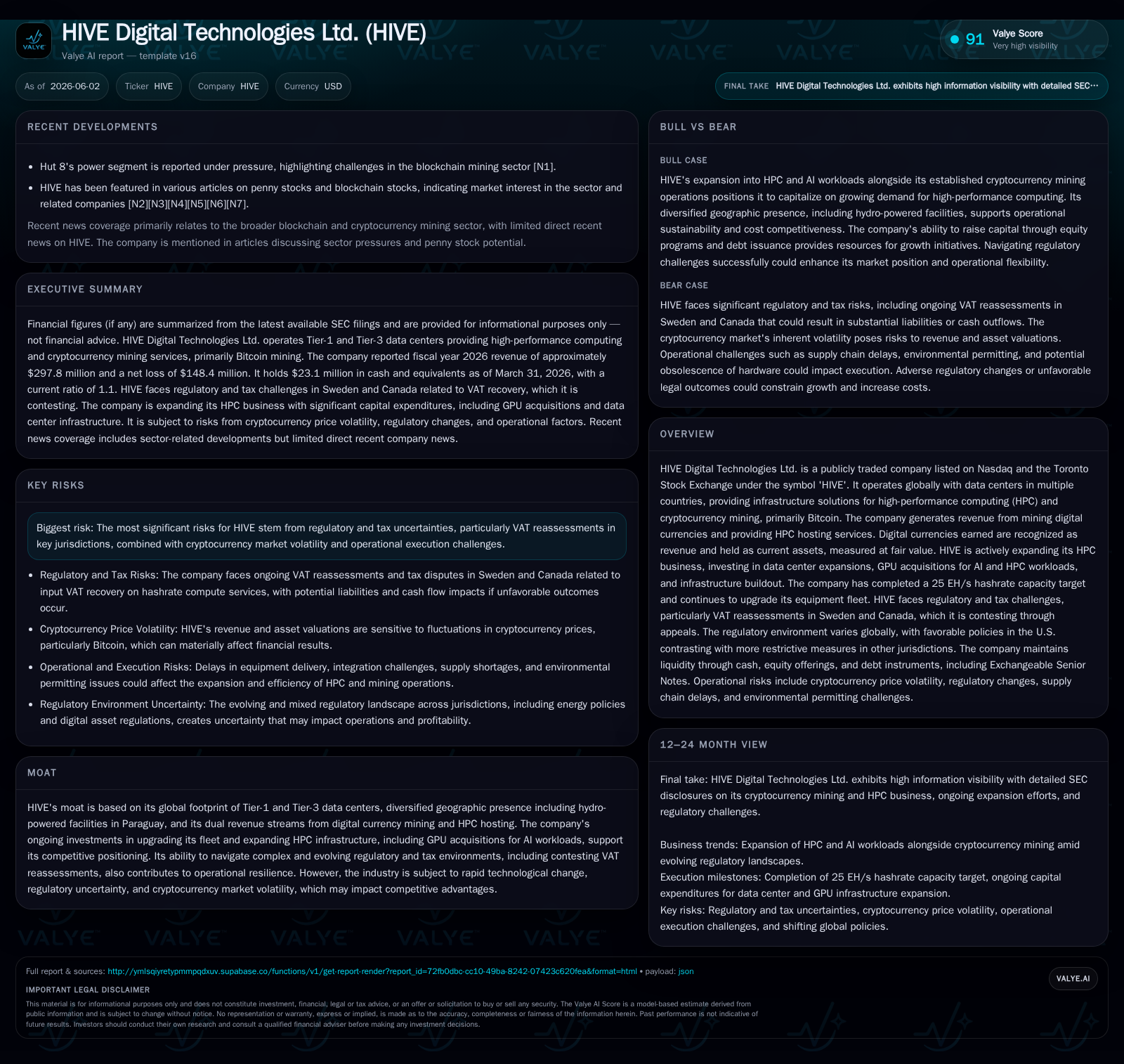
In its March 2026 quarter, HIVE Digital Technologies reached its targeted 25 EH/s Bitcoin mining hashrate capacity, reinforcing its position among global digital asset miners. Alongside mining, the company continues expanding its high-performance computing (HPC) services through strategic data center land acquisitions and GPU deployments tailored for AI workloads. However, regulatory headwinds persist, with VAT reassessments in Sweden and Canada posing potential financial uncertainty that the company actively contests. HIVE’s geographic diversification, hydroelectric-powered operations, and multi-use Tier-I data centers underpin its competitive moat, while liquidity and limited debt provide a stable base for further growth execution.
Quarterly Operating Update Highlights New Hashrate Milestone
HIVE Digital Technologies Ltd.'s latest quarterly filing as of March 31, 2026, reveals the completion of a key strategic operating milestone: achieving a Bitcoin mining hashrate capacity of 25 exahashes per second (EH/s) [S2][F1]. This capacity level not only reflects significant scale but indicates that substantial capital investments in mining equipment and infrastructure have come into productive operation. The enhanced hashrate capacity directly impacts revenue since digital currencies mined are recognized at fair value upon earning, thus coupling operational efficiency to top-line performance [S5]. The Q4 fiscal 2026 also witnessed solid cash generation from core operating activities with net operating cash inflows reaching $62 million year-over-year, a substantial increase from prior periods that underscores improved mine efficiency and operational maturation [S6].
Alongside the mining business, HIVE maintains a growing footprint in high-performance computing (HPC) services. HPC hosting revenues have nearly doubled compared to the prior year, supported by investments in GPU fleets tailored to AI/ML applications [S16]. This dual focus on compute-intensive workloads diversifies revenue profiles beyond volatile cryptocurrency markets.
Dual Revenue Model: Cryptocurrency Mining Meets High-Performance Computing Services
HIVE's business model is distinguished by two principal revenue streams: cryptocurrency mining—predominantly Bitcoin—and HPC infrastructure hosting [S1]. Revenue generation from mining stems from securing digital currencies through computational work; these mined coins are immediately accounted for at fair market value and held as current assets subject to price fluctuations
Complementing this is a strategically expanding HPC segment hosting GPUs optimized for AI workloads. Recognizing the increased demand for AI-ready computing, HIVE is investing heavily in infrastructure capable of supporting high-density GPUs within Tier-I data centers that support both traditional cloud workloads and more specialized compute tasks [S1]. This infrastructure duality underpins HIVE's value proposition as it mitigates reliance on any singular market segment while capturing growing HPC demand driven by artificial intelligence development.
The company's acquisition of contiguous land parcels totaling around 33 acres near Ontario's Toronto-Waterloo innovation corridor—with a combined power allocation of 320 MW—signals commitment to scaling this HPC business line [S9]. Such power capacity is critical given the energy-intense nature of both cryptomining and high-density GPU hosting.
Competitive Positioning Enabled by Global Data Center Footprint and Energy Sourcing
HIVE operates a geographically diversified network of data centers across multiple countries including hydro-powered facilities in Paraguay. This gives it a competitive edge over sector peers who often face higher energy costs and carbon emission considerations by relying on fossil fuels or less sustainable energy sources [S1]. Hydro-powered sites not only reduce operational expenses but enhance ESG credentials increasingly valued by customers and investors alike.
The company's portfolio comprises both Tier-I and Tier-III data centers enabling progressive infrastructure upgrades towards higher operational reliability and workload flexibility. Such tier classification standard supports a wide spectrum of technical requirements—from dedicated Bitcoin mining rigs to advanced cloud or AI workloads—strengthening customer retention through ecosystem versatility.
This multi-jurisdictional presence also dilutes regulatory risk exposures on a geographic basis but incurs complexity as local tax administrations impose differing interpretations on VAT recovery eligibility for blockchain-based compute activities.
Regulatory and Tax Risks Focused on VAT Reassessments in Sweden and Canada
A salient challenge confronting HIVE arises from tax authorities' reassessment practices tied to VAT input recovery claims in Sweden and Canada. These jurisdictions have scrutinized whether blockchain-based hashrate services qualify under existing tax frameworks for input VAT recovery typically afforded to other data processing or cloud services [S1].
The Swedish Tax Authority (Skatteverket) has issued retrospective decisions reallocating VAT eligibility for certain operations that include Bitcoin mining hosted at Tier-I data centers. Similar audit activity in Canada targets federal GST/HST and provincial sales taxes such as Quebec’s QST related to digital asset mining operations [S1]
HIVE currently holds no material provision against these claims based on management’s assessment that favorable rulings remain probable. The company continues litigation and administrative appeals asserting alignment with statutory law. However, unfavorable outcomes could prompt substantial repayment demands inclusive of interest or penalties, driving working capital pressures or curbing reinvestment capacities [S1].
Such regulatory uncertainties reflect wider sector dynamics where emerging taxes lag behind rapid technological evolution, complicating capital planning amid potentially inconsistent enforcement practices.
Growth Drivers Anchored in Infrastructure Expansion and GPU Deployments for HPC AI Workloads
Looking ahead, HIVE’s growth trajectory is anchored by ongoing capacity expansions both within its cryptocurrency mining operations and more prominently within HPC services targeting AI workloads [S9]. Recent land acquisitions near Toronto enable large-scale data center development equipped with ample power allocations suited for dense GPU racks essential to AI model training and inference workloads
Investment plans include upgrading existing Tier-I facilities toward Tier-III standards offering increased uptime guarantees demanded by enterprise clients. Enhanced cooling technologies typically incorporated during such upgrades improve energy efficiency crucial for cost containment given the magnitude of electrical consumption associated with these computing tasks.
On the equipment front, timely procurement and deployment of GPUs align with accelerating AI adoption rates worldwide. Efficient GPU utilization rates translate directly into higher margin potential within HPC hosting services compared to lower-margin conventional cloud offerings—a differentiation partially leveraged by specialist providers like HIVE.
Lastly, sustained capex intensification signals confidence in capturing structural demand shifts rather than purely speculative expansion stemming from transient market conditions.
Key Risks: Regulatory Outcomes and Cryptocurrency Market Volatility as Top Watchpoints
Two primary risk clusters merit focused attention: regulatory tax disputes and market volatility tied to cryptocurrency prices. Uncertainty around VAT reassessments creates contingent liabilities that may impact future cash flow stability depending on judicial outcomes [S1]. The timing of final resolutions remains uncertain but affects strategic decisions around capital allocation particularly when paired with intense capital expenditure requirements.
Simultaneously, dependency on Bitcoin price movements introduces earnings volatility inherent to mining revenues recognized at fair value each period. Downward price trends compress margins since operational inputs such as electricity are largely fixed short term. While diversification into HPC services reduces concentration risk, these newer segments are still characterized by competitive pressures requiring efficient scale scaling and technology upgrades.
Operational execution risks also exist related to integrating newly acquired sites or deploying advanced hardware technologies while maintaining service reliability demanded by enterprise clients.
What to Watch Next: Demand Signals, Tax Appeal Outcomes, and Capital Deployment Execution
Market participants should closely monitor forthcoming quarterly updates detailing hashrate utilization developments alongside changes in Bitcoin network difficulty—itself an indicator of miner competition intensity influencing profitability margins [S2][S3]. Additionally, judicial or administrative rulings regarding VAT claims especially in Sweden could materially affect working capital outlooks as well as reinvestment pace.
Execution milestones around breaking ground on new data center builds near Toronto-Waterloo innovation corridor will provide signals about infrastructure scale advancement alongside updates on GPU fleet expansion metrics within HPC lines. Any revisions or guidance commentary linked to capital spending budgets will also merit scrutiny given their direct bearing on medium-term growth sustainability.
Financial Condition Snapshot: Operating Cash Flows, Liquidity, and Capital Spending Trends
At fiscal year-end March 31, 2026, HIVE reported $23 million in cash and equivalents against modest total debt approximated at $2 million resulting in negative net debt positioning—a signifier of conservative leverage posture amid expansion efforts [F1]
Overall financial discipline coupled with careful capital allocation aligns with strategic imperatives emphasizing scaling productive assets while retaining liquidity buffers amidst regulatory uncertainties.
This report reflects analysis grounded exclusively in publicly available SEC filings dated up to June 2, 2026. It does not constitute investment advice but aims to provide an informed industry perspective balancing operational advancement against regulatory complexities critical for stakeholders following HIVE Digital Technologies Ltd.'s evolving footprint.
Disclaimer: This is research-only, informational analysis and not investment advice. It may include AI-generated interpretation and general industry context. Always verify important details using primary sources.

Comments