
Hallmark Venture Group's Latest Financial Struggles and Structural Changes
Hallmark Venture Group faces acute liquidity constraints and governance shifts that cloud its operational outlook amid sparse public disclosure.
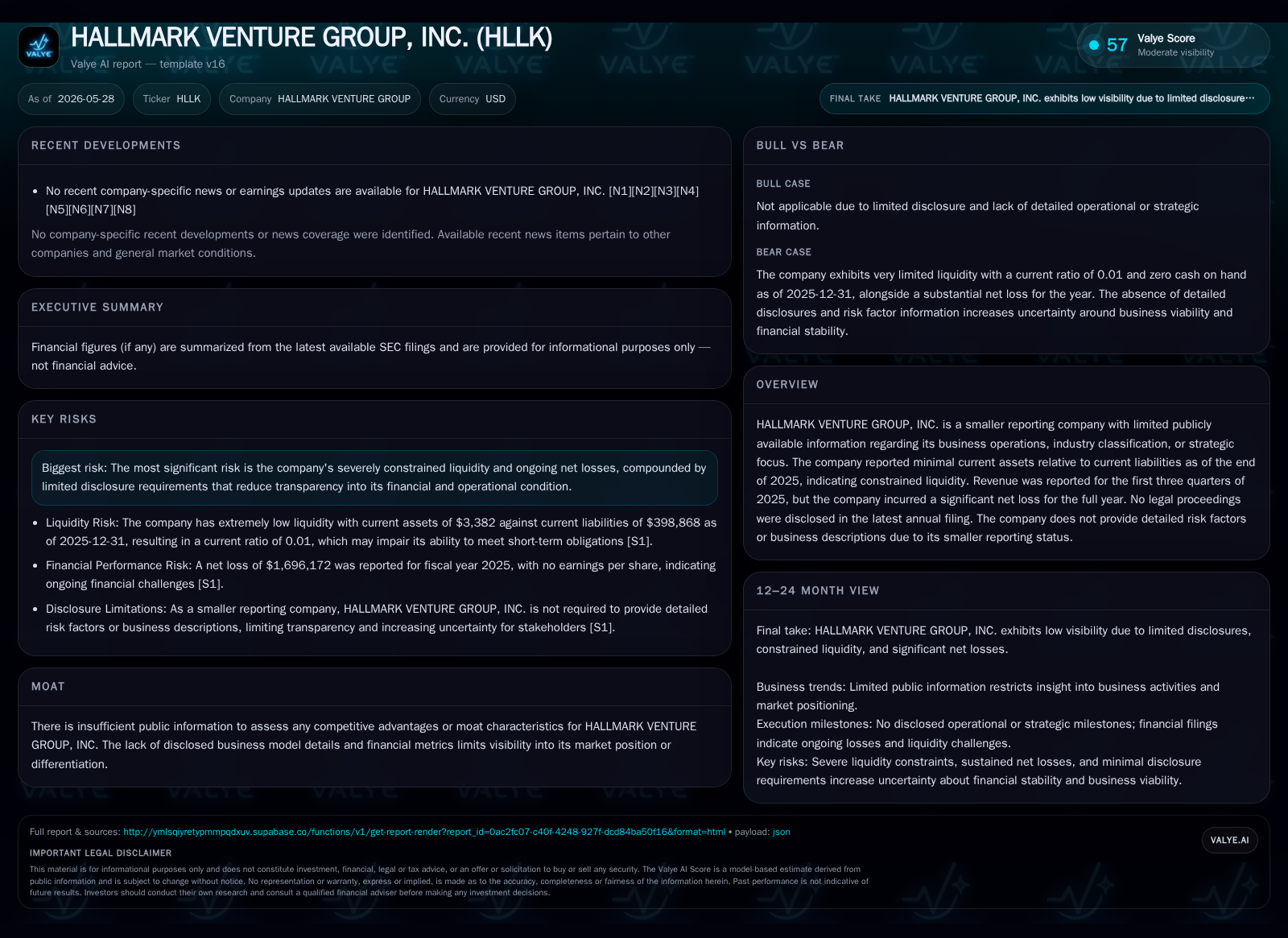
Hallmark Venture Group's latest 10-Q filing in November 2025 highlights severe liquidity stress with a current ratio near 0.01, zero cash reserves at year-end, and growing net losses deepening its financial distress. Concurrently, a May 2025 change in control and board composition reflects significant internal restructuring, complicating the company's strategic trajectory. Limited public disclosure owing to its smaller reporting status obscures a clear understanding of business operations, competitive positioning, or growth prospects. Investors should monitor forthcoming filings closely for clarification on liquidity management and strategic direction.
Latest Quarterly Update: Escalating Liquidity Concerns and Operational Losses
In its most recent quarterly filing dated November 20, 2025 ([S2]), Hallmark Venture Group disclosed a dire liquidity situation marked by an extraordinarily low current ratio near 0.01. The company's reported current assets stood at just $3,382 against current liabilities close to $398,868 as of December 31, 2025 ([F1]). Most notably, the cash and equivalents balance was zero, indicating no readily available liquid funds to meet short-term obligations or support ongoing operations ([F1]).
This imbalance exacerbates funding risk especially for a company with minimal publicly disclosed operations. Moreover, Hallmark reported a net loss of approximately $1.7 million for the fiscal year ended December 2025, a stark deterioration from modest profitability in the prior year ([F1]). This financial hemorrhaging signals widening operational losses despite prior gains seen through FY2024.
Alongside these financial stresses, May 2025 events revealed significant leadership transactions where control shifted decisively from Evan Bloomberg to Paul Strickland through preferred share and membership interest exchanges ([S6]; [S11]).
Business Model Overview: Unpacking Ambiguity in Hallmark Venture Group’s Activities
The company's latest amended annual report ([S1]) provides scant detail about the nature of Hallmark’s business activities or any substantive description of products or revenue streams. As a smaller reporting company under SEC regulations, Hallmark is not mandated to disclose extensive business or risk factor information. Consequently, there is limited visibility into who pays for what services or products the company offers.
This opacity creates challenges in assessing revenue mechanics such as pricing models, volume drivers, customer concentration, contract terms, or switching costs. The only reported revenue figure available is from FY2024 at approximately $610K; however, no further granularity is offered regarding customer segments or end markets ([F1]; [S1]). Without knowing whether Hallmark operates as an investment vehicle, service provider, or technology venture entity, it is difficult to benchmark its operating model meaningfully.
Industry Dynamics: Peer Benchmarking and Competitive Context Amid Sparse Disclosure
Absent explicit details on distribution channels or product differentiation strategies for Hallmark, it is reasonable to infer structural vulnerabilities in market positioning due to restricted investment capacity and absence of identifiable competitive moats (). Such dynamics heighten sensitivity to external shocks and constrain long-term growth options.
Growth Opportunities: Potential Paths in an Unclear Operating Environment
Post-May 2025 ownership restructuring through assignment of Jubilee Intel LLC membership interests hints at potential asset realignment strategies within Hallmark's portfolio ([S6]). The transfer exchanged full ownership of Jubilee Intel LLC for series A preferred shares controlled by Paul Strickland’s affiliated entity—enabled by governance reshuffling documented in subsequent filings ([S11]).
This transaction could mark an inflection where Hallmark consolidates focus under new leadership aiming to reposition assets or enter different arenas compatible with its funding capabilities. However, given severe cash constraints and operational losses exceeding $1.6M in FY2025 ([F1]), any growth would likely require either capital injection or value creation through leverage of existing holdings.
Strategic clarity remains elusive absent further disclosures. Nonetheless, if new control holders implement operational efficiencies or pursue acquisition opportunities within niche venture domains aligned with their expertise, modest recovery potential might ensue contingent on external financing availability.
Key Risks and Constraints: Addressing Financial Fragility and Transparency Gaps
Hallmark’s most salient risk factors center overwhelmingly on financial fragility compounded by minimal transparency mandates as a smaller reporting company ([S1]; [S2]). The balance sheet depicts declining equity standing at almost negative $400K at end-2025 reflecting cumulative retention deficits even after previous operating income swings positive briefly during FY2024 ([F1]).
Operating cash flow remains persistently negative (-$150K in FY2025), emphasizing recurring funding gaps detracting from sustainable operations ([F1]). Zero cash reserves further intensify emergency liquidity concerns that may precipitate creditor action or restrictive covenants imposed by existing debt holders reporting total debt approximating $217K as of Q1 2025 ([F1]).
Additionally, governance turbulence revealed by rapid director removals and reappointments within weeks during May 2025 injects uncertainty regarding strategic consistency and managerial stability impacting investor confidence ([S11]). The lack of explicit risk disclosures leaves outside parties without adequate early warning signals around commercial viability or regulatory exposure.
Maintaining operations without external financial support appears tenuous absent defined corrective measures forthcoming from management’s future disclosures.
Governance and Structural Shifts: Impact of Recent Control Changes
An unusual sequence unfolded in early May 2025 when majority shareholder Evan Bloomberg exercised voting control over the preferred series to remove key directors including Paul Strickland temporarily before reinstating him shortly thereafter alongside an assignment transaction involving a wholly owned subsidiary ([[S6]; [S11]]).
This complex choreography resulted in Strickland regaining his positions as President and Secretary while concurrently consolidating voting control via Selkirk Global Holdings LLC—the entity controlled by him—which acquired Bloomberg’s preferred shares position ([S6]). Bloomberg subsequently resigned entirely from the board.
These moves represent a significant shift concentrating operational authority into Strickland’s hands alone. While this might streamline decision-making under stressed conditions, it raises questions about independent oversight robustness as control blocks concentrate dramatically with a sole officer/director controlling both management roles and voting decisions.
Next Steps for Investors: Critical Milestones and Upcoming Filings to Monitor
Investors should prioritize monitoring upcoming quarterly reports (future Form 10-Qs) alongside any definitive proxy statements or event-driven Form 8-Ks.
Key developments to watch include updated disclosures on liquidity and any strategic initiatives potentially tied to recent membership interest disposals; changes in board composition enhancing independence; plus progress towards returning to profitability or improving cash flow generation ([S2]; [S7]).
Clarity here will be vital to evaluate whether Hallmark can stabilize financially while mapping coherent paths toward growth that justify continued stakeholder engagement.
Annual Financial Review: Historic Trends Highlight Persistent Challenges
Historical performance (annual)
Capital returns and efficiency (annual)
The above table underscores Hallmark's highly volatile performance trajectory over four years ending fiscal 2025 ([F1]). After enduring consecutive losses in early years marked by eroding equity base—nearly reaching negative $900K—the company briefly turned profitable with revenue approaching $610K in FY2024 producing positive operating income of about $270K.
However this improvement reversed dramatically in FY2025 with operating income dropping back into deep loss territory near $230K leading to a net loss exceeding $1.69 million—a deterioration exceeding twelvefold relative to prior year profits—which compressed reported equity further below zero though marginally less negative than prior years.
Persistent operating cash flow deficits underscore difficulty achieving sustainable break-even levels indicating structural challenges possibly related to product-market fit constraints or cost absorption inefficiencies extending beyond cyclical fluctuations [F1]
Disclaimer: This analysis is based solely on publicly available SEC filings and reputable news sources as referenced; it does not constitute investment advice or endorsements. Readers should conduct additional research before making any financial decisions related to Hallmark Venture Group Inc.
Disclaimer: This is research-only, informational analysis and not investment advice. It may include AI-generated interpretation and general industry context. Always verify important details using primary sources.

Comments