
Hilton Worldwide Holdings Inc.: Navigating Growth and Global Hospitality Dynamics in 2026
An in-depth analysis of Hilton’s expansive hotel portfolio, business model, competitive positioning, and the macro risks confronting the hospitality leader as of early 2026.
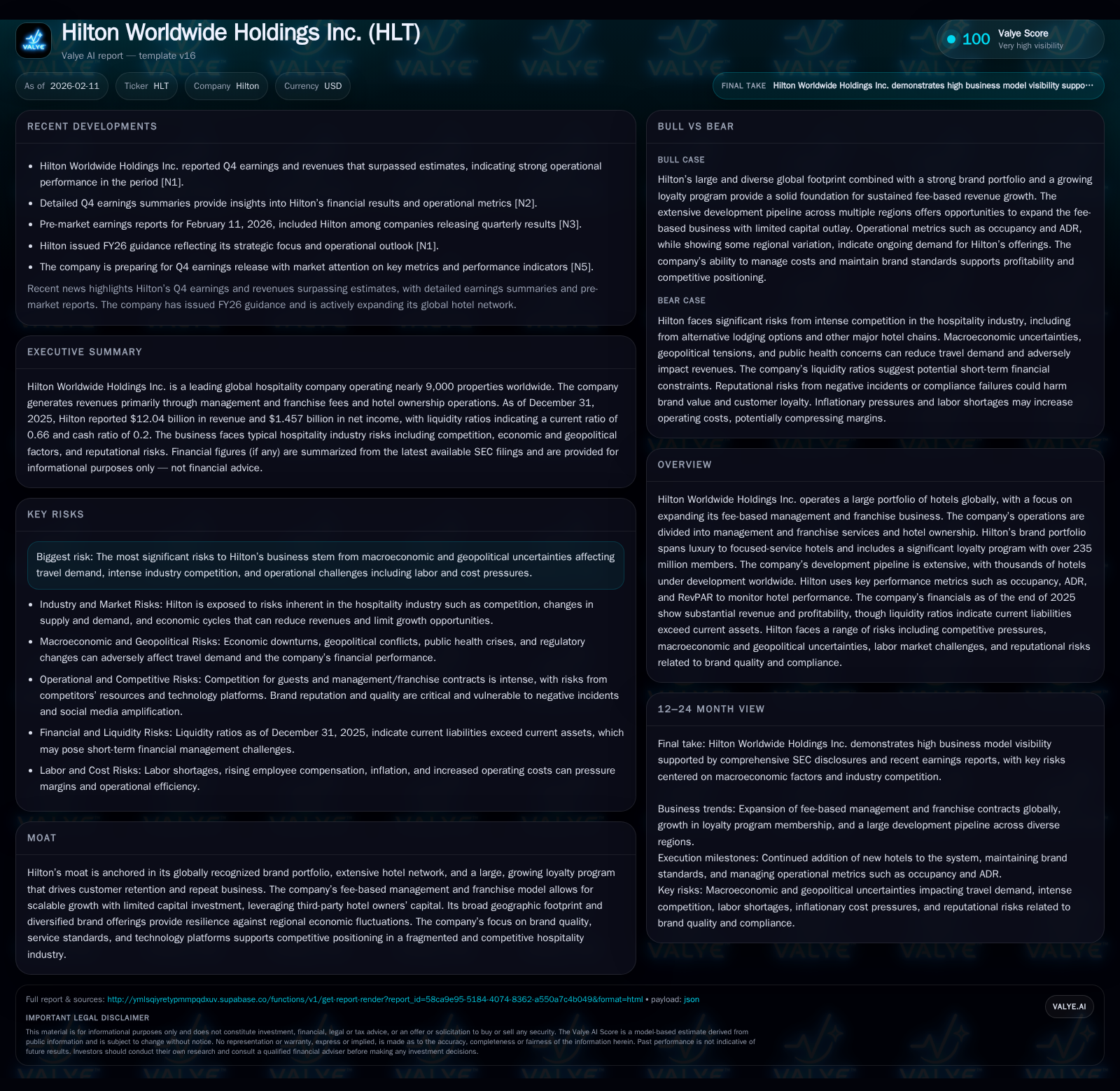
Hilton Worldwide operates one of the largest and most diversified global hotel portfolios, emphasizing a fee-based management and franchising model that supports scalable growth with limited capital outlay. Its extensive brand architecture, coupled with a massive loyal customer base exceeding 243 million members, anchors its competitive moat. While revenue and profitability remain robust, liquidity metrics indicate short-term financial pressures. Hilton contends with significant industry risks including macroeconomic volatility, intense competition, labor challenges, and geopolitical uncertainties that could impact travel demand and operational costs.
Company Overview
Hilton Worldwide Holdings Inc. stands as one of the hospitality industry's giants with a global footprint encompassing approximately 9,158 properties totaling over 1.35 million rooms spanning 143 countries as of December 31, 2025 [S1]. Its portfolio is unmatched in diversity – ranging from luxury flagship brands to focused service offerings and includes several all-suite hotels as well as timeshare enterprises.
The company’s strategic business structure bifurcates into two main segments: management and franchise services on one side, and direct ownership operations on the other. The dominant thrust is towards the former, wherein Hilton leverages its intellectual property — namely brand trademarks and proprietary technology — through management contracts or franchising agreements with third-party hotel owners. This framework allows Hilton to expand the network vigorously without assuming significant capital costs related to property ownership or refurbishment.
Segmentation and Geographic Footprint
Hilton reports its results through two operational segments:
Management & Franchise: Encompasses fees generated for overseeing hotel operations as a manager or franchisor. These arise primarily via royalty fees calculated as a percentage of gross room revenues under long-term franchise agreements. Additional income streams include licensing fees from strategic partners such as co-branded credit card providers and management services rendered to company-owned hotels.
Ownership: Includes revenues derived from direct hotel operations such as nightly room sales along with food & beverage services at consolidated hotels owned by Hilton.
Geographically, Hilton divides its operations into three regions: Americas (including U.S., which represents about 64% of total rooms), EMEA (Europe, Middle East & Africa), and Asia Pacific [S1]. Each region offers varying growth opportunities but also exposes Hilton to distinct macroeconomic dynamics and competitive landscapes.
Expansive Development Pipeline
Growth remains a cornerstone strategy for Hilton, particularly centered on scaling its fee-based model. The development pipeline at the end of 2025 included approximately 3,703 hotels accounting for over 520,000 rooms [S1]. Notably, nearly half of these new rooms are currently under construction with more than half located outside the U.S., demonstrating aggressive international expansion efforts.
By prioritizing partnerships where third-party owners provide capital for construction or renovations while Hilton lends expertise in branding and operations management, Hilton achieves scalable growth with minimized capital investment risk.
Financial Snapshot
For fiscal year-end December 31, 2025, Hilton reported revenues totaling $12.04 billion accompanied by net income of $1.457 billion [F1]. The company shows strong top-line growth supported by improved occupancy rates alongside gains in Average Daily Rates (ADR) and Revenue Per Available Room (RevPAR).
However, liquidity metrics raise cautionary flags; current assets stood at $3 billion versus current liabilities of approximately $4.51 billion yielding a current ratio near 0.66 [F1]. This indicates potential working capital constraints necessitating prudent cash management strategies amid post-pandemic recovery phase challenges.
Competitive Moat & Loyalty Program Strength
Hilton’s competitive advantage is multifaceted:
- Brand Portfolio: The extensive set of globally recognized brands caters to a wide spectrum of guest preferences across luxury and value-oriented segments.
- Scale & Network Breadth: Its vast hotel network delivers geographic diversification aiding resilience against regional downturns.
- Loyalty Program: The Hilton Honors membership surged to around 243 million by year-end 2025 [S1], driving repeat bookings while furnishing valuable data insights enabling personalized marketing efforts.
- Fee-Based Model: Reduces dependency on capital-intensive asset ownership; enhances returns on invested capital via management/franchise fees tied directly to hotel revenue performance.
- Technological Adoption: Continuous enhancements in digital reservation platforms strengthen direct booking capabilities against disintermediation from online travel agencies (OTAs).
Collectively these factors create high switching costs for customers and franchisees alike reinforcing Hilton’s market position amid fragmented global competition.
Industry Context & Risks
The hospitality sector remains highly sensitive to cyclicality driven by broader economic conditions affecting travel demand. Several risk factors bear watching:
- Macroeconomic Uncertainty: Fluctuating consumer confidence due to inflationary pressures or geopolitical instability could dampen discretionary spending on travel.
- Competition: Intense rivalry from Marriott International, Hyatt Hotels, Accor Group among others necessitates continuous innovation in service delivery.
- Labor Market Challenges: Labor shortages in key markets elevate wage expenses potentially compressing margins.
- Regulatory Compliance: Diverse global jurisdictions impose varying health/safety standards and tax regimes affecting operational cost structures.
- Technological Disruption: Dependence on multiple online intermediaries whose pricing algorithms or AI-based marketing could reduce direct customer engagement offered by Hilton.
Moreover, there is an ongoing transition towards hybrid work models influencing business travel volumes—a traditionally lucrative segment for large-format hotels—that may have longer-term implications for occupancy patterns.
Strategic Outlook & Operational Efficiency
Management discussions underscore a commitment to balancing robust system growth while managing inflationary cost headwinds. Investments in technology infrastructure aim at enhancing guest experiences and operational fluidity. Developing markets within Asia Pacific present high-growth terrain albeit accompanied by local regulatory complexities.
Additions during fiscal year 2025 included roughly 796 new hotels equating to about 97,000 additional rooms — net unit growth was approximately 6.7% after accounting for removed units [S1]. This signals resilience in acquisition pipelines despite macro uncertainties including elevated interest rates raising financing costs in certain geographies.
Increasingly sophisticated data analytics empower dynamic pricing strategies that optimize RevPAR outcomes amid fluctuating demand. Long-term contracts with third-party owners frequently incorporate clauses aligning incentives around brand standards preservation ensuring consistency across locations.
Final Thoughts
Hilton Worldwide embodies a powerful combination of scale, strategic asset-light growth focus, brand equity, and loyalty-driven consumer engagement that positions it well within an evolving global hospitality landscape. Yet stakeholders must remain attuned to economic cycles impacting discretionary travel spending as well as the company’s near-term liquidity posture which reflects some financial tension despite solid operational cash generation.
Adaptivity in navigating labor market tightness alongside technological innovation adoption will remain critical areas determining future competitiveness. Further geographic expansion poses both opportunity and exposure to cross-border complexities. In aggregate, the company maintains a defensible moat but faces inherent industry risks requiring vigilant risk mitigation practices coupled with continued brand stewardship.
This analysis reflects information available as of February 2026 from public filings including SEC Form 10-K for fiscal year ended December 31, 2025 [S1], supplemented by recent earnings call transcripts [N1]–[N5] and market context assessments. It does not constitute investment advice but aims to provide a comprehensive enterprise overview within current operating realities.
Disclaimer: This is research-only, informational analysis and not investment advice. It may include AI-generated interpretation and general industry context. Always verify important details using primary sources.

Comments