
Hilton Worldwide Q2 2026: Growth in Fee-Based Segment and Loyalty Program Expansion
Hilton Worldwide expanded its global hotel network and loyalty program in Q2 2026, supporting scalable fee-based revenue growth amid stable financial leverage.
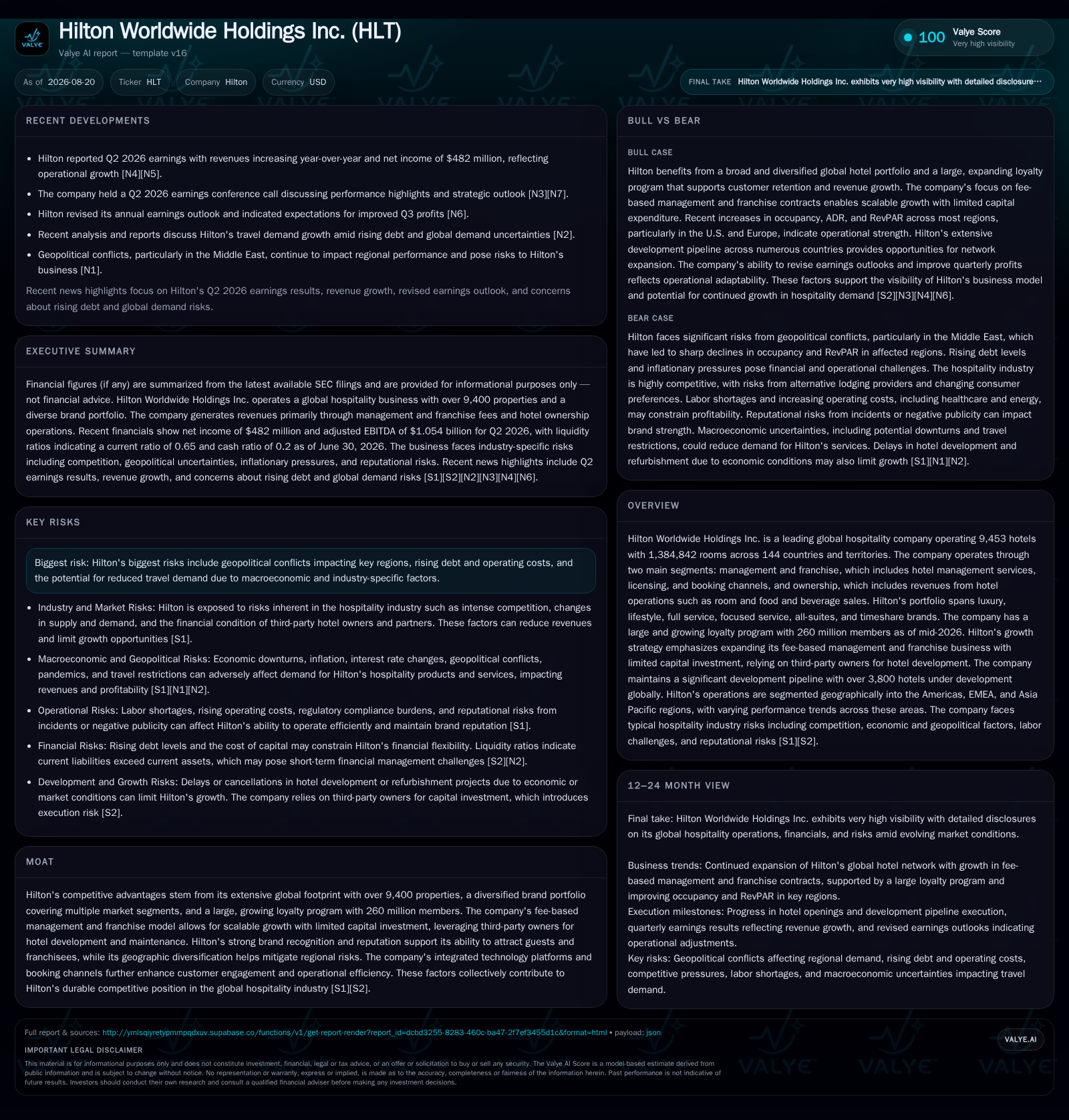
Hilton Worldwide Holdings Inc. reported operating metrics for Q2 2026 showing an increase to 9,453 properties and 1,384,842 rooms globally, alongside a 15% year-over-year growth in its Hilton Honors loyalty program to 260 million members. This expansion underpins growth in its fee-based management and franchise segment, which benefits from scalability and limited capital investment. The company maintains a financial profile consistent with its asset-light model, with $1.009 billion in cash, $13.444 billion in total debt, and a current ratio of 0.65 as of June 30, 2026. While the large development pipeline of over 3,800 hotels signals future growth potential, inflationary and macroeconomic risks warrant close monitoring.
Q2 2026 Operating Performance and System Growth
Hilton Worldwide Holdings Inc. reported operating metrics for the quarter ended June 30, 2026, showing continued expansion of its global hotel network and loyalty program. As of the quarter end, Hilton operated 9,453 properties comprising 1,384,842 rooms across 144 countries and territories, reflecting growth from the prior year [S2]. Concurrently, the Hilton Honors loyalty program membership increased by 15% year-over-year to 260 million members, underscoring enhanced customer engagement and brand loyalty [S2].
This system-wide growth in properties and rooms directly supports Hilton's fee-based management and franchise business, which generates revenues primarily through management and franchise fees paid by third-party hotel owners. The loyalty program expansion further strengthens Hilton's competitive positioning by driving repeat bookings and increasing the attractiveness of its brands to owners and guests alike.
Business Model and Segment Revenue Dynamics
Hilton operates through two main segments: management and franchise, and ownership. The management and franchise segment provides fee-based revenues by managing hotels or franchising its brands to third-party owners. These fees include management and franchise fees, licensing fees from strategic partners, and fees for managing owned hotels. This asset-light model allows Hilton to scale its revenues with limited capital investment, as third-party owners typically fund hotel construction, renovation, and maintenance [S2].
In contrast, the ownership segment derives revenues from direct hotel operations, including room sales and food and beverage services at consolidated properties. This segment faces greater exposure to operating cost inflation and capital expenditure requirements. The fee-based segment's higher operating leverage and lower capital intensity generally support stronger margins and free cash flow generation relative to the ownership segment.
The growth in system-wide properties and the loyalty program membership enhances Hilton's ability to increase fee-based revenues efficiently, as more properties under management or franchise translate into higher fee income without proportional capital deployment.
Development Pipeline and Growth Outlook
Hilton's development pipeline remains robust, with over 3,800 hotels under development globally as of Q2 2026. The majority of these hotels are expected to enter the system under management and franchise contracts, further expanding Hilton's fee-based business [S1][S2]. This pipeline spans diverse geographic regions, supporting Hilton's strategy of broadening its global footprint and brand presence.
While the pipeline signals sustained future growth potential, execution risks exist amid elevated inflation and challenging capital market conditions, which have caused delays in some openings. The ability to convert this pipeline into operating hotels in a timely manner will be a critical factor in realizing revenue growth and margin expansion.
Financial Position and Capital Structure
As of June 30, 2026, Hilton reported $1.009 billion in cash and cash equivalents alongside $13.444 billion in total debt, resulting in net debt of approximately $12.435 billion [F1]. The company's current assets totaled $3.295 billion against current liabilities of $5.076 billion, yielding a current ratio of 0.65, which is typical for asset-light hospitality firms [F1].
Risks and Industry Context
Hilton operates in a cyclical hospitality industry sensitive to macroeconomic conditions, travel demand fluctuations, and inflationary pressures. Rising operating costs, including labor, energy, and insurance, may compress margins, particularly in the ownership segment. Additionally, capital availability constraints for third-party owners could delay hotel development or franchise expansions.
Competitive pressures from other global hospitality companies and alternative lodging options also influence Hilton's market positioning. The company's extensive brand portfolio and large loyalty program provide competitive advantages but require ongoing investment and execution.
Analytical Conclusions
Hilton's expansion in fee-based management and franchise contracts, alongside a significant increase in Hilton Honors loyalty membership, may support revenue growth with limited capital investment [S2]. The growth in system-wide properties and rooms, combined with loyalty program expansion, could contribute to fee-based revenues and potentially enhance brand strength, which may enable more efficient network scaling.
Financially, Hilton's substantial leverage and working capital deficit align with the asset-light hospitality model but necessitate monitoring amid inflation and macroeconomic uncertainties. Progress in converting the development pipeline into operating hotels and continued loyalty program membership growth will be key indicators of future revenue potential. Operating margin trends and free cash flow generation will reveal the impact of inflation and cost pressures. Finally, leverage levels, refinancing activity, and liquidity position warrant attention given the company's significant debt load.
Together, these factors will clarify Hilton's ability to sustain its asset-light growth strategy and navigate industry cyclicality and macroeconomic challenges.
Disclaimer: This is research-only, informational analysis and not investment advice. It may include AI-generated interpretation and general industry context. Always verify important details using primary sources.

Comments