
Hewlett Packard Enterprise Shifts to AI-Infused Hybrid Cloud Growth in Q2 2026
Q2 2026 results reveal HPE’s profit resurgence fueled by AI-native networking and GreenLake hybrid cloud adoption.
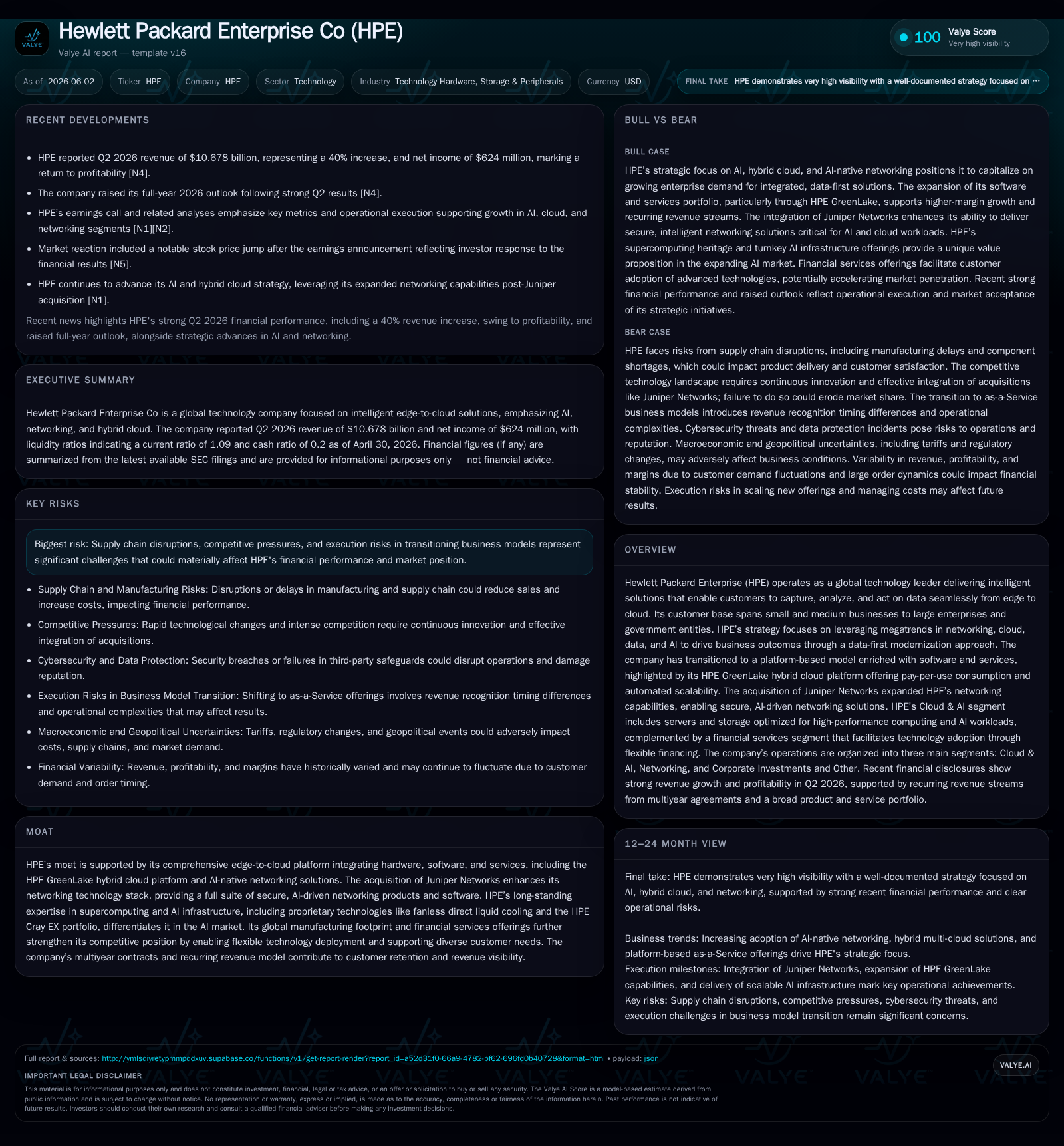
In its latest quarterly filing, Hewlett Packard Enterprise (HPE) reported a marked turnaround with net earnings rising to $1.076 billion, driven by strong revenue growth and operational execution amid AI and hybrid cloud megatrends. The company’s strategic integration of Juniper Networks complements its GreenLake pay-per-use platform, framing a competitive edge in AI-infused networking and consumption-based hybrid cloud services. Despite tangible progress, supply chain volatility and macroeconomic uncertainties persist as challenges to consistent growth. Looking forward, HPE’s ability to maintain recurring revenue momentum and execute multiyear contracts will be critical to sustaining its platform-based business expansion.
Quarterly Operating Momentum: Profitability Rebounds and Revenue Growth
Hewlett Packard Enterprise’s Q2 2026 filing reveals a meaningful financial inflection point as net earnings jumped to $1.076 billion from prior-year losses [S2], underpinned by a robust 40% revenue increase reported in several news commentaries [N5][N6]. This rebound reflects renewed customer investment post-macroeconomic headwinds that had previously delayed IT spending cycles [S1]. Notably, inventory grew materially to over $9 billion signaling both higher demand anticipation and supply chain rebuilding efforts [S2], which alongside stronger accounts receivable dynamics points toward improving operational leverage. These factors collectively confirm improved business health and provide a foundation for confidence in scaling recent gains.
Platform-Based Business Model: Integrating Hardware, Software, and Consumption Services
HPE’s transformation into a platform-centric enterprise sits at the core of its strategic repositioning. Anchored by the GreenLake hybrid cloud platform, the company offers customers flexible consumption models that rely on pay-per-use billing rather than large upfront capital expenditures [S1][S2]. This shift enhances customer stickiness through recurring revenue streams sustained by multiyear contracts that embed deeper relationships across SMBs to large enterprises and public sector customers. The acquisition of Juniper Networks furthers this paradigm by integrating AI-driven software layers atop a comprehensive hardware stack spanning from edge devices through data centers to cloud infrastructure. The blended offering bridges traditional hardware sales with growing software-as-a-service (SaaS) elements including networking intelligence capabilities, reinforcing usage-based consumption mechanics vital for long-term revenue durability.
Industry Context: Competitive Positioning in AI-Native Networking and Hybrid Cloud
Juniper Networks’ $13.4 billion merger completed mid-2025 represents a pivotal enhancement for HPE’s competitive moat in networking technology [S1]. This acquisition enables delivery of "AI for Networks" — leveraging artificial intelligence to optimize network operations — coupled with "Networks for AI," which builds essential infrastructure tailored for data-intensive AI applications [S1]. In comparison to peers like Cisco Systems or Dell Technologies’ networking segments, HPE stands out by positioning secure, automated networking as an integral component of enterprise AI workflows rather than just connectivity solutions alone [N13]. Meanwhile, its GreenLake platform battles head-to-head with other major hybrid cloud vendors but differentiates itself through deep integration across hardware-software-service layers promoting easier adoption among legacy IT environments transitioning toward multi-cloud architectures.
Growth Drivers: AI Adoption, GreenLake Expansion, and Edge-to-Cloud Trends
Structural tailwinds shaping HPE's addressable market include rapid expansion of compute-intensive AI workloads and the explosion of enterprise data generation at the edge [S1][N1]. These trends drive demand not only for high-performance servers optimized for AI but also for intelligent networks that enable seamless data flow between edge devices and centralized clouds. The pay-per-use aspect embedded in GreenLake has shown increasing traction as customers favor operational expense models conducive to scaling compute resources dynamically — one factor behind reported rises in usage-based consumption metrics [N6]. Additionally, the company's broad product footprint allows cross-selling opportunities where new workloads spur incremental demand for storage systems alongside financial services support financing these deployments efficiently.
Risks and Challenges: Supply Chain, Macro Uncertainty, and Execution Complexity
Despite positive momentum, significant risks persist that could disrupt HPE’s trajectory. The company continues grappling with uneven demand patterns exacerbated by longer sales cycles intrinsic to large enterprise deals coupled with residual macroeconomic uncertainty impacting discretionary IT spend [S1]. Tariff fluctuations following recent U.S. Supreme Court decisions introduce variability into component costs and logistic complexities posing ongoing supply chain management burdens directly affecting gross margins and inventory turnover efficiency [S2]. Furthermore, integrating Juniper Networks while extracting anticipated synergies remains execution-sensitive; any delays or misalignments could impede operating profit expansion assumptions embedded in current forecasts [S1][N3]. Lastly, technology transitions embracing new AI innovations amplify the need for continual R&D investments balanced against pressure on cost management.
Governance Update: Board Amendments with Elliott Investment Management
A material governance development was disclosed in early June 2026 wherein HPE amended its Cooperation Agreement with activist investor Elliott Investment Management to fix the board size at no more than 14 directors through the 2027 Annual Meeting [S3]. This agreement signals a continued collaboration framework aimed at ensuring stable oversight during this transformational phase for HPE but also sets boundaries around shareholder activism influence. Such arrangements often balance short-term tactical interventions against longer-term strategic continuity — a dynamic that warrants ongoing observation given Elliott's capacity to shape future corporate governance or strategic decisions.
Outlook and Milestones: What to Watch in HPE’s Path Forward
Market watchers will closely monitor several key metrics noted during recent earnings commentary including GreenLake billings growth rate acceleration underpinning future ARR expansion [N4][N5], operating margin improvement trajectories linked to cost synergies from Juniper integration, plus customer retention/net retention rates indicating subscription health dynamics critical under recurring revenue models [N6][S2]. Additionally, new product launches or expansions particularly targeting emerging AI workload optimization or edge infrastructure offerings may represent catalysts validating HPE's differentiation strategy further. Macro indicators such as tariff updates or supply chain stabilization will also shape underlying achievable growth steps.
Financial Overview: Capital Structure, Liquidity, and Profitability Snapshot
As of April 30, 2026, Hewlett Packard Enterprise maintained cash and cash equivalents totaling approximately $5.3 billion juxtaposed against total debt estimated near $18.2 billion yielding net debt close to $12.9 billion; the current ratio stood at about 1.09 reflecting near-parity liquidity coverage [S2][F1]. Positive net income contrasted with prior loss periods emphasizes improved profit conversion supported by structural shift toward higher-margin software-plus-services offerings plus operational discipline during inventory buildup phases.
This analysis synthesizes publicly available SEC filings as of June 2026 alongside verified industry news sources without providing investment advice or price targets. It aims to deliver insight into Hewlett Packard Enterprise’s evolving strategic priorities and competitive dynamics within the shifting enterprise IT landscape emphasizing hybrid cloud and AI workloads.
Disclaimer: This is research-only, informational analysis and not investment advice. It may include AI-generated interpretation and general industry context. Always verify important details using primary sources.

Comments