
Heartflow’s Path to Defining Non-Invasive Coronary Diagnostics and Its Financial Crossroads
Heartflow delivers pioneering AI applications in coronary artery disease assessment, yet faces significant financial deficits and regulatory scrutiny.
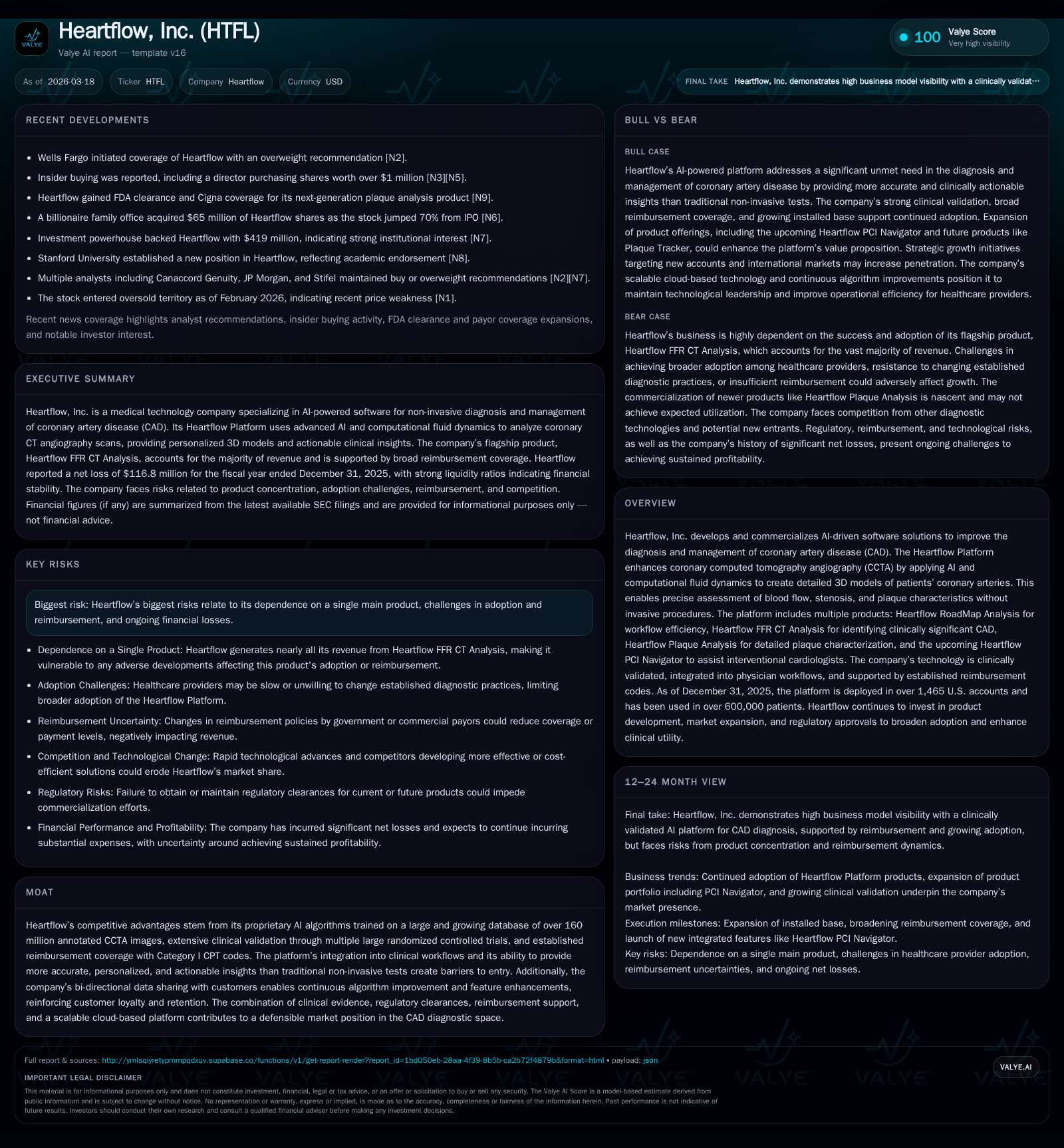
Heartflow, Inc. has positioned itself at the forefront of coronary artery disease (CAD) diagnostics through its AI-powered Heartflow Platform, which leverages computational fluid dynamics combined with CCTA imagery to non-invasively assess blood flow and plaque characteristics. Despite rapid clinical adoption reaching over 600,000 assessed patients by end-2025 and established reimbursement codes, the company continues to report substantial operating losses driven by reliance on a single main product and nascent commercialization of secondary offerings. Meanwhile, regulatory investigations related to alleged Anti-Kickback violations raise further uncertainty around future operations. Going forward, milestones such as product launches like PCI Navigator and reimbursement stability will be critical for market expansion and any path toward profitability.
From Rapid Adoption to Revenue Plateau: Tracing Heartflow’s Growth Trajectory
Since inception, Heartflow’s revenue expansion has predominantly been driven by wide clinical adoption of its core Heartflow FFR CT Analysis product. The platform had assessed over 600,000 patients by December 31, 2025, including about 219,000 patients during that year alone [S1]. This volume demonstrates significant physician uptake reflecting acceptance of the "CCTA + Heartflow" pathway as an effective standard for non-invasive CAD diagnosis.
However, despite strong initial momentum, revenue growth appears to have plateaued recently. Factors contributing include entrenched habits among healthcare providers reluctant to deviate from traditional diagnostic protocols along with pricing pressure linked to contract negotiations featuring utilization-based rebates [S8]. Moreover, concentration risk stems from a relatively small number of customers controlling multiple facility accounts; loss or volume reduction from any major customer could materially impact topline [S8].
Operating losses also persisted against this backdrop of adoption with the firm reporting approximately $64 million operating income deficit in fiscal year 2025 [F1]. The lack of diversification beyond its primary offering magnifies vulnerability to fluctuations in single-product demand.
Fiscal Year Performance Summary
Historical performance (annual)
| FY |
|---|
| 2025 |
Source: SEC companyfacts cache [F1].
Source: [F1]
Decoding the Heartflow Platform: Proprietary AI Advantages and Product Suite
Heartflow’s core value proposition lies in its proprietary AI algorithms developed on an extensive database exceeding 160 million annotated CCTA images [S1]. The technology applies computational fluid dynamics—a physics-based modeling approach—to transform a standard CCTA scan into a fully personalized 3D coronary model assessing fractional flow reserve without invasive catheterization.
This unique integration enables detailed quantification of coronary stenosis severity, blood flow impediments, plaque volume, and composition—parameters pivotal for tailoring individualized treatment strategies [S1]. Unlike traditional stress tests that only infer ischemia indirectly or anatomical scans measuring limited metrics, Heartflow offers direct hemodynamic insights enhancing clinical decision-making.
Multiple randomized controlled trials validate the accuracy and outcomes utility of this approach (e.g., the PRECISE trial), underpinning physician confidence [N1][S22]. The software's embedding within existing clinical workflows is facilitated by support for Category I CPT codes ensuring stable reimbursement avenues—a significant competitive moat versus emerging alternatives lacking standardized payment structures.
The full product suite includes:
- Heartflow FFR CT Analysis: The foundational fractional flow reserve assessment tool.
- Heartflow Plaque Analysis: Recently commercialized to offer granular plaque characterization.
- Heartflow RoadMap Analysis: Workflow accelerator enhancing operational efficiency.
- Heartflow PCI Navigator: Anticipated Q2 2026 release aimed at guiding interventional cardiologists in percutaneous coronary intervention planning [S1][S3].
Emerging Pipeline Products and Market Penetration Constraints
While core technology adoption is robust, advancing secondary products faces headwinds described in filings as “commercialization nascence” [S1][S2]. Specifically, Heartflow Plaque Analysis must overcome entrenched diagnostic practices where clinicians default to familiar imaging modalities rather than integrate novel plaque quantification tools.
Moreover, reimbursement coverage for these newer offerings remains less certain compared to the flagship FFR CT Analysis leading payors to hesitate on broad payment commitments [S1]. Provider behavior inertia combined with these payor constraints poses tangible barriers limiting rapid scale-up potentials.
Product differentiation in this segment is critical given stiff competition from cost-effective or more innovative rivals who may already hold first-mover advantages within plaque analysis domains [S22]. Thus market penetration depends not only on further evidence generation but also strategic education efforts targeting clinical mindshare transformation.
Regulatory and Legal Backdrop: Impact of DOJ Investigations on Business Outlook
In October 2025, Heartflow and certain employees received civil investigative demands from the U.S. Department of Justice relating to alleged violations under the federal Anti-Kickback Statute and Civil False Claims Act centered on their financial relationships with providers and sales/marketing conduct [S4][S5][S6].
These statutes prohibit inducing providers via improper financial incentives when billing government health programs such as Medicare or Medicaid. The investigation focuses on whether certain arrangements caused false claims submission or inflated billing [S6].
The company states active cooperation but cannot currently assess duration or outcome implications; contingent risks include potential material adverse effects on operations or cash flows pending resolution [S5]. Regulatory enforcement within medical device sectors frequently leads to prolonged inquiry periods adding unpredictability to near-term forecasts.
This looming legal overlay intensifies under the umbrella of increased scrutiny for healthcare companies’ compliance with anti-fraud laws including HIPAA-related obligations for data integrity [S10]. While broader litigation does not currently reflect material financial damage per management opinion, reputational impacts remain possible.
Financial Health Check: Operating Losses, Cash Resources, and Return Metrics
Heartflow’s financial statements for FY2025 depict continuing losses consistent with prior periods yet reinforcing cautionary signals around sustainability:
- Operating income declined roughly $64 million,
- Net loss deepened near $117 million,
- Free cash flow was negative approximately $59 million,
- Cash & equivalents stood at $44.8 million,
- Current ratio healthy at ~5.2 reflecting solid short-term liquidity,
- Return on equity estimated at negative 38.8% indicating erosion of shareholder value amid losses [F1].
Despite ample working capital buffer mitigating immediate liquidity distress risks, persistent cash burn underscores dependency on equity issuance or debt access going forward absent profitability improvements.
Capital Allocation Practices: Investment Priorities Over Shareholder Returns
Given ongoing financial deficits precluding earnings distributions, Heartflow follows a capital discipline focused on growth reinvestment rather than returning cash through dividends or share repurchases [F1][S1].
Investment priorities center largely around R&D expenditure aimed at expanding feature sets across platform components including anticipated PCI Navigator launch as well as refining AI algorithmic accuracy through continuous data assimilation from provider networks.
Accordingly, capital deployment reflects strategic intent to bolster clinical evidence base while navigating regulatory landscape rather than short-term yield maximization typical in mature enterprises.
Competitive Landscape and Reimbursement Dynamics in CAD Diagnostics
Heartflow operates within a dynamic competitive environment characterized by fast-paced technological evolutions where alternative vendors may field products offering enhanced user interfaces or cost advantages possibly eroding market share over time if unaddressed [S22]. Competitors have launched plaque analysis tools ahead of Heartflow’s Plaque Analysis gaining some first-mover benefits with clinicians accustomed to their modalities.
Nonetheless, Heartflow distinguishes itself through robust clinical validation backed by randomized trials plus established Category I CPT codes securing relatively stable reimbursement levels which critically support customer willingness for integration into care pathways relative to less reimbursed competitors [S1][S22].
Payor coverage consistency remains vital because changes—such as coding revisions or rate cuts—could directly depress product adoption given high cost sensitivity within healthcare service procurement frameworks [S1][S2]. Clinical workflow embeddedness combined with expansive database-driven algorithm enhancements further fortify barriers against newcomer displacement efforts.
What Investors Should Watch: Upcoming Milestones and Potential Catalysts
Key indicators shaping Heartflow’s progression include:
- Commercial rollout status of the PCI Navigator slated for second quarter 2026,
- Final data releases from ongoing clinical trials validating expanded indications or demonstrating improved patient outcomes,
- Resolution progress regarding DOJ investigations providing clarity on potential penalties or compliance reforms,
- Reimbursement policy updates especially concerning expanded third-party payor coverage or pricing adjustments affecting all platform products,
- Adoption metrics reflecting physician acceptance rates beyond flagship analysis into broader platform components,
- Competitive responses potentially introducing new disruptive products challenging current market positioning [N1][S3].
Forecast visibility remains inherently limited due to ongoing legal uncertainties alongside challenges typical of commercializing nascent medical technology requiring extended physician education cycles.
Disclaimer: This analysis is based strictly on information publicly filed with regulatory agencies and verified news sources as referenced; it does not constitute investment advice nor an endorsement of any securities. Readers should consult independent professional guidance before making investment decisions.
Disclaimer: This is research-only, informational analysis and not investment advice. It may include AI-generated interpretation and general industry context. Always verify important details using primary sources.

Comments