
H2O America Strengthens Regulated Footprint Through Quadvest Acquisition and Regulatory Navigation
Q2 2026 updates highlight H2O America's regulatory progress and capital strategy amid acquisition integration and litigation risks.
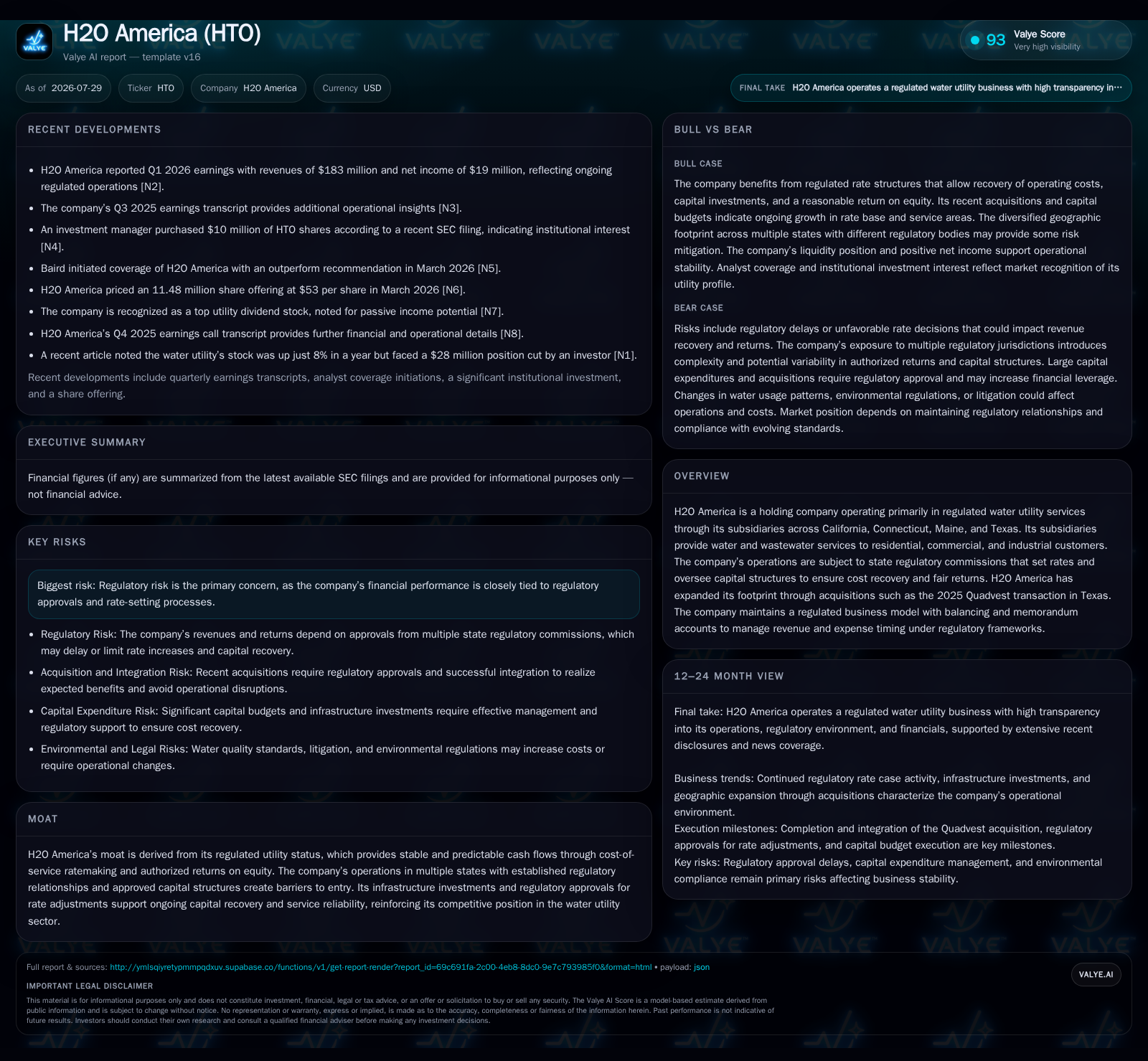
H2O America’s Q2 2026 filings reveal ongoing regulatory review delays for the key Quadvest acquisition, which introduces timing uncertainty but also expands the company’s Texas footprint. The company’s operating model centers on regulated rate base growth through infrastructure investments balanced against regulatory lag, managed via balancing accounts under multi-state commission oversight. Legal exposure from PFAS contamination litigation remains a noteworthy financial risk. Capital structure shows solid liquidity but elevated leverage due to acquisition-related financing. Investors should monitor regulatory approvals, capital expenditure authorizations, and integration milestones for confirmation of expected earnings growth.
Q2 Update: Acquisition Progress and Regulatory Approval Timelines Shape Near-Term Outlook
In its latest quarterly filing ending June 30, 2026, H2O America disclosed ongoing delays in obtaining the necessary regulatory clearances from the Public Utility Commission of Texas (PUCT) to finalize its substantial Quadvest acquisition [S2][S3]. While originally anticipated for approval around mid-2026, the PUCT's review process has extended unpredictably. This creates notable uncertainty regarding the timing of revenue recognition tied to the acquired assets as well as the realization of cost efficiencies anticipated from combining operations.
The PUCT's scrutiny includes an appraised fair market value assessment that sets the ratemaking base for the transaction at approximately $483.6 million [S1]. However, regulatory conditions imposed—or potential impositions—could delay transaction closure further or alter terms materially. Failure or postponement risks dampen near-term financial benefits from this expansion into Texas service counties such as Bandera, Blanco, Comal, Hays, Kendall, Medina, and Travis [S1][S3].
Financing efforts are ongoing in support of this acquisition; notably a recent equity offering designed to augment capital resources was priced ahead of the quarter close [S7]. Management's clear strategy is to balance acquisition funding while maintaining operational flexibility.
Operating Model Anchored in Regulated Rate Base Growth Amid Controlled Regulatory Lag
H2O America's fundamental revenue mechanism relies on regulated tariffs established through cost-of-service ratemaking administered by state public utility commissions in California, Connecticut, Maine, and Texas [S1]. These commissions allow recovery of prudent operating expenses plus an authorized return on invested capital represented by the rate base—the net value of physical water utility assets deployed.
This regulatory framework exposes revenues to "regulatory lag," given that rate cases occur periodically rather than continuously. To counterbalance timing gaps between incurred costs/capital expenditures and tariff adjustments, H2O America utilizes balancing and memorandum accounts which temporarily record variances pending formal recovery or refund through future rates [S1]. This system supports revenue stability despite inherent timing mismatches.
Capital expenditure programs target ongoing infrastructure investment including pipeline replacement and wastewater treatment plant upgrades across all service territories. Such investments incrementally increase the rate base value over time which can enhance authorized returns if duly approved.
Operating across multiple states adds complexity due to varying commission policies on allowed capital structures—roughly consisting of debt/equity mixes around 43-49% debt—and permitted returns on equity ranging typically between high single digits reflecting market conditions [S1]
Moderating Regulatory Risk Within Multi-State Utility Footprint
Regulatory risk remains a primary concern given dependency on several distinct state regulators with differing procedural timelines and policy stances [S1][S2]. In California and Connecticut/Maine regions where legacy operations are well established, H2O America leverages longstanding commission relationships to secure predictable adjustments. The Texas jurisdiction governing Quadvest is somewhat more uncertain given the pending transaction status.
This multi-jurisdictional exposure requires sophisticated engagement strategies to mitigate adverse rulings or prolonged case durations that could impair revenue or increase costs unexpectedly [S4][S5]. Rating agencies have noted this risk component as a factor affecting credit assessments
Peer companies like California Water Service Group face similar challenges balancing consistent returns amidst region-specific regulatory practices; American Water Works Company exemplifies the scale approach facilitating broader diversification benefits.
Infrastructure Investment Focus Sustains Service Reliability Across Diverse Territories
Capital expenditures remain a cornerstone driver supporting H2O America's long-term growth by maintaining critical water distribution networks and wastewater treatment capabilities connected to expanding customer bases across residential, commercial, and industrial segments [S1].
Recent disclosures emphasize continued prioritization of replacing aging mains and plant modernization projects essential for compliance with increasing environmental mandates as well as enhancing service reliability metrics such as reduced non-revenue water loss.
Such infrastructure investments not only preserve operational standards but also underpin incremental rate base additions that fuel regulated return accruals—essential for sustaining earnings power under cost-of-service models.
Acquisition Integration Complexities Highlighted by Quadvest Transaction Conditions
The Quadvest acquisition introduces heightened integration complexity driven by regulatory conditionality around transaction closure which exposes H2O America to potential costs or delays that may constrain synergy realization in the near term [S1][S3].
Management must navigate both internal operational harmonization between Quadvest’s assets and existing Texas Water Company operations alongside external uncertainties posed by pending PUCT decisions. Any prolonged delay increases financing costs linked to acquisition-related debt while limiting immediate contribution margins.
Such integration risks temper margin expansion visibility compared with organic base business progression.
PFAS Litigation Exposure Presents Ongoing Financial Considerations
Legal proceedings related to per- and polyfluoroalkyl substances (PFAS) contamination remain an active area affecting H2O America subsidiaries SJWC and CWC among others [S1]. The utilities participate in multistate multidistrict litigations seeking reimbursement for remediation costs.
Although settlements aggregating over $25 million have been received recently—for example involving 3M Company and DuPont—contingent liabilities persist with unclear ultimate outcomes or potential exposure magnitude [S1]. Such litigation introduces earnings volatility risk depending on settlement progression or court outcomes.
Monitoring these developments is critical as unresolved claims may influence future capital allocation priorities or credit considerations.
What To Watch: Upcoming Rate Case Decisions, CapEx Authorizations, And Integration Milestones
Key upcoming catalysts include:
- PUCT final determination on the Quadvest acquisition enabling deal closure or triggering termination/renegotiation clauses;
- Rate case filings across all major states influencing authorized ROEs and tariff levels vital for capital recovery;
- Approval of major infrastructure capital projects driving future rate base growth;
- Integration progress reports quantifying synergy realization timing post-acquisition;
- Updates related to PFAS litigation settlement or new claims impacting financial forecasts. Monitoring these events will provide essential clarity about risk mitigation effectiveness and growth sustainability.
Financial Profile Discussion: Liquidity Strength Versus Elevated Leverage From Growth Financing
The company's ability to generate stable cash flow from regulated operations partially offsets refinancing risks attributable to interest rate volatility or credit rating sensitivity exposed by increased indebtedness [S4][S5]. Ongoing capital expenditures funded through operating cash flow supplemented by financings represent standard sector practice though constrain free cash flow metrics temporarily.
In summary, H2O America exhibits financial characteristics typical of regulated utilities pursuing measured external growth requiring careful balance between investment needs and leverage tolerance.
Disclaimer: This analysis is based solely on publicly available information from SEC filings dated up to July 28, 2026. It does not constitute investment advice or research views.
Disclaimer: This is research-only, informational analysis and not investment advice. It may include AI-generated interpretation and general industry context. Always verify important details using primary sources.

Comments