
Huron Consulting Accelerates Growth Through Acquisitions and Diversified Consulting Services
Strong Q2 results highlight Huron Consulting's expanded capabilities across Healthcare, Education, and Commercial sectors amid disciplined integration and solid financial footing.
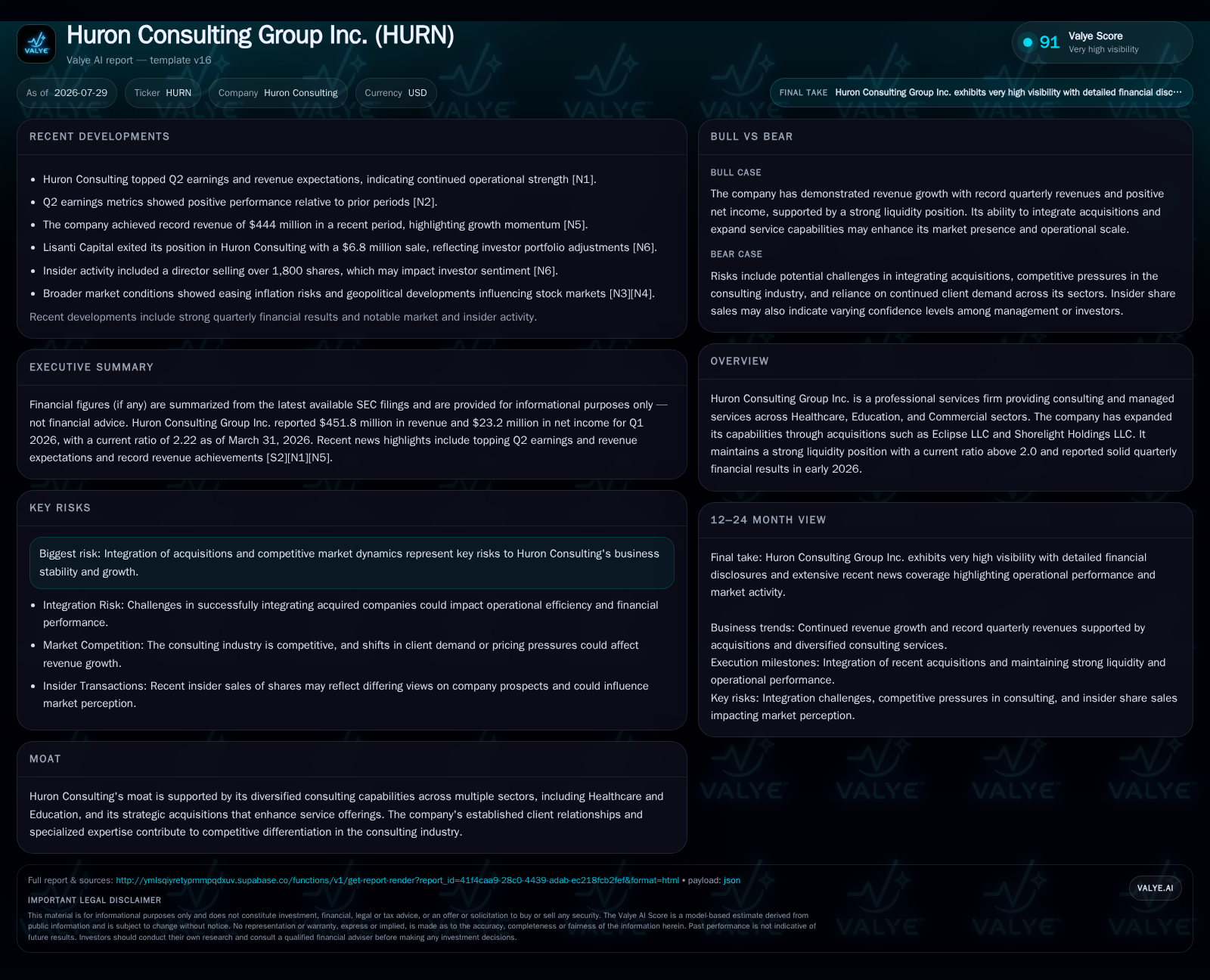
Huron Consulting Group reported robust second-quarter performance driven by strategic acquisitions and broad sector diversification. The recent addition of RelateCare expands AI-driven capabilities in Healthcare, complementing earlier deals such as Eclipse LLC and Shorelight Holdings. The company’s multi-industry approach and balance of consulting and managed services deepen client penetration while maintaining strong liquidity and manageable leverage. Integration risks remain a watchpoint as Huron focuses on scaling digital offerings alongside traditional consulting.
Recent Operating Update
In its latest Form 10-Q for the quarter ended June 30, 2026, Huron Consulting Group outlined a strong operational performance prominently buoyed by strategic acquisitions that expand its service breadth and technological capabilities. The company reported exceeding earnings estimates as per recent market commentary [N1], driven largely by its diversified portfolio spanning Healthcare, Education, and Commercial sectors. Notably, the acquisition of RelateCare on June 3, 2026—a provider of AI-enabled healthcare solutions—augments its existing portfolio within the Healthcare segment with advanced analytics and digital transformation capabilities [S9], [S10].
This deal aligns with Huron's ongoing strategy to integrate complementary firms that enhance its consulting footprint with managed services infused by technology innovations—particularly relevant given the healthcare industry's increasing emphasis on data-driven operational efficiency.
Business Model Analysis
Huron operates fundamentally in the professional services consulting space where revenue is generated primarily through fee-based engagements encompassing strategic advisory, operational improvement consulting, managed services contracts, and increasingly digital product offerings. Clients span both public and private sectors requiring expertise in navigating complex regulatory environments, operational challenges, and transformational change.
The firm's three-segment structure—Healthcare; Education; Commercial (covering financial services to industrials)—is designed to leverage deep industry specialization while delivering diverse services tailored to client needs across strategy formulation to execution support [S2], [S16]. This segmentation enhances client retention by creating multiple touchpoints across organizational functions.
Monetization leverages project-based fees combined with longer-term managed service arrangements that provide more predictable revenue streams. The growth mix also involves cross-selling newly acquired or developed digital capabilities into legacy clients across units. This hybrid consulting-plus-managed-services model supports incremental margin expansion if consultancy utilization rates remain high.
Capacities such as billable utilization rates, client retention metrics, average contract size, and backlog are thus key operating indicators implicitly tracked by management given their impact on revenue growth sustainability and operating leverage realization.
Industry Structure and Competitive Position
Within the broader professional services consulting industry characterized by intense competition from large global firms like Accenture, Deloitte, PwC, as well as niche players offering specialized technology or managed services solutions, Huron positions itself through sector-focused expertise combined with a growing suite of AI-augmented digital tools.
Peer firms often compete on scale, technical domain depth, geographic reach, and integration capacity for acquisitions; here Huron employs a deliberate acquisition strategy evidenced by purchases such as Eclipse LLC (healthcare revenue cycle expertise) and TVG-Treliant Holdings (financial regulatory advisory) during 2025 coupled with RelateCare most recently—all strengthening vertical specialization relevant to client demand drivers [S25], [S26], [S9].
While it lacks Accenture's scale or Deloitte's brand cachet globally, Huron’s agile segmentation fosters tight client relationships enhancing retention and upsell potential. Its competitive moat derives from this diversified yet industry-focused service mix paired with emerging technological integration promoting long-term differentiation.
Growth Drivers
Several structural trends underpin Huron's growth trajectory:
- Complexity in Client Environments: Increasing regulatory burdens especially in healthcare and financial industries escalate reliance on advisory firms able to navigate compliance while driving operational improvements.
- Digital Transformation Demand: Adoption of AI-powered tools like those introduced via RelateCare expands addressable market for consulting-managed service hybrids blending technology implementation with strategic insights.
- Cross-Sector Expansion: Diversification reduces dependence on any single vertical mitigating cyclical risk while enabling cross-pollination of best practices across Healthcare, Education, Commercial sectors.
- Acquisition-Fueled Service Diversification: Integration of targeted acquisitions broadens capability set rapidly without slower organic build-out addressing urgent client needs effectively.
- Geographic Reach Enhancement: Though not explicitly detailed here, typical industry dynamics suggest expansion into new geographies supports scalable growth alongside domestic client base deepening.
These factors collectively drive pipeline health measured by project win rates and backlog improvement alongside elevated managed services contract renewal rates critical for recurring revenue stability.
Risks and Watchpoints
Integration complexity presents the primary risk given the accelerated acquisition cadence during late 2025 into mid-2026; ability to successfully meld acquired firms’ cultures, processes, and systems into cohesive operations will materially affect margin expansion prospects.
Talent recruitment and retention are perennial concerns for consultancies dependent on high-caliber professionals; competition from larger firms offering perhaps more expansive career paths could strain workforce continuity impacting billable utilization levels.
Pricing pressures stem from competitive bid environments especially in commoditized service categories; sustaining pricing premiums relies on demonstrated differentiated expertise or proprietary methodologies which Huron appears enhancing via technology investments but must concretely validate over time.
Macroeconomic uncertainties that dampen corporate spending or public sector budgets can reduce discretionary consulting budgets affecting volume demand. Sector concentration risks exist but are partially mitigated here owing to diversified industry spread.
Furthermore, evolving regulatory or cybersecurity requirements could impose unexpected costs or liabilities particularly when handling sensitive healthcare or financial data inherent to key client segments.
What To Watch Next
Upcoming milestones include:
- Monitoring integration progress metrics for newly acquired entities such as RelateCare signaling realization of anticipated synergies.
- Tracking segment-level performance trends across Healthcare versus Education and Commercial to identify structural shifts or portfolio rebalancing needs.
- Updates on managed services contract renewals providing visibility into recurring revenue durability.
- Financial covenant compliance updates beyond current strong standing indicating leverage flexibility for future acquisitions or capital investment.
- Adoption pace of digital capabilities alongside traditional consulting services deciphering future margin trajectory potential.
- Any management commentary around market demand shifts driven by macroeconomic factors or competitive moves shaping forward guidance nuances if available.
Financial Profile Discussion
As of March 31, 2026, balance-sheet data indicates a strong liquidity position characterized by a current ratio of approximately 2.22x supported by $26 million cash balances against $232 million in current liabilities [F1]. Total debt was approximately $856 million, primarily comprising revolving credit facilities and term loans under an amended credit agreement with flexible borrowing options [F1], [S2].
Restructuring charges remained modestly low ($0.4 million in Q2) primarily related to office space rationalization rather than major workforce downsizing indicating efficient cost control measures during integration phases [S2]. Share repurchase initiatives authorized previously have not been highlighted materially affecting capital structure recently but remain potential tools for capital allocation flexibility.
Financial position in context
As of 2026-03-31, companyfacts shows $26 million in cash and equivalents and $856 million of total debt [F1]. The same snapshot implies net debt of roughly $830 million, keeping balance-sheet context relevant but secondary to the operating story [F1]. Current assets of $515 million and current liabilities of $232 million imply a current ratio near 2.22x for 2026-03-31 [F1].
Disclaimer
This analysis is provided for informational purposes only without investment advice or research views. It synthesizes available public filings and news disclosures to present an informed perspective on Huron Consulting Group's operating dynamics within the professional services consulting industry context.
Disclaimer: This is research-only, informational analysis and not investment advice. It may include AI-generated interpretation and general industry context. Always verify important details using primary sources.

Comments