
Mondelez International Balances Growth with Liquidity Pressures Amid Commodity Cost Inflation
Q2 2026 results highlight Mondelez's resilient global confectionery business despite working capital constraints and cost pressures.
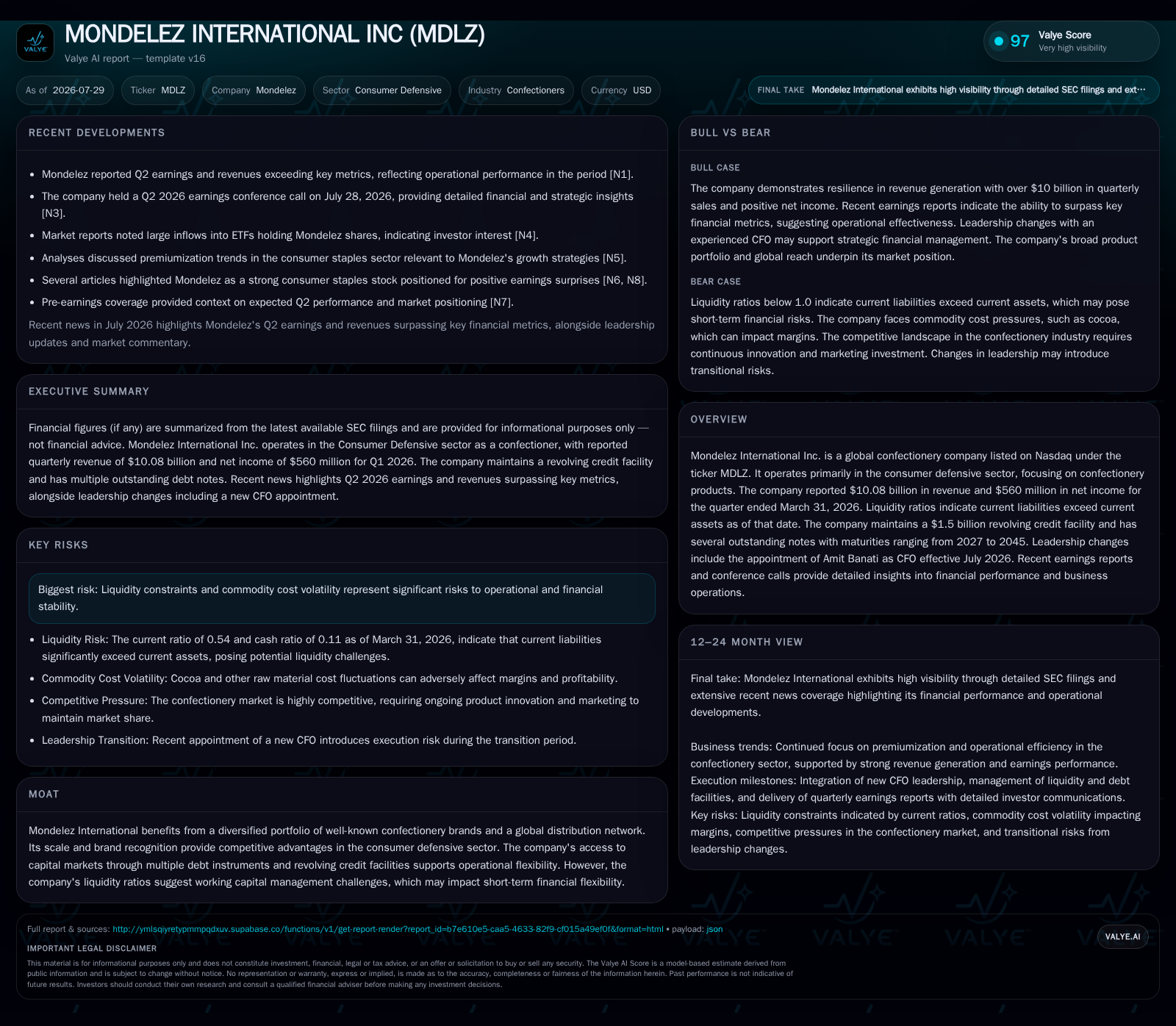
Mondelez International reported solid second-quarter 2026 revenue of $10.08 billion and net income of $560 million, reflecting steady demand for its diversified confectionery portfolio. The company faces notable working capital management challenges, evidenced by a low current ratio of 0.54 as of Q1 2026, partly due to elevated current liabilities exceeding current assets. Commodity cost inflation continues to pressure gross margins, tempered by disciplined pricing and marketing spend. Leadership changes, including the appointment of CFO Amit Banati, signal strategic focus on financial management. Growth strategies pivot around emerging markets expansion, product premiumization, and innovation amid intensifying competitive dynamics.
Recent Operating Update
Mondelez International's Q2 2026 earnings reported a top line of approximately $10.08 billion alongside net income of around $560 million, reflecting continued consumer demand despite a challenging inflationary backdrop [S2]. The strong brand portfolio sustained steady organic sales growth even as commodity costs—primarily cocoa and sugar—exerted pressure on margins. Pricing actions and cost efficiencies helped cushion gross profit erosion, but working capital strains emerged as a notable theme.
The appointment of Amit Banati as Executive Vice President and Chief Financial Officer effective July 1, 2026 introduces proven consumer packaged goods (CPG) financial expertise to navigate these pressures [S17]. Banati’s background with Kenvue and Kellogg equips him to focus on capital structure optimization, cost discipline, and strategic investments moving forward
Business Model Overview
Mondelez operates as an integrated manufacturer and brand owner within the global confectionery sector. Its revenue streams derive from selling branded products across categories such as chocolate bars (e.g., Cadbury, Milka), biscuits (such as Oreo), gum, candy, and snack foods primarily through retail grocery chains worldwide [S1]. The company monetizes through volume-driven sales complemented by premiumization strategies that allow selective price increases or new product introductions.
Distribution occurs through extensive retail partnerships covering supermarkets, convenience stores, e-commerce platforms, and foodservice channels. Given the perishable nature combined with impulse purchase characteristics in confectionery, maintaining broad geographic penetration and shelf presence is critical for sustained revenue growth.
Margins in this business depend heavily on managing commodity costs—including cocoa beans, sugar, dairy inputs—and supply chain efficiencies. Trade promotions and advertising spend significantly influence consumer purchase behavior but must be balanced against gross margin targets.
Working capital management is essential given large-scale inventory requirements tied to seasonal demand patterns and raw material procurement cycles.
Industry Structure and Competitive Position
The confectionery industry is characterized by strong brand loyalty but heightened competition from private labels and regional manufacturers operating at lower price points. Mondelez’s scale provides advantages in negotiating power over suppliers and retailers while enabling substantial marketing budgets.
Peers like The Hershey Company and Nestlé’s confectionery segment share similar dynamics with comparable exposures to commodity volatility and category growth challenges.
Sustaining competitive positioning depends on continuous product innovation—e.g., healthier options or premium gourmet lines—and expanding presence in emerging economies where confectionery consumption is growing faster due to rising disposable incomes.
Growth Drivers
Emerging market expansion remains a cornerstone for Mondelez’s long-term growth strategy, leveraging increasing urbanization and middle-class populations hungry for branded indulgences [S1]. By tailoring products to local tastes while maintaining core global brands’ appeal, the company aims to capture incremental volume.
Premiumization lifts average selling prices through fortified offerings that meet evolving consumer preferences towards natural ingredients or functional benefits. Product innovation—such as smaller format packs or novel flavors—is also deployed to stimulate category growth across mature markets.
Effective marketing spend boosts brand equity amid intensifying private label competition; digital channels support consumer engagement initiatives enhancing direct-to-consumer opportunities.
Seasonal campaigns aligned with holidays or special events optimize incremental sales peaks supporting overall revenue [S3]
Risks and Watchpoints
Commodity price fluctuations pose persistent risks given the exposed raw materials profile—sharp increases can compress margins if price hikes cannot fully pass through consumers [S5]. Supply chain disruptions remain relevant amid geopolitical tensions or pandemics impacting sourcing or distribution networks.
Regulatory risks include potential sugar taxes or stricter labeling rules which could alter consumer behavior or increase compliance costs.
Intense private label competition necessitates ongoing marketing investment; inadequate responses risk erosion of market share especially in developed markets with slower category growth.
Currency volatility impacts reported earnings stemming from diverse geographic exposures.
What to Watch Next
Upcoming milestones include quarterly earnings releases where organic sales growth rates, gross margin trends, advertising expense ratios, and operating income margins will indicate whether pricing strategies offset commodity inflation effectively.
Tracking working capital turnover improvements or inventory days reduction will provide insight into liquidity management progress.
The impact of newly appointed CFO Amit Banati’s strategic initiatives towards financial discipline will be observable through capex rationalization announcements or refinancings.
Product launch success rates in premium segments and emerging markets penetration metrics serve as early markers for incremental revenue streams [N2][N3]
Monitoring macroeconomic indicators in key emerging markets will also be crucial given their disproportionate contribution to growth projections.
Financial Profile Discussion
At March 31, 2026, Mondelez International held current assets of approximately $12.75 billion versus current liabilities near $23.5 billion, indicating a current ratio of roughly 0.54 [F1]. Net debt approximates $17.6 billion after subtracting cash balances from total outstanding debt levels noted in recent filings, reflecting moderately high leverage common among large consumer staples firms aiming for balanced shareholder returns alongside capital investment [F1].
Capital allocation considerations under new CFO leadership may focus on optimizing this leverage profile while sustaining investments in innovation, marketing efficiency enhancements, and geographic expansion programs aimed at durable growth.
This analysis reflects data through Q2 2026 anchored to Mondelez International’s recent SEC filings including the latest Form 10-Q dated July 28, 2026 [S2] complemented by its FY25 Form 10-K for business model context [S1]. Commentary incorporates industry dynamics typical for global CPG confectionery manufacturers facing volatile commodities costs alongside evolving consumer preferences in diverse geographies.
Financial position in context
Current assets of $12.7bn and current liabilities of $23.5bn imply a current ratio near 0.54x for 2026-03-31 [F1]
Disclaimer: This is research-only, informational analysis and not investment advice. It may include AI-generated interpretation and general industry context. Always verify important details using primary sources.

Comments