
Lazard's Q2 2026 Profit Pressure and Strategic Expansion in Private Capital Advisory
Higher costs weigh on Lazard’s second-quarter earnings while acquisition of Campbell Lutyens highlights growth in private capital advisory.
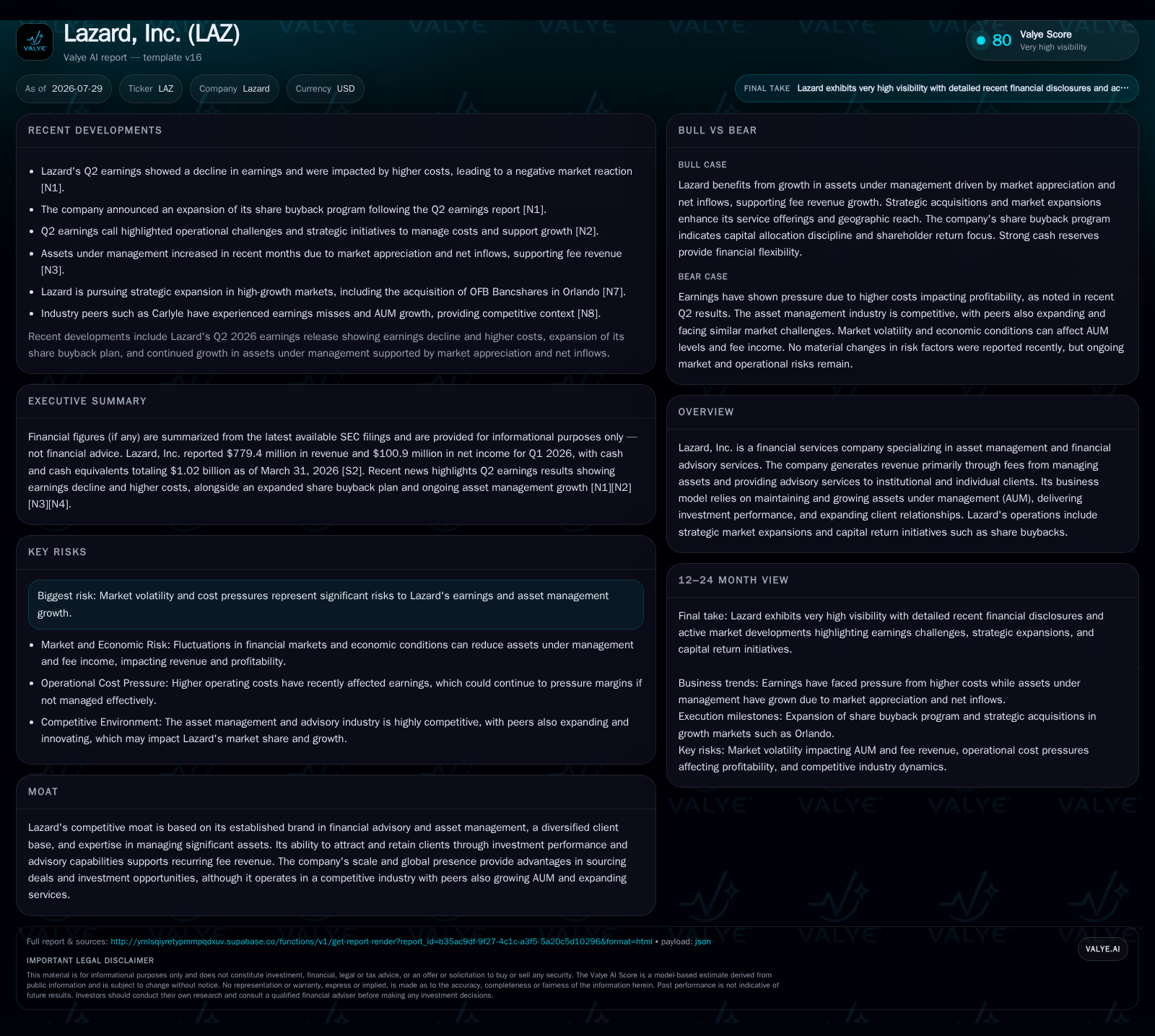
In Q2 2026, Lazard, Inc. reported a notable earnings miss driven by elevated operating expenses despite steady assets under management and advisory revenues. The company announced a significant strategic acquisition of Campbell Lutyens, signaling a push to expand its private capital advisory capabilities amid competitive fee pressures. Cost inflation and market volatility remain key risks, but recurring fee revenue from asset management and transactional advisory fees provide a dual revenue engine. Monitoring net inflows, transaction volumes, and integration progress of the acquisition will be critical near-term.
Recent Operating Update: Q2 2026 Financials Reflect Cost Pressures
Lazard, Inc. reported second-quarter results for the period ending June 30, 2026, highlighting a notable earnings shortfall primarily driven by elevated operating expenses, including higher compensation costs and other overheads [S2][N1]. Despite stable assets under management (AUM), net income declined compared to prior quarters, reflecting the margin sensitivity inherent in Lazard’s fee-based revenue model. Operating expenses grew faster than revenues, indicating near-term challenges to margin expansion absent stronger revenue growth or effective cost controls.
The firm’s AUM demonstrated resilience amid market volatility, with net inflows showing mixed trends that underscore the ongoing uncertainty in global financial markets [S2][N3]. This stability in AUM supports recurring management fee revenue, a critical component of Lazard’s business model, but fluctuating net inflows and market valuations continue to influence fee-related earnings.
In response to the earnings pressure, Lazard expanded its share repurchase authorization during the quarter, signaling management’s confidence in capital return strategies as a means to optimize shareholder value in a moderate growth environment [N1]. This capital deployment approach also reflects a balancing act between returning cash to shareholders and preserving financial flexibility amid macroeconomic uncertainties.
Business Model: Dual Revenue Streams from Asset Management and Advisory Services
Lazard’s business model integrates two complementary revenue engines: asset management and financial advisory services [S1]. Asset management revenues primarily derive from recurring management fees calculated as basis points on AUM, which fluctuate with asset values and client net inflows or outflows. Performance fees, contingent on investment returns exceeding benchmarks, provide episodic upside but are less predictable.
Financial advisory fees stem from transactional mandates, including mergers and acquisitions (M&A), restructuring, and capital raising activities. These fees are largely episodic and tied to deal volume and complexity, often commanding higher margins when deal flow is robust. This dual revenue structure blends steady, recurring fee income with variable, transaction-based fees, requiring Lazard to maintain both strong investment performance and active deal origination pipelines.
Key operating metrics for Lazard include client retention rates, net inflows/outflows in asset management, investment performance relative to benchmarks, and transaction volumes in advisory services. These KPIs directly impact fee revenue generation and margin profiles, making them critical to monitor for assessing operational health and growth prospects.
Industry Structure and Competitive Positioning
The asset management and financial advisory sector is highly competitive, with firms vying for institutional and high-net-worth clients globally. Lazard’s established brand and expertise in complex financial advisory position it well within this landscape. Its diversified client base, spanning pension funds, sovereign wealth funds, corporations, and affluent individuals, helps mitigate client concentration risks.
Peers include global asset managers like BlackRock, which leverage scale in AUM; integrated financial institutions such as Goldman Sachs, combining advisory and wealth management; and boutique advisory firms like Evercore, specializing in M&A. Lazard’s competitive differentiation lies in its global reach combined with specialized advisory capabilities, particularly in private capital advisory, a growing segment focused on alternative investments and fund placement.
Growth Drivers: Strategic Acquisition of Campbell Lutyens
A significant strategic development in the first half of 2026 was Lazard’s acquisition of Campbell Lutyens Holdings Limited for an initial consideration of $460 million, with additional deferred and earn-out payments contingent on growth targets through 2030 [S29]. Campbell Lutyens is a leading independent advisor specializing in private capital fund placement, secondary market transactions, and general partner capital advisory.
This acquisition diversifies Lazard’s advisory fee base beyond traditional M&A into the expanding private capital advisory market, which benefits from rising private equity fundraising and secondary market activity globally. The deal enhances Lazard’s ability to capture fee revenue from alternative asset classes and broadens its client relationships.
Successful integration of Campbell Lutyens is critical to realizing synergies and cross-selling opportunities. Key metrics to watch include incremental revenue growth from the combined private capital advisory platform, client retention within the expanded advisory services, and the pace of cross-divisional client conversions. Execution effectiveness in these areas will influence medium-term growth and margin expansion.
Risks and Constraints: Market Volatility and Cost Inflation
Market volatility remains a central risk factor for Lazard, directly affecting AUM levels and, consequently, management fee revenue. Fluctuations in equity and credit markets can also dampen M&A activity, reducing advisory fee income [S1][S2]. The firm’s disclosures emphasize these exposures alongside the potential for reduced investor risk appetite during economic downturns.
Cost inflation, particularly in compensation and headcount-related expenses, poses structural challenges to margin improvement [N1][S2]. The competitive landscape for talent in financial services drives wage pressures that may outpace revenue growth unless offset by productivity gains or pricing power
Regulatory changes, including potential fee caps, fiduciary standards, and data security requirements, could increase compliance costs or constrain certain revenue streams. Client retention is another critical risk; loss of key clients could reduce recurring fee revenue and increase acquisition costs.
What to Watch Next: Execution Milestones and Operational KPIs
Key near-term indicators for assessing Lazard’s performance include:
- Progress on integrating Campbell Lutyens, with a focus on revenue synergy realization and operational alignment.
- Trends in net inflows and outflows in asset management, reflecting client confidence and market conditions.
- Advisory segment transaction volumes and fee revenue, signaling deal pipeline health and market activity.
- Operating expense trajectory, particularly compensation-related costs, which influence operating leverage and margins.
- Investment performance relative to benchmarks, impacting performance fees and client retention.
- Capital deployment activities, including further share buybacks or dividend policy adjustments, informing balance sheet management [S3][N2]
Positive momentum in private capital advisory growth and margin recovery would support Lazard’s strategic positioning, while sustained cost pressures or weak deal flow could challenge profitability.
Financial Profile and Capital Structure
The firm’s ability to convert fee revenue into operating income amid rising costs will be pivotal for improving return on equity and free cash flow generation. Disciplined expense management combined with revenue diversification underpins Lazard’s financial resilience in a cyclical environment.
This analysis integrates Lazard’s latest quarterly disclosures and recent event filings to provide a comprehensive view of the company’s operational and strategic developments within the asset management and financial advisory industry. It emphasizes key business drivers, competitive context, and execution risks without offering investment research views.
Disclaimer: This is research-only, informational analysis and not investment advice. It may include AI-generated interpretation and general industry context. Always verify important details using primary sources.

Comments