
Acadia Healthcare's Multifaceted Growth Strategy and Operational Resilience in Q2 2026
Acadia Healthcare’s Q2 2026 results highlight robust network expansion and revenue growth driven by acquisitions, de novo facilities, and joint ventures amid staffing and regulatory headwinds.
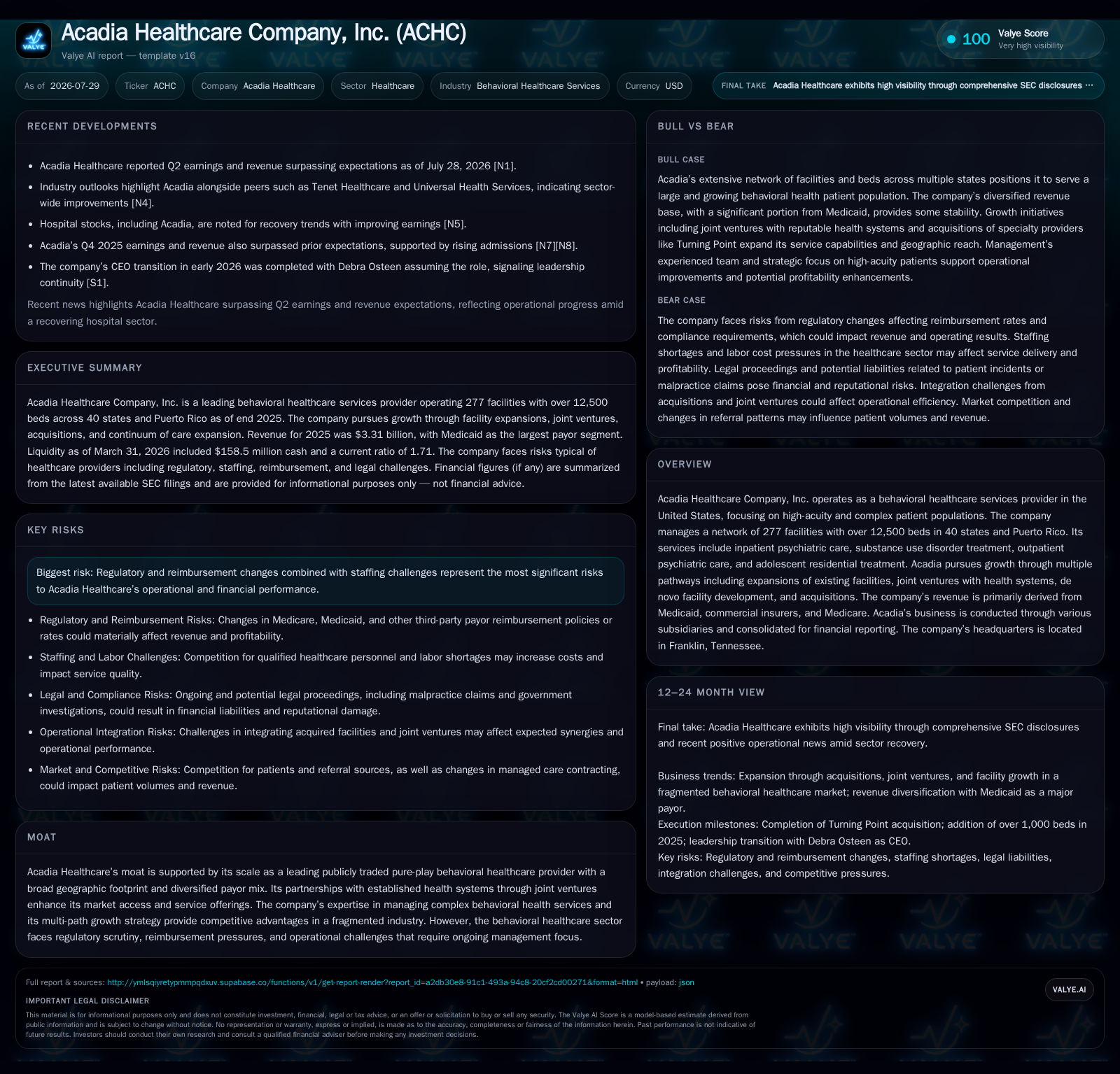
In the second quarter of 2026, Acadia Healthcare demonstrated effective execution of its multi-path growth strategy through expanded bed capacity, joint venture contributions, and same-facility revenue improvements. The company operates 277 behavioral health facilities comprising over 12,500 beds, serving high-acuity patient populations primarily reimbursed by Medicaid, Medicare, and commercial insurers. While payer mix diversity aids revenue resilience, regulatory scrutiny and staffing challenges remain meaningful risks. Acadia’s financial position reflects a moderate net leverage ratio supported by solid liquidity to fund ongoing capital-intensive expansions.
Q2 Operating Momentum Reflects Multi-Path Growth Efficacy
Acadia Healthcare’s second-quarter 2026 results demonstrate effective execution of its multi-path growth strategy, highlighted by expanded bed capacity through acquisitions and de novo developments, alongside accretive contributions from joint ventures and same-facility revenue growth [S2][S3][N1]. Although the company does not disclose explicit occupancy rates this quarter, ongoing capital expenditures totaling approximately $467 million in 2025 on facility enhancements and expansions signal management’s confidence in sustained patient demand and improved utilization over time [S21]. Given the labor-intensive nature of behavioral healthcare services, successful ramp-up of new capacity depends heavily on addressing persistent staffing constraints, which remain a critical operational challenge [S6].
Service Mix Depth: High-Acuity Care Fuels Revenue Base
Acadia operates a nationwide network of 277 behavioral health facilities with over 12,500 beds across 40 states and Puerto Rico, focusing primarily on inpatient psychiatric care and specialized substance use disorder treatment programs [S1]. This service mix extends to residential adolescent treatment and outpatient psychiatric services, catering to high-acuity patient populations that generally require longer average lengths of stay. The clinical complexity and acuity of these patients support some pricing resilience against reimbursement pressures often seen in less acute behavioral health segments.
By diversifying across inpatient psychiatric hospitals, substance use disorder clinics, outpatient services, and joint ventures, Acadia mitigates concentration risk across payer sources while building clinical expertise that differentiates it from more diversified hospital operators with behavioral units, such as Tenet Healthcare and Universal Health Services [S1]. This specialized focus enables the company to forge strategic partnerships with health systems seeking experienced providers capable of managing compliance-intensive, high-acuity care effectively.
Payer Mix Diversity Provides Partial Mitigation Against Reimbursement Volatility
Medicaid reimbursement remains a primary revenue source for Acadia’s behavioral health services but is complemented by significant contributions from Medicare and commercial insurance payors [S1][S2]. This diversified payer mix offers partial insulation from reimbursement volatility driven by government policy reforms, including the One Big Beautiful Bill Act (OBBBA) enacted in July 2025, which affects Medicaid eligibility and coverage parameters.
While Medicaid expansion increases volume opportunities among lower-income populations requiring behavioral health interventions, it also introduces sensitivity to governmental budget cycles and evolving work requirement policies that may impact eligibility. Commercial insurance contracts, typically associated with higher reimbursement rates, require stable renegotiations to maintain favorable revenue per patient day. Management closely monitors payer mix trends and reimbursement rate adjustments to balance margin preservation against the risk of cost inflation and regulatory changes.
Scaling Through Joint Ventures: Expanding Market Access With Health Systems
Acadia strategically leverages joint ventures (JVs) with established health systems as a capital-efficient growth modality that deepens market penetration without full asset ownership burdens [S1][S2]. These partnerships facilitate shared risk arrangements and reciprocal referral channels between general hospitals and specialized psychiatric services, aligning with payer incentives promoting integrated care models.
Recent JV partnerships contributed approximately $5 million to operating income, illustrating meaningful earnings diversification beyond wholly-owned operations [S1]. This JV approach also enables entry into markets with higher regulatory or competitive barriers, where endorsement from local health systems accelerates acceptance and patient access.
Managing Sector-Specific Risks: Staffing Constraints and Regulatory Scrutiny
Workforce shortages remain a significant challenge across the behavioral healthcare sector, driven by scarcity of skilled labor and elevated turnover rates. Acadia explicitly acknowledges these staffing constraints as factors limiting occupancy optimization and increasing labor costs [S1][S6]. Recruiting and retaining qualified psychiatrists, nurses, therapists, and support staff is both costly and time-intensive, constraining bed utilization despite physical capacity expansions.
Regulatory risk is heightened by ongoing federal investigations into admission eligibility criteria and billing practices dating back several years [S6]. While a prior $19.9 million settlement resolved one inquiry without admission of wrongdoing, subsequent subpoenas from the Department of Justice and the Securities and Exchange Commission underscore continued scrutiny. Legal fees and settlement costs contribute to earnings volatility, necessitating robust compliance frameworks and transparent government relations to mitigate reputational and financial risks.
Pathways Forward: Facility Development, Acquisitions, and Outpatient Expansion Potential
Looking ahead, Acadia plans to continue selective de novo facility development targeting underserved geographic markets alongside opportunistic acquisitions aimed at consolidating fragmented regional behavioral health providers [S3][N1]. Capital expenditures remain substantial, reflecting the capital-intensive nature of inpatient psychiatric and substance use disorder treatment beds; however, management emphasizes disciplined project prioritization to balance return horizons against cash flow impact.
Outpatient services, including telehealth, represent a growing segment complementing the traditional inpatient-centric model. Although outpatient volumes remain nascent relative to inpatient care, this segment offers scalability benefits through lower capital requirements and broader demographic reach, potentially enhancing payer mix quality and aligning with industry trends favoring less restrictive care settings when clinically appropriate.
Financial Profile Discussion: Balance Sheet Robustness Amid Capital Demands
As of March 31, 2026, Acadia reported cash and cash equivalents of approximately $158 million against total debt near $2.52 billion, resulting in a net debt position of about $2.36 billion. The company’s current assets of $837 million versus current liabilities of $489 million yield a current ratio of approximately 1.71, indicating adequate short-term liquidity coverage [F1]. This leverage profile aligns with sector norms for publicly traded behavioral health providers engaged in aggressive capacity growth funded through credit markets.
The company’s debt structure includes senior notes with varying maturities and interest rates, and covenants that limit additional indebtedness and require maintenance of leverage and interest coverage ratios [S4][S5]. At year-end 2025, Acadia was in compliance with all financial covenants, including a consolidated total net leverage ratio of 4.0x and an interest coverage ratio exceeding minimum thresholds [S4][S5]. Ongoing capital expenditures and acquisitions necessitate careful liquidity management to sustain growth while preserving covenant compliance.
What to Watch Next: Revenue Guidance, Margin Trajectory, and Staffing Trends
Key near-term variables to monitor include updates to same-facility revenue guidance, which will indicate the sustainability of organic growth amid macroeconomic and reimbursement headwinds [S3]. Stabilization or improvement in staffing levels is critical, as labor represents the largest expense component affecting operating margins and profitability leverage.
Progress in resolving regulatory investigations remains a pivotal factor influencing market sentiment, given the potential for contingent liabilities or increased compliance costs that could affect future earnings volatility [S6]. Additionally, the success of acquisition integrations will test management’s execution discipline, impacting timelines for cost synergy realization and incremental revenue capture.
Timely disclosures on these operational and regulatory developments will provide clearer insights into Acadia’s trajectory toward optimizing scale economies while navigating sector-specific challenges.
Disclaimer: This is research-only, informational analysis and not investment advice. It may include AI-generated interpretation and general industry context. Always verify important details using primary sources.

Comments