
Franklin Street Properties Sharpens Office Portfolio Focus Amid Regional Market Shifts
FSP’s Q2 2026 update spotlights leasing improvements in its Sunbelt and Mountain West office portfolio, balancing regional growth drivers against concentration risks.
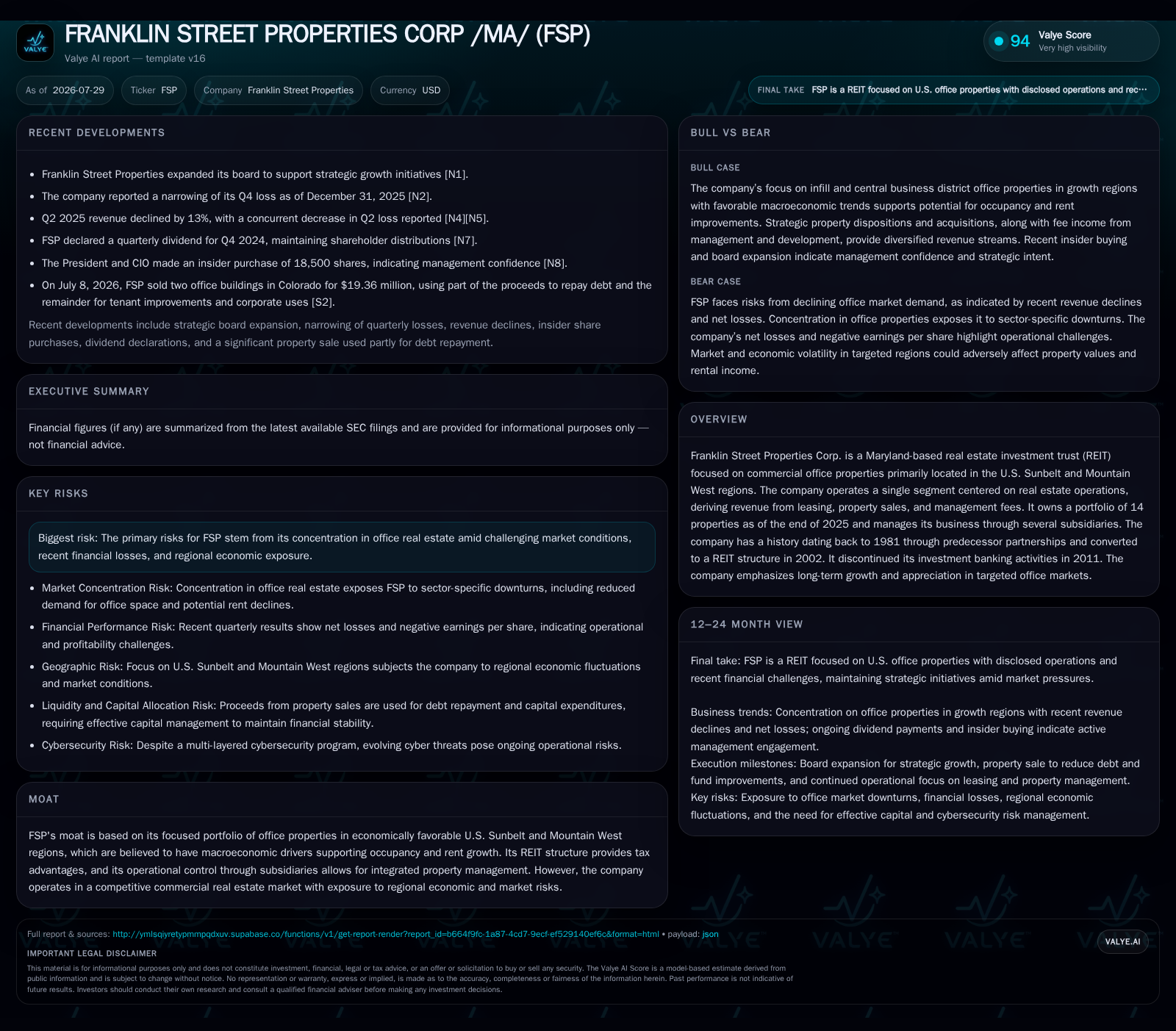
Franklin Street Properties Corp. announced Q2 2026 results underscoring modest leasing momentum within its concentrated portfolio of 14 commercial office properties primarily in the Sunbelt and Mountain West regions [S2][S3]. The company continues to rely on rental income complemented by property dispositions, operating through subsidiaries to manage assets efficiently [S1]. Its focused regional strategy exposes it to macroeconomic factors driving office demand but also concentrates risk amid broader market uncertainty. Leasing metrics such as occupancy and net operating income (NOI) show tentative recovery, while strategic property sales provide capital flexibility [S2][S3]. Ongoing monitoring of leasing velocity, rent growth, and capital deployment will inform FSP’s ability to capitalize on regional economic tailwinds and mitigate cyclical headwinds.
Q2 Operating Update Highlights: Leasing Momentum Meets Regional Market Dynamics
Franklin Street Properties Corp.'s second quarter ended June 30, 2026, reflected cautious optimism in its commercial office portfolio performance across its core U.S. Sunbelt and Mountain West markets. Recent filings indicate incremental improvements in occupancy rates and leasing velocity supported by continuing demand for select infill office locations [S2][S3]. The company reported property dispositions including the sale of two office buildings in Englewood, Colorado for approximately $19.36 million gross proceeds [S10], demonstrating ongoing portfolio rebalancing aligned with strategic capital priorities.
While FSP's overall net operating income (NOI) remained under pressure from cautious tenant renewals and limited rent escalation opportunities typical of the current market environment, partial recovery signs emerged as leasing spreads began stabilizing compared to prior quarters [S2][S3]. The transaction activity provides liquidity inflows that were partly used for debt repayment as well as tenant improvements and building upgrades — necessary investments to stay competitive in tight leasing markets against peer REITs managing larger portfolios [S10]. The close alignment with regional economic data suggests FSP’s near-term growth is highly sensitive to macroeconomic fluctuations inherent in its geographic focus.
FSP’s Office Portfolio Strategy: Regional Focus with Integrated Asset Management Levers
FSP operates as a Maryland-based real estate investment trust (REIT), maintaining ownership of 14 commercial office properties primarily situated within vibrant Sunbelt and Mountain West metro areas known for population influxes and corporate relocations [S1]. This geographic concentration strategy is designed to harness macroeconomic tailwinds like expanding labor markets and business-friendly regulatory environments that typically support occupancy rate improvement and rental rate growth over the long term.
Revenue generation at Franklin Street hinges predominantly on rental income derived from existing lease agreements with tenants occupying their properties. Complementing this steady stream are gains from selective property dispositions executed when values are optimized or portfolio adjustments are warranted [S1]. The company manages operations mainly through wholly owned subsidiaries—enabling centralized control of property management activities which contributes to cost efficiencies, improved tenant service delivery, and tighter margin control critical for EBITDA stability.
The REIT structure confers significant tax advantages that enhance Franklin Street's capacity to distribute dividends sustainably while reinvesting in property CapEx such as tenant improvements — a vital driver of tenant retention given competitiveness among peers who frequently renovate or reposition assets to achieve higher market rents.
Competitive Benchmarking: Leasing Performance Against Office REIT Peers in Key Regions
Against a backdrop of large-scale office REIT peers such as Boston Properties or SL Green Realty who operate diversified portfolios across multiple major U.S. cities including coastal hubs, Franklin Street's Sunbelt focus exposes it to more regionally concentrated cycles but also potentially stronger demographic growth factors.
Leasing KPIs like average rental rate per square foot, lease renewal rates, and net operating income (NOI) growth typically lag behind those seen at coastal peers during robust cycle phases but may exhibit better relative resilience during downturns thanks to higher local population migration and business expansions.
Growth Catalysts: Regional Economic Trends and Portfolio Enhancements Driving Demand
Sunbelt states such as Texas, Arizona, Florida, and select Mountain West cities benefit from favorable business climate conditions—tax incentives, lower operational costs—and demographic trends involving domestic migration which stimulate sustained demand for quality office space. Franklin Street’s emphasis on infill central business district properties intersects well with these secular forces fostering leasing spread improvements when matched with active asset repositioning initiatives [S1][N1].
The recent board expansion signals a heightened focus on exploiting these growth avenues by potentially accelerating acquisitions or deeper renovations tailored to evolving tenant needs such as enhanced amenities or flexible workspace designs. Investments funded partly by recent property sales evidence management’s intent to optimize capital allocation dynamically toward high-return projects promoting long-term asset appreciation.
Risk Assessment: Portfolio Concentration Risks, Leasing Volatility, and Macroeconomic Headwinds
Franklin Street’s narrow portfolio concentrated largely in Sunbelt/Mountain West markets inherently amplifies exposure to localized economic downturns or shifts in office demand patterns—a structural risk accentuated by current macroeconomic pressures including rising interest rates which elevate borrowing costs impacting acquisition viability and refinancing terms [S1][S2].
Tenant credit risk remains another pertinent concern where defaults or non-renewals could produce sharp NOI declines due to limited diversification across industries or geographies. Moreover, intense competition from newer supply developments or repurposed office spaces may compress achievable rents below historical market levels thereby constraining funds from operations (FFO).
Operational risks linked to implementing effective property management at scale are slightly mitigated by internal subsidiaries yet require continued investment into tech-enabled management platforms amidst evolving cybersecurity risks noted by the board’s oversight framework emphasizing multi-layer protection strategies [S23]. Environmental compliance costs related to sustainability mandates also introduce variable expenditure burdens.
What To Watch: Near-Term Milestones In Leasing Velocity, Occupancy And Capital Deployment
Key indicators shaping FSP’s immediate outlook include quarterly updates on occupancy rates—whether positive renewals advance beyond replacement leases—and progress on lease renewal rates reflecting tenant retention effectiveness. Any new leasing spreads exceeding prevailing market rents would signal pricing power that could enhance NOI trajectories going forward.
Equally critical is observing further asset disposition timing coupled with subsequent deployment of proceeds into value-accretive capex or targeted acquisitions within strategic regions that demonstrate consistent demand fundamentals [S2][S3][N1]. Forward-looking guidance revisions around these variables will provide clarity on management’s confidence levels navigating lingering sector uncertainties.
Financial Profile Discussion: Balance Sheet Liquidity, FFO Trends And Capital Strategy
As of March 31, 2026, Franklin Street held approximately $23.75 million in cash and equivalents providing reasonable liquidity buffer for working capital requirements and tenant improvement commitments during a period marked by slow but steady revenue recovery potential [F1]
Despite booked net losses recorded at year-end reflecting non-cash impairments or one-time charges tied to market valuation resets (-$44.96 million net loss for FY25), the underlying funds from operations (FFO) remain pivotal metrics tracked internally though not explicitly quantified here. Maintaining disciplined capital management is evident given recent debt repayment funded partially through asset sales lowering leverage risk amidst volatile interest expense environments.
This analysis leverages direct company filings alongside industry-standard KPIs relevant for commercial office REITs concentrating on regionally driven growth dynamics and balance sheet stewardship characteristic of Franklin Street Properties Corp.'s operational model. Readers should not interpret this commentary as investment advice but rather a contextual examination grounded in publicly available disclosures.
Disclaimer: This is research-only, informational analysis and not investment advice. It may include AI-generated interpretation and general industry context. Always verify important details using primary sources.

Comments