
Jushi Holdings Advances U.S. Cannabis Strategy Amid Regulatory and Structural Transition
Q2 2026 filings show Jushi navigating complex regulatory shifts while pursuing domestication to Nevada for strategic alignment.
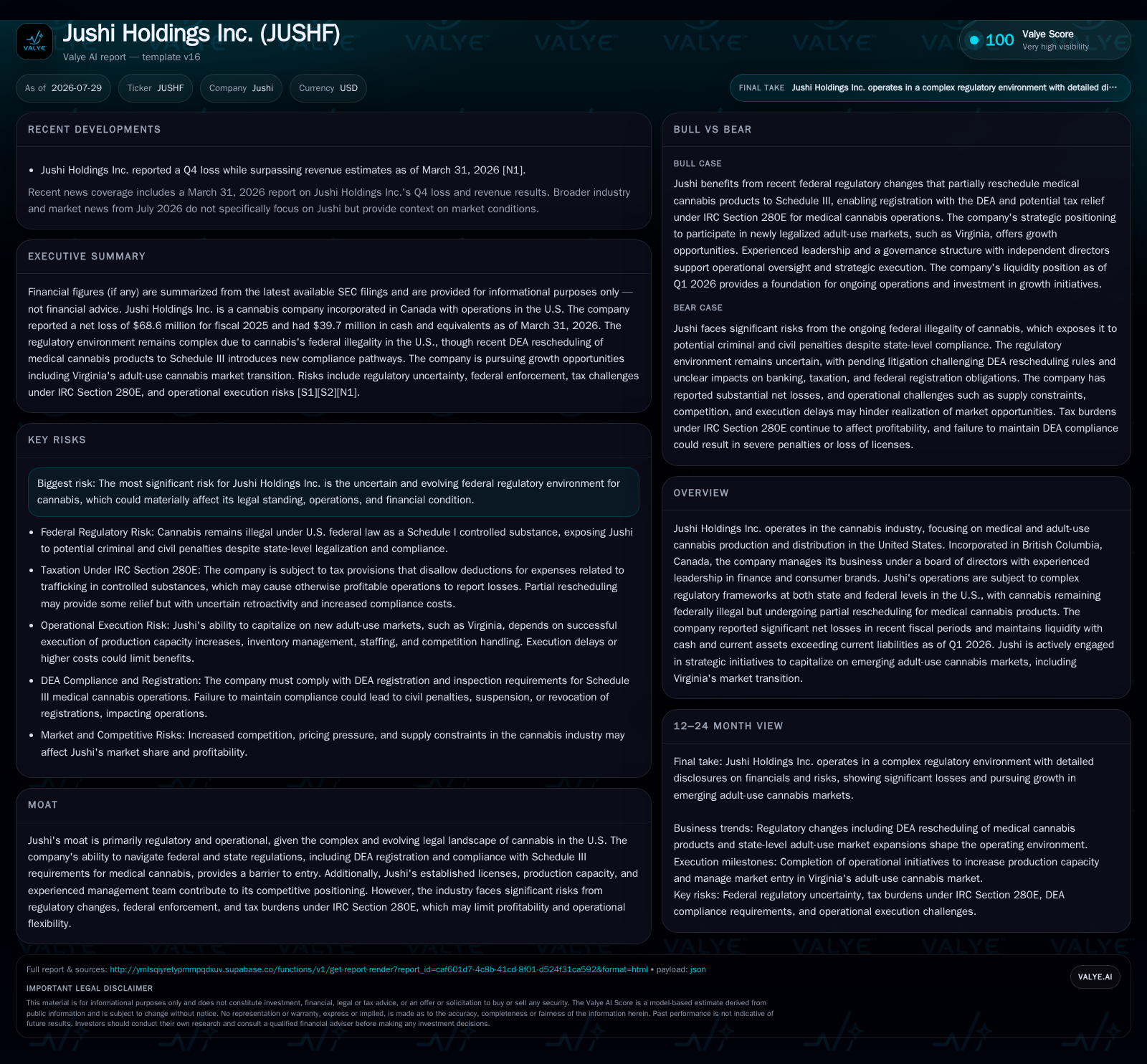
Jushi Holdings Inc. reported operational progress in its second quarter 2026 10-Q, underscoring ongoing challenges and opportunities in the cannabis sector. The company secured shareholder approval for redomiciling from British Columbia to Nevada, aiming to better align its corporate structure with predominantly U.S.-based operations. While cannabis remains federally illegal, recent partial rescheduling of medical cannabis products introduces new federal compliance requirements that Jushi is actively addressing. The company remains heavily leveraged with a net debt position exceeding $200 million but maintains liquidity above current liabilities as it targets growth in emerging adult-use markets such as Virginia.
Recent Operating Update: Strategic Redomicile and Regulatory Compliance
Jushi Holdings Inc.'s second quarter 2026 10-Q filing dated July 28, 2026, highlights the company's navigation through a complex and evolving regulatory environment in the U.S. cannabis sector [S2]. A pivotal development during this period was shareholder approval of a Continuance plan to redomicile the company from British Columbia, Canada, to Nevada, USA [S26]. This strategic move aims to better align Jushi’s corporate domicile with its predominantly U.S.-based operations, which span medical and adult-use cannabis markets. Management emphasizes that while the Continuance is expected to enhance operational efficiency and shareholder value, uncertainties remain regarding the timing and realization of these benefits, reflecting the inherent challenges of regulatory and market volatility in the cannabis industry [S26].
Concurrently, Jushi is adapting to significant federal regulatory shifts. In April 2026, the DEA partially rescheduled certain FDA-approved medical cannabis products from Schedule I to Schedule III under the Controlled Substances Act (CSA), enabling qualifying state-licensed operators to pursue DEA registration and comply with new federal regulatory requirements [S28]. The DEA concluded administrative hearings in mid-July 2026, marking a critical juncture for medical cannabis operators like Jushi to integrate federal compliance frameworks. However, adult-use cannabis remains federally classified as a Schedule I substance, maintaining substantial legal and operational risks despite evolving state legalization regimes [S28].
This bifurcated regulatory landscape creates a dual compliance environment: medical cannabis operations may increasingly align with federal standards through DEA registration and oversight, while adult-use segments continue to operate under federal prohibition. The impact of this regulatory split on Jushi’s product portfolio profitability, access to banking services, and operational flexibility remains a key area of focus.
Business Model: Vertically Integrated Cannabis Producer and Distributor
Jushi operates as a vertically integrated multi-state operator (MSO), managing licensed cannabis cultivation, product manufacturing, and distribution across multiple U.S. states [S1]. Its product portfolio includes cannabis flower, edibles, concentrates, and other derivative products, distributed primarily through licensed dispensaries and wholesale channels. This vertical integration strategy enables Jushi to control product quality, optimize production yields, and capture margin across the value chain, consistent with industry peers such as Curaleaf Holdings and Cresco Labs.
Revenue is generated through wholesale sales to dispensaries and direct retail sales where permitted, with pricing and margins varying by product category. Flower products typically drive higher volume sales, while edibles and concentrates offer opportunities for margin enhancement through product innovation and brand differentiation. Key operating metrics include licensed cultivation capacity (measured in square footage or plant count), production yield per plant or per square foot, product sales volume (grams sold), number of dispensaries operated or supplied, average selling price by product category, gross margin per product line, inventory turnover rates, and customer acquisition costs for branded products.
The capital-intensive nature of cannabis cultivation and manufacturing facilities, combined with stringent regulatory compliance requirements such as licensing renewals, product testing, and security protocols, places significant pressure on operating cash flow [S1]. Additionally, the federal tax code under IRC Section 280E disallows deductions for many business expenses related to controlled substances, resulting in elevated effective tax rates that compress EBITDA margins even for large-scale operators
Industry Structure and Competitive Position
The U.S. cannabis industry operates under a fragmented and complex regulatory framework, with states varying widely in their legalization status, licensing requirements, excise tax structures, and enforcement policies. Federal prohibition under the CSA as a Schedule I substance for non-medical cannabis products restricts interstate commerce and banking access, creating unique operational challenges and barriers to scale [S28].
Within this environment, MSOs like Jushi compete by securing broad state licensing footprints, expanding cultivation and manufacturing capacities, and developing diversified product portfolios. Competitors such as Green Thumb Industries and TerrAscend similarly emphasize geographic diversification and vertical integration to mitigate regulatory risks and capture market share. While Jushi does not disclose precise market share or cultivation capacity figures publicly, maintaining substantial licensed acreage and manufacturing throughput is critical to competitive positioning.
Federal restrictions on interstate cannabis commerce limit scalability and national consolidation, compelling MSOs to focus on state-by-state growth and operational efficiencies. The partial federal rescheduling of medical cannabis products introduces potential pathways for regulatory easing but does not yet resolve the fundamental federal-state legal conflict.
Growth Drivers
Jushi’s growth strategy centers on expanding into newly legalized adult-use markets, including Virginia, where it holds state licenses, while optimizing operations in established markets [S1]. The ongoing wave of state-level adult-use legalization offers episodic revenue growth opportunities but requires significant capital investment in cultivation infrastructure, manufacturing capacity, and retail channel development.
Product innovation is a complementary growth lever, with differentiated edibles, concentrates, and wellness-oriented extracts targeting premium consumer segments and reducing reliance on commoditized flower sales. Brand development and consumer marketing are increasingly important as markets mature and competition intensifies.
Operational improvements aimed at increasing cultivation yields per plant or per square foot directly enhance unit economics and margin profiles, critical in an environment of pricing pressure. Additionally, M&A activity remains a strategic avenue for geographic expansion, scale synergies in procurement and distribution, and portfolio diversification.
Potential federal policy developments, including further rescheduling or descheduling, could materially improve banking access and enable interstate commerce, representing a significant inflection point for MSOs like Jushi, though timing remains uncertain [S28].
Risks and Watchpoints
Federal illegality remains the primary risk, with adult-use cannabis still classified as a Schedule I substance under the CSA, exposing Jushi to potential enforcement actions despite compliance with state laws [S28]. The partial rescheduling of medical cannabis products introduces new compliance obligations and operational complexities.
The IRC Section 280E tax provision continues to impose a substantial tax burden by disallowing most business expense deductions related to controlled substances, limiting profitability and cash flow generation [S1]
Liquidity constraints are persistent due to the capital-intensive nature of cultivation and manufacturing operations, coupled with limited access to traditional banking and credit facilities. Jushi’s current capital structure reflects these pressures, with significant leverage and ongoing investment requirements.
Compliance complexity escalates with multi-state operations subject to diverse regulatory regimes, necessitating robust internal controls, quality assurance, and reporting systems to avoid license revocations or penalties.
Execution risks related to the Continuance redomiciling process include potential delays or failure to realize anticipated operational efficiencies and cost savings [S26]. Market competition intensifies as more operators enter legalized states, increasing pricing pressure and requiring differentiation through product innovation and brand strength.
Supply chain risks such as cultivation pests, raw material shortages, or manufacturing disruptions can affect yield consistency and product availability. Consumer demand variability linked to economic conditions and social acceptance trends adds further uncertainty.
Litigation risks from product claims or workplace safety issues could result in reputational damage or financial liabilities. State-level regulatory changes, including licensing fee adjustments or packaging mandates, require agile operational responses.
What To Watch Next
Key upcoming developments to monitor include:
- Progress and completion status of the Nevada Continuance transaction following shareholder approval [S26].
- Legal and regulatory outcomes related to DEA rescheduling rules and any judicial challenges impacting operational certainty [S28].
- Quarterly financial performance trends, particularly movement toward EBITDA breakeven amid ongoing capital expenditures.
- Licensed cultivation capacity utilization rates as indicators of scale efficiency and production optimization.
- Shifts in product mix emphasizing growth in higher-margin edibles and concentrates.
- Regulatory developments in key states like Virginia, including expansions of adult-use licenses and retail footprint opportunities.
- Improvements in capital structure, including reductions in interest expense and net leverage.
- Impacts of federal policy changes on banking access and interstate commerce rights.
- Management commentary on strategies to mitigate IRC Section 280E tax impacts and optimize tax planning.
- Announcements of M&A activity that could enhance geographic diversification or product portfolio breadth.
Financial Profile Discussion
This financial positioning underscores the capital-intensive nature of Jushi’s business and the importance of operational scale, margin expansion, and regulatory clarity to improve cash flow generation and deleveraging prospects.
This analysis is based exclusively on publicly filed SEC documents through July 28, 2026, and validated financial data as of March 31, 2026. It avoids speculative assertions and focuses on the operational, regulatory, and financial factors shaping Jushi Holdings’ current and near-term outlook, reflecting the unique complexities of the U.S. cannabis industry.
Disclaimer: This is research-only, informational analysis and not investment advice. It may include AI-generated interpretation and general industry context. Always verify important details using primary sources.

Comments