
Seven Hills Realty Trust Maintains Portfolio Stability Amid Transitional CRE Market Recovery
SEVN’s Q2 2026 filing reveals steady portfolio credit quality and disciplined leverage management within the evolving middle market transitional CRE finance environment.
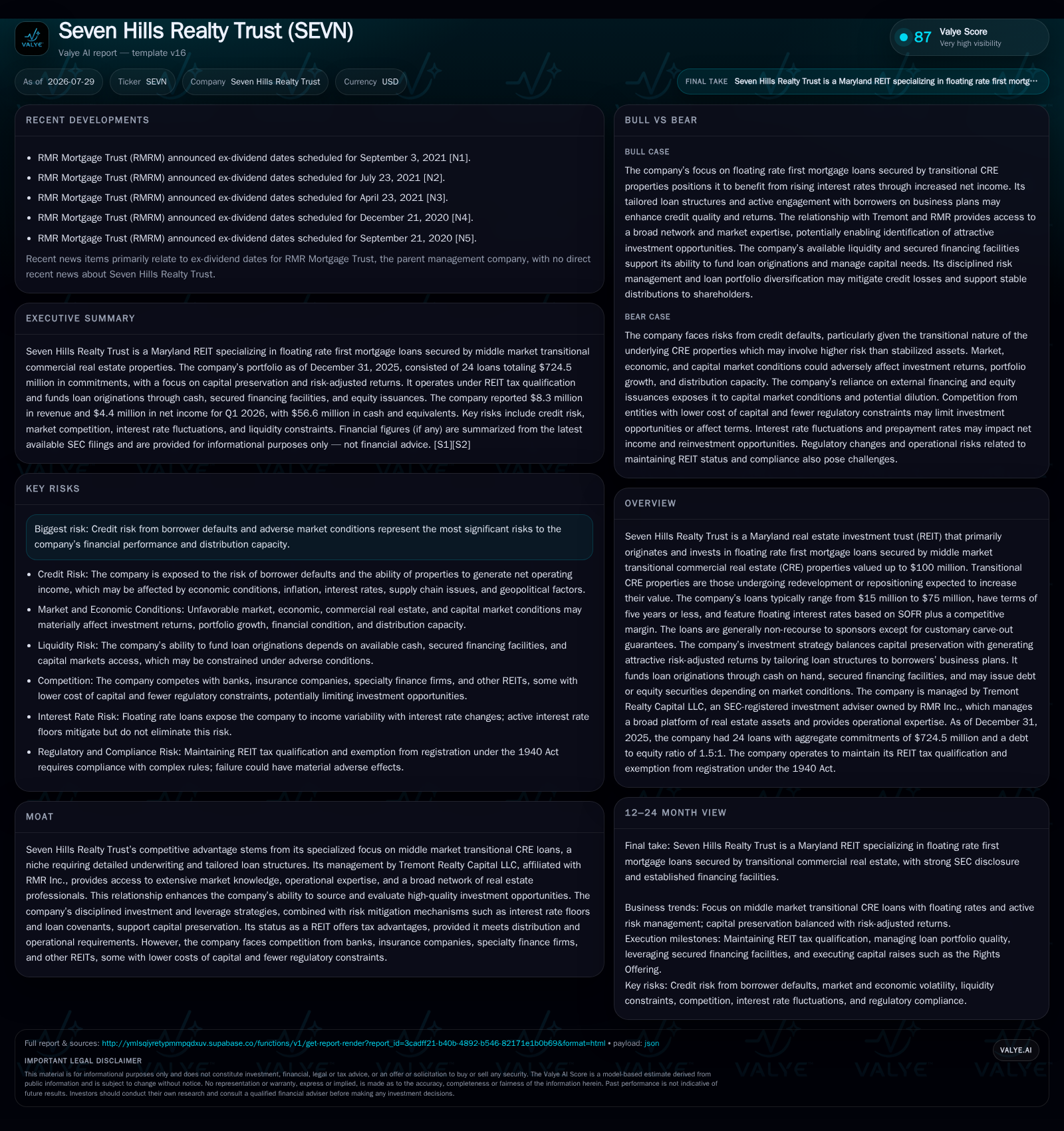
Seven Hills Realty Trust (SEVN) reported stable operational results in its Q2 2026 10-Q, reflecting consistent portfolio performance in a recovering commercial real estate market. The company’s focus on floating rate first mortgage loans secured by transitional properties, supported by specialized underwriting and secured financing facilities, underpins its competitive positioning. Key risks remain borrower credit quality and interest rate volatility, but SEVN’s conservative leverage and active risk monitoring provide resilience amid ongoing sector uncertainties.
Q2 2026 Operating Update Highlights Portfolio Resilience during Transitional CRE Market Dynamics
In its July 28, 2026 quarterly report [S2], Seven Hills Realty Trust reaffirmed a stable operating profile characterized by consistent loan portfolio size and weighted average coupon rates. The company reported no material deterioration in credit quality or movement into non-accrual status during the quarter, underscoring borrower resilience within its middle market transitional CRE focus [S3]. The risk environment remained consistent with prior disclosures [S1], emphasizing borrower credit performance and prevailing market conditions as primary drivers.
Liquidity management continues to rely on disciplined access to multiple secured financing facilities alongside robust cash reserves [F1]. This prudent approach supports operational flexibility during evolving transaction volumes and market liquidity.
Business Model: Focused on Floating Rate First Mortgage Loans for Transitional CRE
SEVN concentrates on originating and investing in floating rate first mortgage loans ranging from $15 million to $75 million, secured by transitional commercial real estate properties with valuations up to $100 million [S1]. These loans carry floating interest rates tied to SOFR plus competitive margins and incorporate average interest rate floors near 2.81% as of late 2025 [S1]. This design provides yield sensitivity to rising rates while protecting against significant downside rate declines.
The transitional CRE segment involves properties undergoing redevelopment or repositioning intended to enhance asset value. SEVN’s loans generally have terms of five years or less, reflecting their bridge financing nature with expected refinancing or sale exit strategies aligned to redevelopment milestones [S1].
Loans are structured as non-recourse to sponsors except for standard carve-out guarantees that mitigate risk without fully exposing sponsor balance sheets. Additionally, SEVN earns ancillary fees such as origination, exit, extension, or modification fees that supplement interest income and enhance overall yield [S1]
Competitive Position: Niche Expertise Enhances Underwriting Precision
SEVN differentiates itself within the mortgage REIT sector by focusing on the underserved middle market transitional CRE niche requiring specialized origination expertise and customized deal structuring. This specialization is reinforced through its affiliation with Tremont Realty Capital LLC, which provides deep domain knowledge and an extensive network for sourcing and managing complex loans [S1].
While larger peers like Starwood Property Trust or Blackstone Mortgage Trust offer scale and broader diversification, SEVN’s concentrated strategy allows precise tailoring of loan covenants and structures according to borrower business plans and collateral profiles. This active engagement supports effective risk mitigation.
The competitive landscape includes banks, insurance companies, specialty finance firms, and other mortgage REITs targeting various CRE debt segments. SEVN’s floating rate loan focus with embedded interest floors can offer relative yield stability amid fluctuating interest rate environments.
Growth Drivers: Market Recovery Supports Bridge Financing Demand
Following three Federal Reserve interest rate cuts in 2025, U.S. CRE transaction activity showed signs of recovery that favorably impacts SEVN’s origination pipeline [S1]. Improved monetary policy stability alongside liquidity availability bolsters investor confidence in transitional assets requiring bridge capital.
SEVN benefits from aligning floating rate asset yields with floating rate secured borrowings—a critical factor as rising base rates increase funding costs industry-wide [S1]. The company’s ability to structure flexible amortization schedules keyed to borrower redevelopment timelines positions it well against banks constrained by regulatory capital rules or risk appetite.
Future growth depends on maintaining disciplined underwriting standards amid macroeconomic uncertainty while leveraging demand for specialized bridge financing solutions tailored to transitional projects.
Risks: Credit Quality Vigilance Critical Amid Transitional Property Uncertainties
Loans secured by properties undergoing transformation inherently carry higher credit risk due to execution uncertainty. SEVN addresses this through comprehensive quarterly credit evaluations assigning dynamic risk ratings from low ("1") to higher risk bands ("4"), based on sponsor financial strength, property performance versus business plans, LTV ratios, covenant compliance, and cash flow sufficiency [S1]
As of late 2025, no loans were rated "impaired/loss likely" ("5"), indicating robust portfolio health proximate to the latest quarterly report [S1][S2]. Risk mitigation also includes covenants enforcing cash flow sweeps or reserve requirements designed to preserve principal during stress events.
Ongoing challenges include inflationary pressures, interest rate volatility affecting repayment capacity and refinancing feasibility, supply chain disruptions impacting redevelopment timelines, and geopolitical uncertainties.
Extension options or modifications aimed at maximizing recoveries may extend asset durations beyond liability maturities—adding execution complexity [S1].
What Investors Should Monitor Post Q2 Filing
Key indicators include new loan originations’ weighted average yields relative to historical norms; any increase in covenant breaches; changes in allowance for credit losses; movements in default or non-accrual statuses; and progress on refinancing bridge loans into longer-term takeout mortgages—critical markers of borrower execution success on transitional projects [S2][S3].
Changes in leverage utilization under master repurchase facilities or amendments affecting collateral advance rates or margin call triggers will also signal shifts in liquidity flexibility amid potentially volatile conditions.
Financial Profile Discussion: Conservative Leverage Positions SEVN for Stability Amid Interest Rate Pressures
As of March 31, 2026, Seven Hills held approximately $56.6 million in cash equivalents against roughly $64.5 million in total debt—yielding a modest net debt position near $7.9 million—reflecting conservative leverage consistent with targeted loan-to-value guidelines capped at about 75% per underwriting standards [F1][S1]
Funding is primarily sourced through secured financing agreements including master repurchase facilities with UBS, Citibank, Wells Fargo, plus a BMO facility extended through early 2028 featuring advance rates around 75%-80%, contingent upon collateral valuations [S4][S5][S6]. These facilities impose covenants requiring maintenance of tangible net worth minimums and liquidity thresholds that reinforce financial discipline [S12][S16].
This capital structure supports adherence to REIT distribution mandates while providing flexibility to absorb margin calls or refinance needs triggered by adverse collateral revaluations or borrower stress scenarios [S1][S23]. Rising base interest rates imply increased funding costs that necessitate ongoing margin management via disciplined loan pricing and fee income diversification
Net interest income remains closely tied to SOFR fluctuations given the predominantly floating rate portfolio—with embedded interest floors mitigating downside yield variability—underscoring the importance of monitoring spread dynamics relative to funding expenses.
Financial position in context
As of 2026-03-31, companyfacts shows $57mm in cash and equivalents and $64mm of total debt [F1]. The same snapshot implies net debt of roughly $8mm, keeping balance-sheet context relevant but secondary to the operating story [F1].
This analysis synthesizes information from Seven Hills Realty Trust’s SEC filings through July 28, 2026 ([S1], [S2], [S3]) supplemented by current financial snapshot data ([F1]) within an industry framework emphasizing mortgage REIT operations focused on middle market transitional CRE lending. It aims to provide an informed perspective grounded exclusively on disclosed evidence.
Disclaimer: This is research-only, informational analysis and not investment advice. It may include AI-generated interpretation and general industry context. Always verify important details using primary sources.

Comments