
TPG RE Finance Trust Navigates Portfolio and Leverage Dynamics with Affiliate Conflicts in Focus
Latest quarter reveals pressure on earnings and portfolio quality amid complex financing and affiliated competition risks.
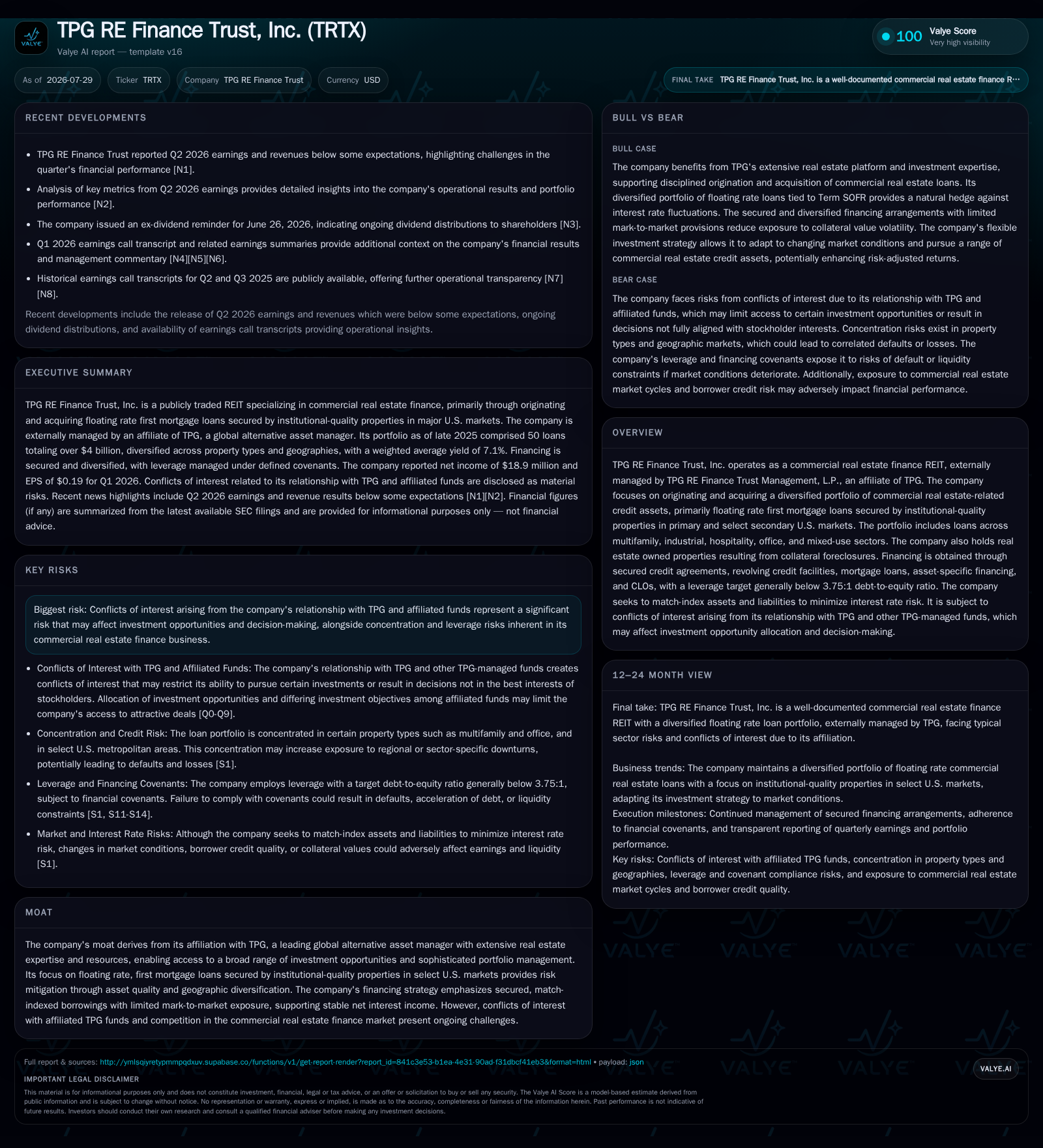
TPG RE Finance Trust, Inc. (TRTX) reported second quarter 2026 operating results signaling challenges in meeting revenue estimates amid a portfolio comprising primarily floating rate first mortgage loans secured by institutional-quality real estate in the U.S. The company’s externally managed REIT business model centers on originating and acquiring commercial real estate-related loans and financing these through secured credit agreements and CLOs with a target leverage below 3.75:1. Although TPG affiliation offers sophisticated management and deal flow access, conflicts of interest with affiliated funds and sector competition could restrict investment opportunities. Monitoring portfolio credit quality, covenant compliance, and capital market access will be key to assessing sustainability of earnings and dividend coverage going forward.
Recent Operating Update
TPG RE Finance Trust’s latest quarterly filing for Q2 ended June 30, 2026 details operational results that fell short of revenue and earnings expectations according to contemporaneous reports [S2][N1]. This shortfall occurred despite the company’s focus on a floating rate portfolio designed to benefit from rising interest rates. The earnings miss underscores potential ongoing pressures from loan performance volatility or competitive pricing dynamics within its commercial real estate finance specialty. The accompanying Form 8-K presented alongside the 10-Q further confirms no significant new material events beyond standard quarterly disclosure [S3].
Business Model: Portfolio Composition and Financing Structure
TRTX operates as an externally managed commercial real estate finance REIT focused on originating and acquiring a diversified portfolio of primarily floating rate first mortgage loans secured by institutional-quality properties concentrated in primary and select secondary U.S. markets [S1]. The portfolio spans multifamily, industrial, hospitality, office, and mixed-use sectors—a range intended to diversify risk while capturing growth across various real estate submarkets.
The company generates income predominantly through net interest spreads earned on this loan book. Loans typically carry principal balances exceeding $50 million with as-is loan-to-value (LTV) ratios below 75% at origination or acquisition [S19]. Floating rate loans indexed to one-month Term SOFR plus credit spreads generally between 250-400 basis points provide natural interest rate sensitivity that increases revenue as benchmark rates rise.
Financing is obtained through a combination of secured credit agreements, revolving facilities, mortgage loans, asset-specific financing arrangements, and collateralized loan obligations (CLOs) issued by wholly owned subsidiaries [S5][S8]. This mix enables match-funding strategies where liabilities are correlated to asset durations and interest benchmarks to reduce mark-to-market volatility exposure. Approximately 82% of their financing arrangements as of year-end 2025 contained no mark-to-market provisions [S8].
Leverage is tactically managed; the firm targets maintaining debt-to-equity ratios generally below 3.75:1 within contractual financial covenants [S16]. The financial covenants encompass LTV limits (maximum around 83%), minimum interest coverage ratios (>1.30x), and liquidity thresholds [$15 million or 5% of recourse debt] monitored primarily by revolving lenders [S21].
The firm also holds some properties as real estate owned (REO), mainly from foreclosures related to impaired loans. These assets introduce property-level operating risk distinct from loan credit risk since carrying costs and disposition timing can materially affect realized returns [S1]
Industry Structure and Competitive Position
Commercial Real Estate Finance REITs like TRTX serve an intermediary role providing capital liquidity between institutional investors seeking yield and real estate operators requiring financing. Its peer group includes large publicly traded REITs such as Starwood Property Trust, Blackstone Mortgage Trust, Annaly Capital Management (in mortgage lending domains), alongside private credit funds aggressively competing for attractive deals outside public markets.
Underlying competitive advantages arise from TRTX’s affiliation with parent TPG—a leading global alternative asset manager with substantial real estate expertise ($38 billion in TPG’s Real Estate platform AUM at end-2025) enabling proprietary sourcing capabilities and sophisticated risk management frameworks [S1]. However, this affiliation also creates conflicts of interest given overlapping investment mandates with other TPG-affiliated funds such as the TRECO Funds highlighting governance complexities not typically faced by stand-alone public REIT competitors [S2]. Conflicts may constrain access to certain deals or lead to suboptimal portfolio construction from a minority shareholder perspective.
The broader sector benefits from favorable trends including increased demand for commercial real estate financing driven by cyclical transaction volumes and refinancing activity plus structurally higher interest rates enhancing floating-rate portfolios’ net yields.
Growth Drivers
Key growth drivers for TRTX include:
- Rising Interest Rates: The predominant floating rate composition of loans makes TRTX’s net interest income positively correlated with benchmark increases like Term SOFR.
- Commercial Real Estate Transaction Activity: Periods of increased refinancing or acquisition activity create more loan origination volume opportunities.
- Portfolio Diversification: Expanding into new geographic or property sub-sectors could mitigate concentration risks while accessing higher growth arenas.
- Capital Market Innovations: Utilization of CLOs or other structured finance vehicles can optimize cost of capital compared to unsecured debt issuance.
- Strategic Sourcing via TPG Network: Leveraging parent firm relationships confers competitive advantage in sourcing larger or unique credits not broadly marketed.
Together these factors set the foundation for expanded portfolio scale or improved yield capture if execution aligns well with macroeconomic conditions.
Risks and Watchpoints
Several key risks merit diligent monitoring:
- Conflict of Interest Risks: Cross-investment among TPG funds may impair independent decision-making or dilute TRTX shareholder interests over time [S2].
- Credit Quality Deterioration: Transitional loan categories face higher underwriting uncertainty during property repositioning phases risking non-performing loans increasing loss reserves.
- Leverage Constraints & Covenant Compliance: Past covenant waivers spotlight sensitivity to collateral values; margin calls could constrain liquidity forcing reactive asset sales potentially at unfavorable prices.
- Interest Rate Mismatch Residual Risk: Although match-funding strategies exist, some residual basis risk remains particularly given evolving capital markets dynamics or derivative absence.
- Liquidity & Refinancing Access Risk: Dependence on capital markets exposes TRTX to disruptions that could impair raising incremental funding needed for new acquisitions or refinancing existing maturities under favorable terms.
- REO Operating Risks: Holding foreclosed properties involves management complexity distinct from financial underwriting demands.
These markers collectively inform trajectory toward stable cash flow generation supporting dividends aligned with REIT qualification requirements.
Financial Profile Discussion
As of March 31, 2026, TRTX held approximately $3.38 billion in total debt against $92 million in cash equivalents producing a net debt position near $3.29 billion consistent with prior levels reflecting stable leverage execution [F1]. This supports their stated target leverage metric below 3.75:1 although exact equity figures would refine this ratio assessment further. The mix includes CLO issuances representing a significant proportion alongside secured revolving lines expiring principally beyond 2030 narrowing near-term refinancing risk concerns [S9][S16].
Notably, the company recorded $60 million net income for full-year 2025 illustrating positive profitability albeit modest relative to balance sheet size which suggests continued reliance on spread income rather than capital gains as core earnings engine [F1]
Its success depends heavily on balancing growth through origination activity against prudent leverage governance amid evolving credit cycles characteristic of the real estate finance industry.
Financial position in context
As of 2026-03-31, companyfacts shows $92mm in cash and equivalents and $3.4bn of total debt [F1]. The same snapshot implies net debt of roughly $3.3bn, keeping balance-sheet context relevant but secondary to the operating story [F1].
Disclaimer: This is research-only, informational analysis and not investment advice. It may include AI-generated interpretation and general industry context. Always verify important details using primary sources.

Comments