
Enphase Energy Advances Integrated Solar Platform Amid Market and Operational Challenges
Enphase Energy's latest quarter shows resilience in integrated solar solutions with ongoing restructuring and strong liquidity support.
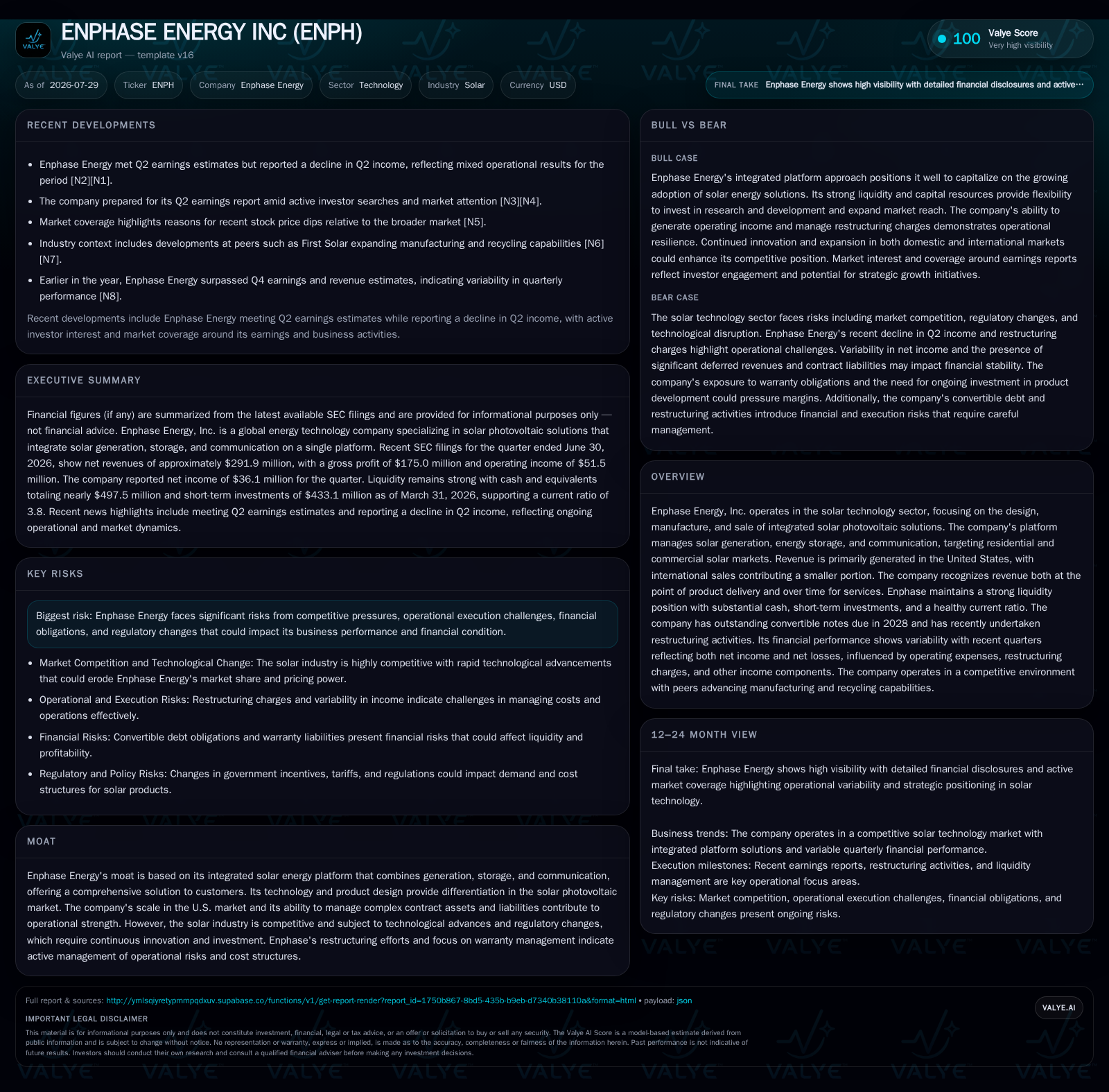
Enphase Energy reported operational results for Q2 2026 showing continued investment in its integrated platform combining solar generation, storage, and communication. The company navigates restructuring charges and warranty management complexities that impact near-term profitability but align with longer-term efficiency goals. Enphase’s business model leverages hardware sales complemented by software-enabled services, primarily focused on the U.S. residential and commercial markets. Competitive pressures and regulatory dynamics remain central risks, while liquidity and capital structure reflect a solid financial footing to support growth initiatives.
Recent Operating Update
Enphase Energy’s Q2 2026 10-Q filing reveals no new allowance activity for credit losses related to loan receivables during the quarter ended June 30, 2026, underscoring stable credit risk management in its financing operations [S2]. The company holds a non-controlling variable interest in a residential solar and storage finance entity classified as a Variable Interest Entity (VIE), reflecting Enphase’s strategic involvement in financing solutions that facilitate customer access to solar-plus-storage systems. This financing exposure complements its core hardware sales by supporting broader market penetration through installer and customer financing programs [S2].
Operationally, Enphase continues to incur restructuring charges and asset impairment costs associated with an ongoing restructuring plan aimed at optimizing its cost structure and aligning manufacturing and service capacity with evolving demand patterns [S2]. These charges, while pressuring near-term operating income, are part of management’s efforts to enhance long-term operational efficiency and margin sustainability amid competitive market conditions
Liquidity remains a key strength, with approximately $498 million in cash and cash equivalents and a current ratio of about 3.8 as of March 31, 2026, providing a robust buffer against short-term risks and enabling capital flexibility for growth initiatives [F1][S11]. The company’s secured revolving credit facility was amended to increase the borrowing capacity from $30 million to $50 million, with payment-in-kind (PIK) interest accruing quarterly at 9% per annum. This facility supplements Enphase’s capital structure, which includes convertible senior notes due in 2028 with a fair value of approximately $573 million, balancing liquidity needs with manageable refinancing timelines [S11][S16].
Business Model Specifics
Enphase Energy operates an integrated solar photovoltaic (PV) ecosystem that combines advanced microinverters, energy storage systems, and a proprietary solar energy management platform. This platform manages solar generation, storage charge and discharge cycles, and grid communication through unified software architecture, enhancing power conversion efficiency and system reliability—key differentiators in the residential and commercial solar markets [S2].
Revenue is generated primarily through the sale of hardware products, including microinverters and energy storage units, recognized at the point of delivery [S2]. Complementing this, Enphase derives recurring revenue from software subscriptions and managed service contracts related to system monitoring, warranty coverage, and energy management services, recognized over time. This hybrid revenue model influences cash flow profiles by blending transactional sales with recurring streams, which depend on factors such as installation volumes, customer segment mix, and software adoption rates
The company’s monetization strategy is concentrated in the U.S. residential and commercial markets, where renewable energy incentives and net metering policies drive demand for distributed generation solutions. While international sales represent a smaller portion of revenue, they offer optionality for geographic diversification subject to regulatory and market conditions [S2]
Industry Structure and Competitive Position
Positioned in the midstream segment of the solar value chain, Enphase designs and manufactures critical components such as microinverters and energy storage units, while providing integrated energy management software. This contrasts with upstream solar module manufacturers like First Solar and downstream installation and EPC firms. Enphase’s integrated hardware-software platform differentiates it from competitors focused solely on hardware or software.
Key competitors include SolarEdge Technologies, which offers inverter and power optimizer solutions with a more centralized inverter approach, and Tesla Energy, which competes with solar-plus-storage bundles emphasizing battery technology and brand strength. SunPower Corporation targets premium residential and commercial solar segments with high-efficiency PV modules but lacks Enphase’s level of software integration.
Competitive dynamics hinge on innovation in microinverter technology, product yield and defect rates, warranty claim management, manufacturing scale economies, pricing power, and expansion of recurring revenue from software and services. These factors collectively influence gross margin trends and operating leverage potential.
Growth Drivers
Several structural factors underpin Enphase’s growth prospects:
- Accelerating adoption of residential solar systems driven by federal and state renewable energy mandates, combined with rising electricity prices that enhance the economics of self-generation.
- Availability of investment tax credits and other renewable incentives that reduce upfront costs for customers.
- Advances in integrating energy storage with solar systems, enabling behind-the-meter load shifting and resilience benefits.
- Increasing commercial sector demand for scalable solar-plus-storage solutions aligned with corporate sustainability goals.
- Expansion of Enphase’s solar energy management platform, which may increase recurring revenue through subscription-based software licenses and grid services.
- Financing solutions facilitated through VIE structures that alleviate upfront capital barriers for customers and installers.
Key operating metrics to monitor include installed solar capacity (MW), number of systems deployed, average selling price (ASP) trends reflecting product mix shifts toward storage integration, warranty claim rates indicating product reliability, and order backlog levels signaling demand strength.
Risks and Watchpoints
Enphase faces several risks that warrant close observation:
- Rapid technological change in solar power conversion and energy storage requires sustained R&D investment to maintain competitive positioning.
- Supply chain disruptions, particularly in semiconductor components critical to microinverter production, could affect manufacturing throughput and delivery schedules.
- Regulatory shifts impacting renewable incentives, net metering policies, or grid interconnection standards could alter customer economics and slow adoption rates.
- Warranty obligations, accounted for using fair value estimates with Level 3 unobservable inputs, represent long-tail liabilities sensitive to product reliability and claim cost assumptions, potentially affecting earnings volatility [S11][S12].
- Execution risks related to restructuring initiatives could delay cost savings and margin improvements.
- Credit risk exposure through financing arms and VIE interests could increase if customer defaults rise amid economic downturns [S2].
- Competitive pricing pressures from established and emerging inverter and energy storage providers may compress ASPs and margins.
Operational indicators to watch include trends in warranty claim costs relative to sales, growth in software subscription uptake, gross margin improvements post-restructuring, and backlog conversion rates reflecting order fulfillment.
Financial Profile Discussion
As of March 31, 2026, Enphase held approximately $498 million in cash and equivalents, supported by current assets of about $1.83 billion against current liabilities near $482 million, resulting in a strong current ratio of approximately 3.8 [F1][S11]. This liquidity position supports operational resilience and investment capacity.
The company’s debt profile is anchored by convertible senior notes due in 2028 with a fair value around $573 million, complemented by a secured revolving credit facility increased to $50 million, which accrues payment-in-kind interest quarterly at 9% per annum [S11][S16]. This capital structure reflects the capital-intensive nature of solar technology manufacturing while providing financial flexibility through deferred cash interest payments.
Enphase’s accounting for warranty obligations incorporates fair value measurements with Level 3 inputs, reflecting long-term exposure to product reliability risks that require ongoing monitoring due to their potential impact on earnings volatility [S11][S12].
Despite near-term earnings pressure from restructuring charges, the company generated positive net cash flows from operating activities exceeding $143 million in the first half of 2026, underscoring underlying cash generation capacity to fund R&D and working capital needs without immediate reliance on external capital markets [S16]
What to Watch Next
Upcoming quarterly disclosures will be critical to assess revenue mix evolution between hardware and higher-margin software and services, providing insight into the sustainability of recurring revenue growth. Progress on restructuring initiatives, including reductions in expense run rates, will indicate the trajectory toward improved profitability.
Monitoring working capital efficiency and capital expenditure plans tied to production scale enhancements will shed light on operational leverage potential. Additionally, updates on the utilization of the revolving credit facility and refinancing strategies ahead of convertible note maturities will inform assessments of financial flexibility.
Finally, developments in renewable energy incentive policies and net metering regulations across key U.S. states will materially influence demand dynamics, requiring agile responses from Enphase to maintain growth momentum.
This analysis synthesizes public SEC filings through July 28, 2026, combined with relevant industry context. It is intended as an informed sector perspective grounded in disclosed factual data and does not constitute investment advice.
Disclaimer: This is research-only, informational analysis and not investment advice. It may include AI-generated interpretation and general industry context. Always verify important details using primary sources.

Comments