InMed Pharmaceuticals Navigates Regulatory Challenges with Rare Cannabinoid Focus and Solid Liquidity
InMed’s niche in rare, non-intoxicating cannabinoids faces significant regulatory uncertainty as U.S. legislation looms.
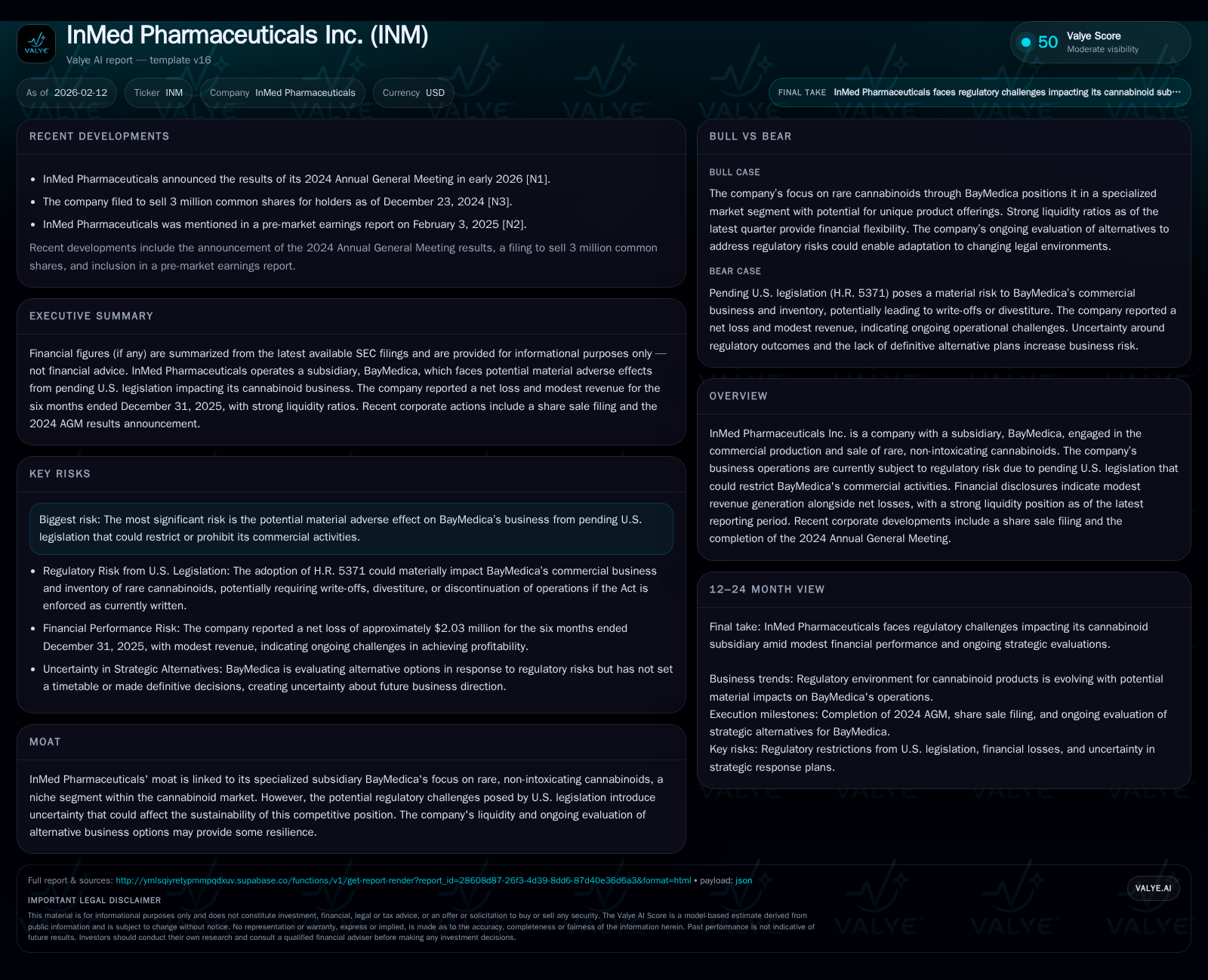
InMed Pharmaceuticals, through its subsidiary BayMedica, occupies a unique position focusing on rare, non-intoxicating cannabinoids—a specialization that affords differentiation yet encounters legislative peril due to the U.S. Continuing Appropriations Act H.R. 5371. Despite modest revenue of approximately $820K and ongoing net losses exceeding $2M, the company maintains a strong liquidity cushion with a current ratio near six. BayMedica continues commercial operations while evaluating strategic alternatives amid unclear regulatory outcomes set for November 2026. Corporate governance developments from the 2024 AGM reflect active stewardship but do not resolve fundamental regulatory uncertainties that heavily influence InMed’s strategic horizon.
Rare Cannabinoids as InMed’s Strategic Niche
InMed Pharmaceuticals anchors its market identity predominantly through BayMedica, a wholly owned subsidiary focused exclusively on the commercial production and sale of rare, non-intoxicating cannabinoids. This specialized portfolio diverges from mainstream cannabinoid products by concentrating on compounds that do not impart psychoactive effects but may hold therapeutic promise.
Such focus crafts a competitive moat distinct within the broader cannabinoid industry where many participants emphasize more common derivatives like CBD or THC. However, this niche inherently heightens sensitivity to shifts in regulation concerning cannabinoid classifications and permissible commerce. As documented financials reveal limited revenue generation juxtaposed against persistent losses, it underscores that while innovation drives differentiation, volume scale remains nascent, reinforcing vulnerability to external shocks [F1], [valye_report_excerpt].
BayMedica Subsidiary: Innovation Under Legislative Fire
BayMedica functions as InMed's commercial engine and innovation hub within this rare cannabinoid niche. Its capability to develop and produce these specialized compounds is central to value creation prospects.
Yet, this operational focus is subject to an uncertain regulatory landscape sharpening risks dramatically. The recently enacted H.R. 5371 bill in the U.S., colloquially termed the Continuing Appropriations Act for 2026, contains provisions that—if implemented in their current form—would directly curtail BayMedica’s ability to continue its present commercial activities [S2], [valye_report_excerpt].
This scenario casts a shadow over future revenue streams and raises questions about inventory viability and long-term operational continuity. While BayMedica presses ahead with sales amid the legislative limbo, its trajectory is anything but assured.
Decoding the Impact of U.S. H.R. 5371 on Business Operations
H.R. 5371 introduces specific prohibitions adversely affecting BayMedica's business model by November 12, 2026, unless amended or repealed prior to enforcement.
Fundamentally ambiguous at present is whether these critical sections of the law will be enacted without change or modified in ways that might soften their impact. This ambiguity impedes precise forecasting concerning sales strategies or inventory management—whether stock will become unsellable necessitating write-downs or if alternative regulatory approvals may emerge.
In consequence, management must grapple simultaneously with continuing operations tactically while exploring strategic safeguards including possible divestitures or pivots in manufacturing approaches—none of which are finalized nor timebound as disclosed to date [S2].
Financial Snapshot: Strength Amid Losses
The latest fiscal disclosures pinpoint modest revenues totaling approximately $820,000 for the twelve months ending December 31, 2025—a figure reflective of BayMedica’s early-stage commercialization efforts compounded by constrained market reach under evolving regulations [F1].
Counterbalancing this top-line generation is a net loss exceeding $2 million over the same period—a persistent deficit indicative of heavy investments in R&D and commercial infrastructure alongside limited scale economics [F1], [S2].
These financial contours portray a company still navigating the transition from developmental footing toward potential profitability.
Liquidity Buffer and Inventory Risk Management
Despite recurring losses, InMed presents a robust liquidity profile evidenced by cash and equivalents nearing $7 million and current assets substantially outpacing current liabilities (current ratio roughly 5.94) as of December 31, 2025 [F1].
This strong short-term financial position provides operational runway and flexibility amid unsettled external threats.
However, inventory risk remains acute as unsold cannabinoid stock reliant on unobstructed legal pathways could swiftly depreciate if regulatory changes restrict sales post-November 2026. Such write-offs would negatively affect asset balances and exacerbate profitability pressures unless mitigated through swift inventory liquidation or other measures [S2], [valye_report_excerpt].
Corporate Governance Highlights from the 2024 AGM
The company’s February 2026 disclosure following its Annual General Meeting reveals active shareholder engagement via standard corporate resolutions including share sale filings reflecting capital structure adjustments amid strategic considerations [N1].
While not elaborated extensively beyond procedural outcomes, this governance activity signals responsiveness amidst regulatory headwinds and ongoing capital needs.
Such stewardship is critical as executives navigate complex decision matrices balancing growth aspirations with increasing legal constraints.
Strategic Alternatives and Outlook Amid Regulatory Uncertainty
Facing substantial external risk from impending U.S. legislation, management has openly acknowledged ongoing evaluations of various contingency paths: potential divestment of BayMedica’s business lines where feasible; pivoting manufacturing techniques contingent on technical viability; or full discontinuation if insurmountable legal barriers materialize [S2], [valye_report_excerpt].
At present no definitive actions have been reported; timelines for decisions remain undefined highlighting strategic flexibility but also underscoring execution uncertainty.
The company’s ability to adapt will hinge critically on legislative developments and their interpretations within relevant jurisdictions—underscoring regulatory risk as paramount in shaping InMed's future trajectory.
This analysis compiles information available as of early February 2026 derived from filed SEC reports and recent news disclosures without offering investment recommendations.
Disclaimer: This is research-only, informational analysis and not investment advice. It may include AI-generated interpretation and general industry context. Always verify important details using primary sources.

Comments