
Inspired Entertainment Confronts Operational Challenges with Strategic Financial Moves
Inspired Entertainment’s Q1 2026 results reveal revenue resilience but net losses amid deferred revenues and cost pressures, accompanied by leadership changes to address financial discipline.
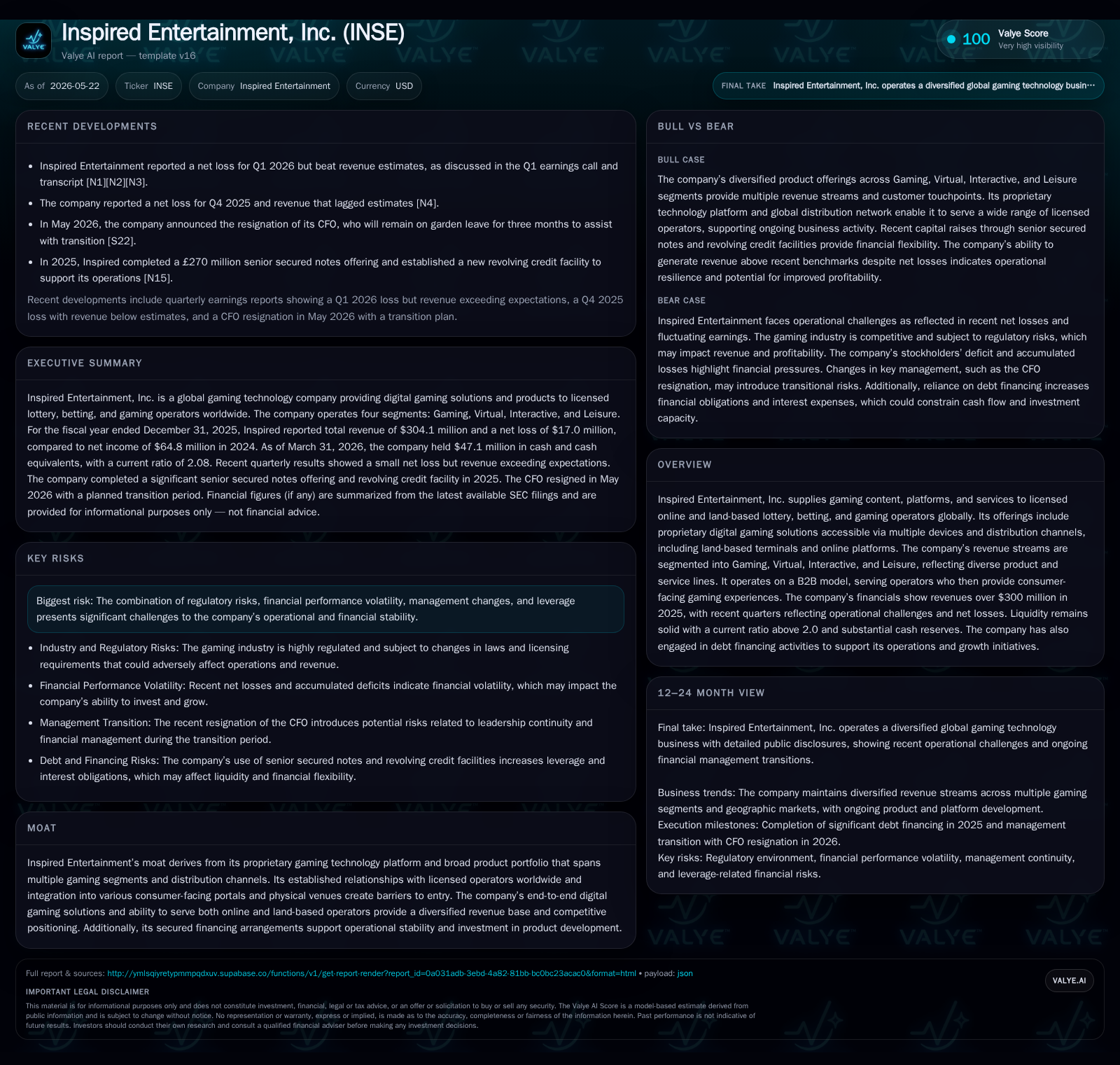
Inspired Entertainment posted a first-quarter 2026 revenue beat tempered by ongoing net losses reflecting operational and deferred revenue recognition challenges. The company remains well-capitalized with a current ratio above 2, though leverage remains elevated. Its B2B gaming platform serves licensed lottery and betting operators globally through diverse digital and land-based products. A recent CFO transition signals strategic recalibration amid regulatory and margin headwinds. Growth hinges on product innovation, market expansion, and licensing pipelines, while risks persist around regulation, technology obsolescence, and financial sustainability.
Recent Operating Developments: Q1 2026 Insights
Inspired Entertainment reported first-quarter 2026 financials on May 7th [S2], signaling a nuanced operating environment. Revenues surpassed analyst expectations driven by steady demand across interactive and gaming verticals but the bottom line remained under pressure with reported net losses. These losses partially reflect the impact of deferred revenue recognition related to timing differences between shipments of gaming terminals or system installations and revenue criteria fulfillment as detailed in the latest annual filing [S1]. Deferred revenues include prepayments that are recognized ratably over service periods such as maintenance or licensing fees, effectively smoothing revenue but also delaying immediate recognition.
Cost pressures persist amid investments in content development and platform enhancements. The April quarter saw some operational strain due to higher cost of sales in connection with inventory management — critical as gaming terminal demand is sensitive to technological refresh cycles and risk of obsolescence [S1]. Management highlighted continued emphasis on controlling operating expenses while prioritizing growth-oriented spend.
On May 18th [S3], Inspired announced the departure of longtime Chief Financial Officer James Richardson, succeeded by Mr. Wilson. This leadership change was framed as amicable without any disagreement related to accounting policies but may represent a strategic refocus on financial discipline amid ongoing challenges.
Business Model Overview: Diversified Gaming Solutions Across Channels
Inspired operates a predominantly B2B business model supplying licensed lottery operators, betting facilities, and gaming venues worldwide with proprietary gaming content, platforms, and services [S1]. Revenue streams are segmented into Gaming (land-based hardware terminals), Virtual (virtual sports content), Interactive (online digital platforms), and Leisure (physical leisure assets) categories.
The company’s products range from server-based gaming machines installed at brick-and-mortar locations to multi-device digital games accessible online. This diversity enables multiple integration points within operator ecosystems — from physical casino floors to mobile betting sites — creating layered revenue streams that mix upfront terminal sales with recurring licensing fees and maintenance contracts.
Revenue mechanics involve licensees paying either upfront for equipment or via ongoing usage/licensing fees structured typically as time-bound contracts or transaction-volume-based royalties. Volume drivers include unit deployments of terminals plus consumer engagement metrics like bets placed on hosted games. Pricing power varies across segments; terminal sales bear one-time sale margins while digital offerings provide higher-margin recurring revenues maintaining stickiness through integration complexity.
This multimodal offering enhances customer switching costs; operators face significant friction replacing established technology stacks including certified terminals mixed with software ecosystem dependency.
Industry Positioning: Competitive Moat and Peer Context
Inspired’s moat centers on its proprietary technology platform combined with an extensive product portfolio spanning both traditional land-based terminals and digital interactive solutions. Established contractual relationships with regulated lottery operators globally form a significant barrier given the complexity of regulatory approval processes for new gaming content or hardware deployments.
Its integrated approach serving online and offline operator models broadens addressable market reach beyond pure-play digital peers or legacy terminal manufacturers limited to single channels. This ambidextrous positioning allows cross-selling opportunities within operator accounts and diversification against market shifts.
Regulatory environments impose persistent operational constraints; however, licensed markets benefit from stable legal frameworks supporting long-term contracts. Compared with pure B2C competitors who face high user acquisition costs and brand dependence, Inspired leverages embedded distribution within operators that own direct consumer relationships.
Potential capacity limits relate chiefly to hardware manufacturing lead times modulated by technological innovation cycles where outdated terminals risk unsaleability or forced markdowns [S1]. Maintaining product relevance demands continuous R&D expenditures supported by secured financing arrangements.
Growth Drivers: Innovations and Market Expansion Opportunities
Growth at Inspired is catalyzed by several vectors:
- New Game Launches: Pipeline additions in virtual sports and interactive digital games aim to increase wallet share within existing customers and attract new operator deals.
- Emerging Markets Expansion: Regulatory liberalization opens opportunities in jurisdictions newly permitting online lotteries or betting platforms where Inspired can deploy turnkey solutions leveraging localized compliance expertise.
- Cross-Segment Synergies: Leveraging client portfolios across Gaming terminals to Interactive platforms allows sticky bundling strategies enhancing lifetime value.
- Secured Financing for R&D: Capital infusion supports rapid product scaling critical against agile competitors.
However, exact timelines for license approvals or new contract signings remain critical execution milestones influencing topline trajectories [S1]. The ability to accelerate adoption of cloud-native gaming solutions versus legacy hardware may define medium-term competitive standing.
Risks and Constraints: Regulatory, Financial, and Market Pressures
Inspired faces layered risk exposure:
- Regulatory Risks: Gaming products are heavily regulated; adverse policy shifts or delays in license renewals can materially disrupt revenue flow [S2].
- Financial Volatility: Net losses continue alongside elevated leverage (~$230 million net debt) stressing cash flows especially if revenue growth stalls [F1].
- Technological Obsolescence: Inventory largely includes gaming terminals vulnerable to rapid tech cycles requiring write-downs if demand softens or standards evolve faster than deployment cycles allow [S1].
- Management Transition: CFO change might introduce short-term execution risk though possibly also inject refreshed capital discipline focus [S3].
- Market Competition: Pressure from both incumbents specializing solely in digital content delivery or hardware providers focusing on volume terminal sales could squeeze margins without differentiated innovation.
These factors cumulatively impose constraints on valuation multiples given cyclicality inherent in operator capital spending budgets paired with policy sensitivity tightening investor scrutiny around profitability timelines.
Leadership Transition and Strategic Implications
The departure of CFO James Richardson in mid-May 2026 followed by the appointment of Mr [S3]. Wilson reflects a potential inflection point in corporate strategy focused on navigating current operational stresses while reinforcing governance structures
Richardson’s exit was not linked to disputes over accounting or policies but coincides with timing when the company faces margin compression amid increased investment demands. Wilson’s background (noted absence of prior disclosed conflicts) suggests an intended steady hand aiming at enhancing financial operations efficiency perhaps aligning liquidity management better with growth aspirations.
This executive change often signifies management’s acknowledgment of need for recalibrated cost controls or capital structure refinements pivotal during periods balancing growth investment against prudent balance-sheet stewardship.
Next Steps: Milestones and Execution Watchpoints
Stakeholders should monitor:
- Upcoming quarterly filings for confirmation of margin trajectory improvement initiatives disclosed during investor calls [N1][N2][S2].
- Progression on licensing deals within emerging regulated markets which could drive incremental bookings fueling medium-term growth pipelines.
- Updates regarding refinancing efforts or credit facility expansions pivotal for sustaining liquidity buffer given leverage profile.
- Regulatory environment news impacting key territories served by Inspired including lottery market developments which affect long-term contract stability.
- Execution success around deferred revenue management as related timing mismatches can transiently obscure underlying operating health.
These tangible metrics serve as barometers for validating management’s strategy execution amidst challenging industry conditions.
Financial Snapshot: Liquidity and Leverage Overview
As of March 31, 2026, Inspired holds $146 million in current assets against $70 million in current liabilities yielding a strong current ratio near 2.08 indicative of comfortable near-term liquidity coverage [F1]
Total debt aggregated approximately $278 million at end-of-year data points available from previous disclosures; adjusted net debt—accounting for cash holdings—is roughly $230 million signaling sustained leverage levels that require active management for interest burden mitigation [F1]
Capital structure support through secured financing grants operational flexibility yet balances critically on maintaining confidence from lenders/investors given volatility tied to regulatory exposure and earnings inconsistency. Cash conversion cycles will be closely watched along with capex pacing aligned against product refresh needs.
This analysis synthesizes publicly disclosed SEC filings including the latest quarterly report (May 7, 2026), recent event announcements (May 18 & 22), company presentations, earnings transcripts, together with comprehensive Valye News industry insight reflecting concrete operational realities without speculative projections or stock research views.
Disclaimer: This is research-only, informational analysis and not investment advice. It may include AI-generated interpretation and general industry context. Always verify important details using primary sources.

Comments