
Identiv's Turnaround: Charting Growth Through Market Expansion and Balance Sheet Discipline
Identiv navigates a post-divestiture landscape, leveraging RFID innovations and emerging markets while managing operational and competitive challenges.
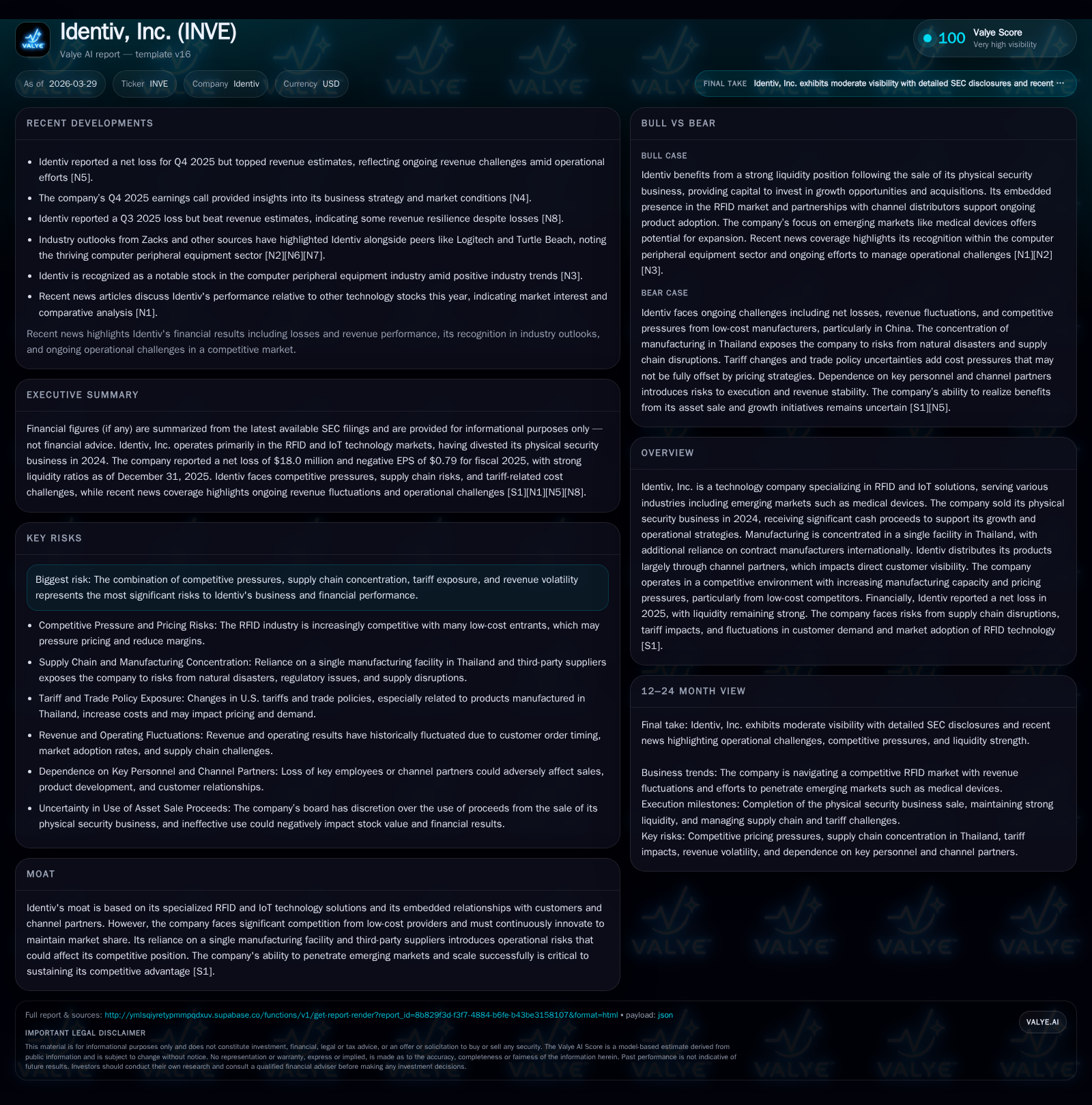
Identiv, Inc. has faced mounting operating losses through 2025 despite steady revenue levels since 2014, driven by pricing pressures and a competitive landscape flooded with low-cost providers. The company’s 2024 sale of its physical security business generated nearly $144 million in cash, bolstering liquidity to pursue growth initiatives and financial discipline. Identiv is focusing strategically on emerging markets, notably medical devices, requiring customized solutions amid significant execution risks. Its operational reliance on a single manufacturing facility in Thailand coupled with supply chain exposure introduces vulnerability. Strong liquidity and ongoing buybacks indicate capital allocation priorities under loss conditions. Investors should monitor new market penetration, margin recovery, and supply normalization for inflection signals.
Historic Performance Trends: From Revenue Stability to Mounting Losses
Identiv's revenue trajectory since FY2014 reveals a largely stabilized top line around the $60 million mark for several years, reflecting steady sales despite evolving market dynamics [F1]. After peaking at approximately $81.2 million in 2014, revenue experienced declines but recovered somewhat to $60.2 million by end-2017, where it has hovered without substantial growth thereafter [F1]. However, this revenue stability masks a worsening profitability profile.
Operating income deteriorated progressively from minor losses (-$0.3M in 2022) into significant negative territory, culminating in an operating loss of $22.1 million in FY2025 [F1]. Net income follows the same trend, exacerbated possibly by non-operating factors, dropping to -$18.0 million in 2025 compared to a brief book gain in 2024 linked to divestiture proceeds [F1]. Operating cash flows have trended negative as well (-$6.7M in 2025), accompanied by restrained capex spending ($1.1M), signaling contraction or tight operational control during loss periods [F1]. These worsening earnings reflect challenges such as gross margin compression amid competitive pressures and higher costs.
Historical performance (annual)
| FY | Net ($bn) | CFO ($mm) | OpInc ($mm) | Capex ($mm) | Net YoY |
|---|---|---|---|---|---|
| 2025 | -0.0 | -7 | -22 | 1 | -124.1% |
| 2024 | 0.1 | -15 | -28 | 1 | +100.0% |
| 2023 | -5489.0 | 1 | -5 | 4 | -1400255002.0% |
| 2022 | -0.0 | -8 | 0 | 4 |
Source: SEC companyfacts cache [F1].
Capital returns and efficiency (annual)
| FY | Buybacks ($) | FCF ($mm) | ROE% |
|---|---|---|---|
| 2025 | 1879000 | -8 | -12.8 |
| 2024 | 1879000 | -17 | 48.6 |
| 2023 | -3 | -7390402.8 | |
| 2022 | -12 | -0.5 |
Source: SEC companyfacts cache [F1].
Note: Detailed year-on-year figures available only for select financial metrics from recent filings.
Strategic Divesture and Capital Infusion: Impact of the Physical Security Sale
The September 2024 divestiture of Identiv's physical security business marked a pivotal restructuring event [S22]. This transaction yielded gross proceeds of approximately $143.9 million in cash, materially reinforcing the company's liquidity profile [S22]. With this infusion, Identiv chose a multipronged capital allocation approach including share repurchases under a $10 million program initiated November 2024, supporting shareholder returns even amid operating losses [S22][F1]. The board retains discretion over remaining proceeds for growth investment, working capital needs, R&D expenditure, or strategic acquisitions aligned with the firm's renewed focus on RFID/IoT technologies.
Post-sale financial statements confirm strong cash and equivalents of ~$129 million at end-FY2025 alongside minimal short-term liabilities leading to a very healthy current ratio near 15x [F1]. However, recurring operating losses underscore dependency on deploying these funds effectively towards innovation and scaling to reverse profitability drag.
Emerging Markets Focus: Leveraging Medical Devices for Growth
Identiv’s current strategic pivot emphasizes penetrating emerging verticals like medical devices that demand complex RFID/IOT customization [S1]. This sector presents distinct technical hurdles requiring tailored solutions capable of meeting rigorous regulatory standards and performance reliability unique to healthcare applications [S1]. Achieving commercial scale depends heavily on market acceptance which is not guaranteed due to potential mismatches between technology capabilities and end-user requirements.
Furthermore, Identiv faces risks related to sustaining the typically higher gross margins associated with medical device instrumentation products given the competitive pricing environment [S1]. The company's long-term growth will hinge on executing rapid product development cycles catering to this niche while overcoming barriers such as customer validation timelines and manufacturing flexibility.
Competitive Headwinds and Pricing Pressures in RFID
The RFID industry has witnessed an influx of lower-cost competitors predominantly from China who leverage cost leadership strategies enabled by inexpensive labor and scale contract manufacturing [S9]. Concurrently, contract manufacturer capacity has expanded broadly across Asia-Pacific regions creating a capacity glut relative to demand growth slowing down.
This overcapacity exerts downward pressure on product pricing forcing margin compression industry-wide [S1][S9]. For Identiv, maintaining differentiated technology leadership becomes imperative as commoditization encroaches on standard product lines with reduced pricing power [S9]. The technologically specialized segments such as secure RFID applications within medical or industrial sectors offer some moat but also require continuous innovation investment.
Operational Footprint Risks: Single-Site Manufacturing and Supply Chain Challenges
Identiv's manufacturing operations are concentrated primarily in one facility located in Thailand supported by additional contract manufacturers internationally [S8][S26]. This geographic concentration introduces significant operational risks including vulnerability to natural disasters—Thailand's region is historically prone to flooding—as well as potential compliance disruptions or equipment failures that could impair supply continuity [S24][S25].
Tariff exposure compounds these risks; approximately 15% of Identiv’s business is subject to U.S.-imposed tariffs linked with Thailand-origin products amidst evolving trade policies creating cost pass-through challenges [S18]. While the company has devised strategies aimed at mitigating tariff impacts through exemptions or supply chain optimization, residual uncertainties remain around enforcement actions affecting profitability.
Reliance on third-party contract manufacturers further complicates quality control and supply reliability resulting in potential shipment delays or inventory shortages that may impair customer relationships if not proactively managed [S26].
Talent Retention: Key Personnel Risks in a Specialized Tech Niche
The niche RFID/IoT technology sector experiences fierce competition for skilled engineers and sales professionals crucial for product innovation and go-to-market execution [S9][S1]. Identiv faces headwinds recruiting and retaining such talent given stronger brand recognition or deeper compensation budgets among some larger competitors.
Equity-based incentives constitute a sizable portion of employee remuneration aligning workforce interests with share price performance; however, recent share price weakness can undermine these incentives adversely affecting morale and attrition rates [S9][S1]. Loss of key personnel threatens continuity of product development cycles and jeopardizes critical client relationships sensitive to sales force turnover.
Financial Health Overview: Liquidity, Cash Flows, and Capital Allocation
At close of FY2025, Identiv showcased robust liquidity metrics highlighted by cash & equivalents totaling approximately $128.6 million against modest current liabilities yielding an exceptionally strong current ratio (~15.19x) evidencing solid short-term financial resilience [F1]. Nonetheless, operating cash flow remained negative at about $-6.7 million while capital expenditures were prudently controlled near $1.1 million reflecting conservative investments during loss phases [F1].
Return on equity stands at approximately negative 12.8%, mirroring unprofitable operations despite sizable equity base post-divestiture infusion [F1]. Share repurchase activity sustained near $1.9 million annually demonstrates continued emphasis on capital discipline even absent profits—with share buybacks likely funded from the abundant cash reserves rather than operational cash flow generation [F1].
These indicators depict a company balancing preservation of financial runway with measured deployment aiming for eventual turnaround outcomes.
Outlook Considerations: What Investors Should Monitor Next
Absent explicit forward guidance beyond balancing initiatives detailed in recent earnings calls and filings ([N1],[N2],[S1]), observers should focus analytically on several critical factors shaping near-term results:
- Commercial traction metrics within medical device verticals where product-market fit remains nascent;
- Pricing trends across RFID components amidst ongoing global capacity realignment;
- Recovery or stabilization of gross margins signaling reduced pressure from low-cost competitors;
- Supply chain normalization especially concerning tariff risks, throughput at Thai plant, plus contract manufacturer reliability;
- Retention statistics for key technical staff reflecting success amid talent war;
- Any shifts in deployment cadence among top customers given significant contribution concentration (i.e., top ten customers >50% revenue);
- Indications of operating leverage improvement reflected through narrowing operating loss trajectory or positive free cash flow generation.
Tracking these markers alongside macroeconomic influences such as tariff policy evolution or geopolitical tensions affecting supply chains will be important for framing Identiv’s medium-term turnaround potential.
This analysis incorporates data explicitly reported within SEC filings up to March 2026 combined with recent public disclosures; it refrains from speculative forecasts or investment recommendations while highlighting material business dynamics shaping Identiv’s prospects within the competitive RFID/IoT landscape.
Disclaimer: This is research-only, informational analysis and not investment advice. It may include AI-generated interpretation and general industry context. Always verify important details using primary sources.

Comments