
Ionis Pharmaceuticals’ Commercial Expansion Challenges Temper Revenue Growth and Profitability in 2025
Despite multiple FDA approvals and a growing commercial footprint, Ionis faced declining revenues and widening losses in fiscal 2025.
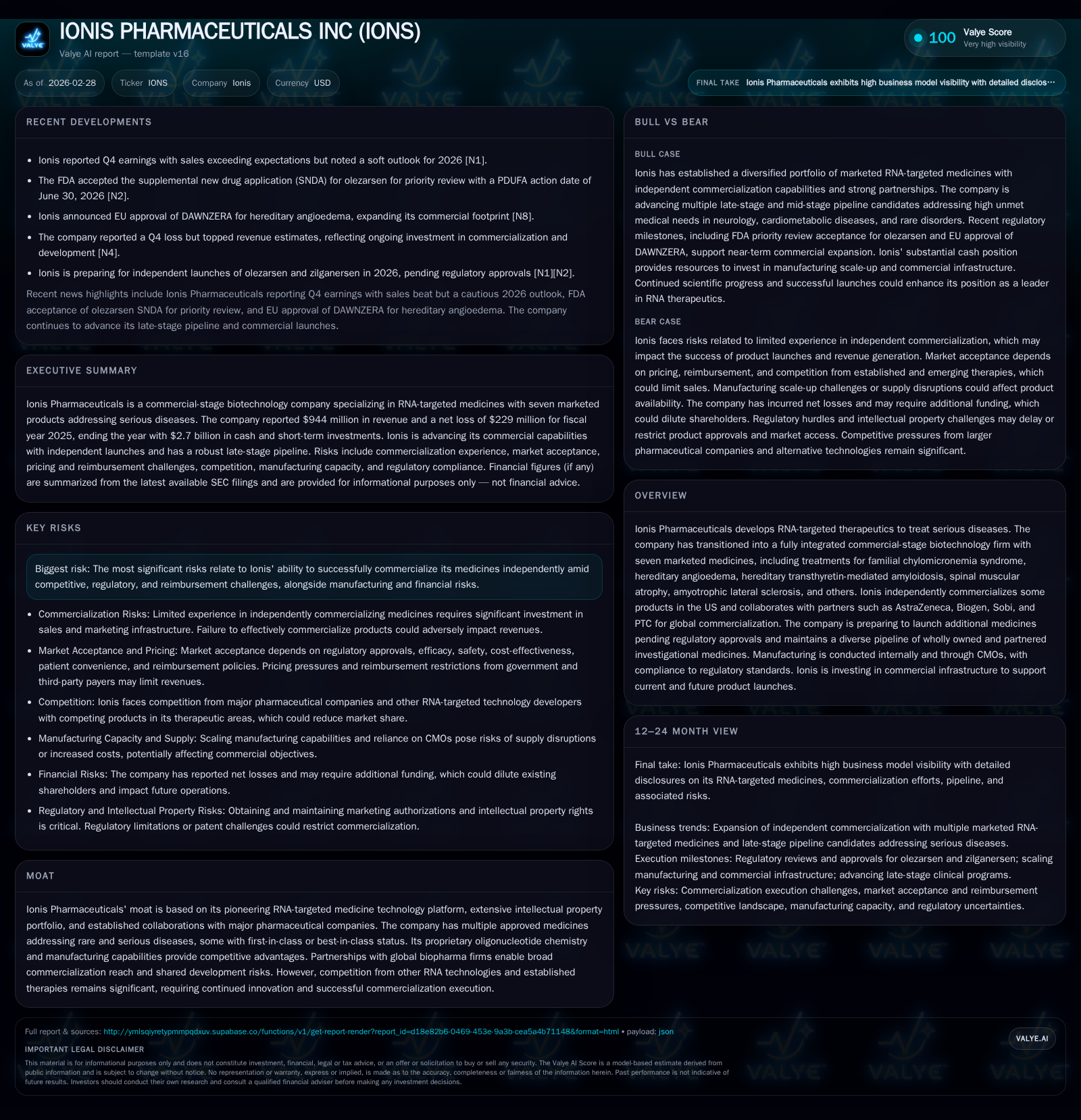
Ionis Pharmaceuticals has matured into a fully integrated commercial-stage biotech firm with seven marketed RNA-targeted therapies addressing rare diseases. However, revenue fell by over 10% year-over-year in 2025, partially due to lingering commercialization investments and competitive pressures. The company’s operating losses more than doubled, reflecting significant spending on scaling internal sales infrastructure for independent launches like TRYNGOLZA and DAWNZERA. Regulatory advances, such as EU approval of DAWNZERA and FDA priority review for Olezarsen, provide potential growth catalysts. Still, ongoing risks around market acceptance, reimbursement hurdles, and manufacturing remain substantial headwinds.
Company Historical Performance
Ionis Pharmaceuticals has evolved over three decades from an RNA drug discovery pioneer into a fully integrated commercial-stage biotechnology company focused on RNA-targeted therapeutics for serious and rare diseases [S1]. This transformation is marked by the company independently commercializing medicines such as TRYNGOLZA and DAWNZERA, alongside partnered collaborations with Biogen (SPINRAZA), AstraZeneca (WAINUA), Sobi, and PTC [S1].
The company reported annual revenues of $203.3 million in fiscal year 2025, down 10.3% from $226.6 million in 2024 [F1]. This contraction follows a steep rebound in 2023 when revenues jumped from $151.9 million in 2022 to $324.5 million on successful launches and partner revenues [F1]. Operating income swung deeper into loss territory at -$214.5 million in 2025 compared to -$110.8 million the prior year [F1], illustrating mounting investments in independent commercialization efforts and infrastructure scale-up necessary for supporting launches within highly specialized markets.
Net loss also expanded significantly to -$229.4 million in 2025 from -$104.3 million in 2024 [F1]. Operating cash flow remained negative at -$268.6 million but improved relative to the previous year's deeper outflows [F1]. Capital expenditures increased modestly to approximately $51.4 million reflecting continued investment in manufacturing capabilities crucial for both proprietary products and contract manufacturing oversight [F1].
Historical performance (annual)
| FY | Rev ($mm) | Net ($mm) | CFO ($mm) | OpInc ($mm) | Rev YoY | Net YoY |
|---|---|---|---|---|---|---|
| 2025 | 203 | -229 | -269 | -214 | -10.3% | -119.8% |
| 2024 | 227 | -104 | -501 | -111 | -30.2% | -1026.5% |
| 2023 | 325 | -9 | -308 | -6 | +113.6% | +96.6% |
| 2022 | 152 | -270 | -274 | -208 |
Source: SEC companyfacts cache [F1].
Capital returns and efficiency (annual)
| FY | FCF ($mm) | ROE% |
|---|---|---|
| 2025 | -320 | -46.9 |
| 2024 | -546 | -17.7 |
| 2023 | -331 | -2.4 |
| 2022 | -290 | -47.1 |
Source: SEC companyfacts cache [F1].
All figures USD millions except percentages; YoY calculated where applicable [F1]
Drivers of Past Growth
Revenue growth historically has been driven primarily by partner collaborations distributing key medicines such as SPINRAZA globally via Biogen, which remains a leading SMA therapy [S1]. In parallel, Ionis's proprietary medicines like WAYLIVRA for familial chylomicronemia syndrome generated niche revenue streams with orphan drug designations enabling premium pricing structures.
The spike in revenue observed in FY2023 corresponded with ramped sales of several proprietary drugs gaining regulatory approvals across multiple regions alongside new partnership milestones [S1]. However, the subsequent decline in FY2024-25 reflects growing pains transitioning toward independent commercialization—particularly of TRYNGOLZA and DAWNZERA—where Ionis must establish its own sales forces and payer relationships domestically [S1][S2].
Cost escalations have accompanied these developments; operating losses widened notably because expenses soared faster than revenues amid investments required for marketing, salesforce expansion, training programs, and supply chain enhancements mandatory for standalone product launches [S1].
Current Commercial Positioning & Pipeline
Ionis currently markets seven medicines targeting rare diseases: TRYNGOLZA (olezarsen) for familial chylomicronemia syndrome; DAWNZERA (donidalorsen) for hereditary angioedema; WAINUA (eplontersen) for hereditary transthyretin-mediated amyloidosis neuropathy; SPINRAZA (nusinersen) for spinal muscular atrophy; QALSODY (tofersen) for SOD1 amyotrophic lateral sclerosis; TEGSEDI (inotersen); and WAYLIVRA (volanesorsen) [S1]. Most medicines benefit from orphan drug exclusivities providing strategic patient populations with limited alternatives.
TRYNGOLZA is the first FDA-approved treatment that significantly reduces triglyceride levels associated with familial chylomicronemia syndrome, supported by clinically meaningful reductions in acute pancreatitis events when coupled with dietary restrictions—a critical clinical outcome relevant to patient quality of life [S1].
DAWNZERA received European Union approval following U.S. authorization for prophylaxis against hereditary angioedema attacks in patients aged twelve or older—the first RNA-targeted prophylactic therapy offering favorable tolerability profiles combined with extended dosing intervals [N10][N11][S1]. Independent commercialization efforts reinforce Ionis’ strategic pivot toward building standalone U.S. revenue streams.
Manufacturing operations are managed internally supplemented by contract manufacturing organizations compliant with current Good Manufacturing Practices ensuring scalable production aligned with regulatory standards amid anticipated launch expansions [S13].
The pipeline remains diverse comprising wholly owned investigational drugs alongside partnered candidates progressing toward pivotal regulatory milestones with notable catalysts such as FDA acceptance of Olezarsen’s supplemental NDA under priority review—a status indicating potentially expedited marketing authorization pending final evaluation [N9][S1].
Future Growth Prospects & Risks
Growth prospects hinge critically on successful commercialization execution of independently launched products like TRYNGOLZA and DAWNZERA within the U.S., expanding international availability through partnerships particularly AstraZeneca’s rights outside the U.S. for WAINUA, plus regulatory approvals enabling market entry for pipeline assets including Olezarsen's anticipated approvals across jurisdictions [N9][N10][N11][S1].
However, Ionis faces substantial risks that could cap growth:
- Limited prior experience commercially launching products independently results in elevated execution risk including effective sales force deployment, payer negotiations on reimbursement rates amidst ongoing U.S. policy shifts that increasingly pressure drug prices especially under programs like Medicare Drug Price Negotiation initiated through the Inflation Reduction Act [S10][S15][S18].
- Competitive landscape intensifies as rival RNA platforms advance rapidly alongside entrenched therapies offering cost-effective or more convenient treatment alternatives possibly curbing physician adoption or patient uptake.
- Manufacturing scalability risks remain linked to reliance on CMOs alongside internal facilities which require stringent regulatory compliance under cGMP guidelines; any failure jeopardizing supply continuity can disrupt commercial momentum.
- Intellectual property challenges exemplified by ongoing patent litigation against Arrowhead Pharmaceuticals introduce uncertainty over exclusivity periods essential to safeguarding future revenue streams [S9][S16].
- Market acceptance among physicians, patients, and payers is not guaranteed despite FDA or EMA approvals; inadequate uptake or restrictive health plan coverage could materially reduce anticipated sales volumes.
Financial Returns & Capital Allocation
Ionis exhibits persistent negative returns—its approximate return on equity reached about -46.9% based on net loss relative to shareholder equity reported at fiscal year-end 2025 [$229M / $489M] [F1]. Negative operating cash flow of roughly $269 million combined with capital expenditures totaling $51 million underscore the heavy reinvestment phase required during commercial infrastructure buildout coupled with manufacturing capacity enhancement initiatives [F1].
Notably, Ionis has not executed share repurchases since at least fiscal year 2022 signaling likely retention of capital aimed at supporting R&D spend and operational overhead instead of returning cash directly to shareholders via buybacks or dividends during this investment cycle [F1].
Regulatory Developments & Milestones To Monitor
Key milestones warrant monitoring given their potential material impact:
- FDA’s decision on Olezarsen’s supplemental New Drug Application under priority review could add a significant controlled triglyceride-lowering therapy option expanding Ionis’ portfolio breadth in lipid disorders.
- Further EU approvals following DAWNZERA’s initial nod may broaden geographic addressable populations improving commercial scale.
- Progression of pipeline molecules into late-stage trials or new indications would enhance medium-term growth prospects but depend heavily on trial outcomes.
- Continued maturation of independent U.S. launches will reveal real-world adoption dynamics impacting near-term revenue trajectories.
- Legislative or regulatory changes affecting pricing frameworks or drug reimbursement policies will likely influence margin profiles particularly as Medicare drug price negotiation programs expand coverage scope.
Industry Contextual Analysis
Ionis operates within the highly competitive RNA therapeutics sector where landmark successes come paired with steep development costs and complex commercial challenges requiring specialized skillsets distinct from traditional pharma marketing models. The company’s proprietary oligonucleotide chemistry provides a competitive edge but must be continually innovated given peer advancements like siRNA technologies advancing at pace.
Market access pressures impact all biologics broadly but rare disease markets present unique pricing power dynamics often tempered by payers' pushback emphasizing cost-effectiveness evidence—pharmacoeconomic data generation thus becomes vital in securing favorable formulary placement.
Commercial scale-up entails significant upfront costs including recruiting specialized sales teams trained extensively to engage niche key opinion leaders overseeing complex patient populations—achieving efficient resource allocation here constitutes a critical success factor.
Conclusion
Ionis Pharmaceuticals stands at a pivotal juncture transitioning from dependence on partners toward establishing itself as an autonomous commercial entity within the biotech landscape specializing in RNA-targeted medicines for rare disorders. Despite setbacks reflected in declining revenues and widening losses during fiscal 2025 primarily attributable to early-stage launch costs, recent regulatory gains combined with robust pipeline candidates offer promising avenues for future growth contingent on adept navigation of commercialization complexities and evolving reimbursement landscapes.
Continued vigilance over regulatory milestones, competitive developments within RNA therapies, payer environment shifts underscored by U.S. healthcare reforms, and legal battles influencing intellectual property protections will be essential factors shaping Ionis' trajectory going forward.
This analysis synthesizes information from publicly available financial statements filed with the SEC ([F1],[S1]-[S29]) and recent news reports ([N1]-[N11]). It aims solely to inform regarding company fundamentals without providing investment advice or recommendations.
Disclaimer: This is research-only, informational analysis and not investment advice. It may include AI-generated interpretation and general industry context. Always verify important details using primary sources.

Comments