
Joby Aviation’s Vertically Integrated eVTOL Ambition Confronts Certification and Scaling Costs
Joby seeks to commercialize urban aerial ridesharing via proprietary eVTOL aircraft amid regulatory and financial hurdles.
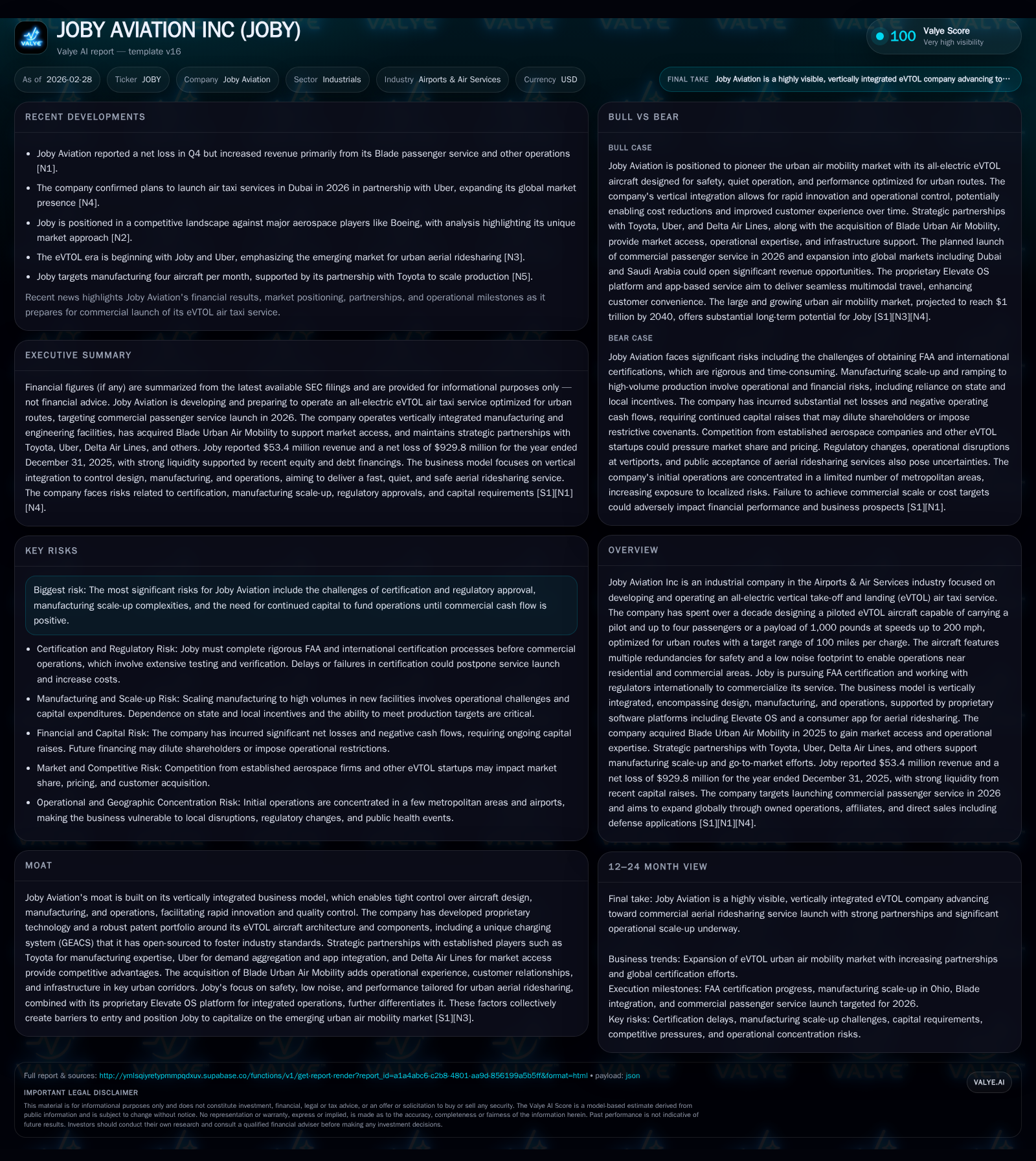
Joby Aviation has pioneered an all-electric vertical take-off and landing (eVTOL) air taxi, designed for urban routes with a pilot and up to four passengers. Leveraging a vertically integrated model, proprietary manufacturing, and strategic partnerships, Joby aims to launch commercial passenger service in 2026. However, persistent operating losses, capital intensity around certification and scaling manufacturing, plus regulatory uncertainties present significant obstacles. Monitoring certification progress, execution on manufacturing ramp-up, and pathway to improved unit economics are critical near-term milestones.
Company Overview
Joby Aviation Inc has emerged as a leading innovator in the nascent Urban Air Mobility (UAM) sector with its eVTOL (electric Vertical Take-Off and Landing) aircraft designed for fast, quiet urban aerial ridesharing. For more than ten years, Joby has focused on engineering a piloted all-electric aircraft capable of transporting one pilot plus up to four passengers or a payload of about 1,000 pounds at speeds near 200 mph and ranges around 100 miles per battery charge [S1]. These performance targets align well with typical metropolitan trip distances—for example over 99% of urban routes in megacities like New York or Los Angeles fall within this range—highlighting the aircraft’s utility for short-haul trips that can dramatically reduce ground travel time by up to tenfold.
The company’s mission revolves around not only technological innovation but also developing a vertically integrated transportation ecosystem encompassing aircraft design/manufacturing alongside operation of its own ride-hailing service [S9][S15]. This integration uniquely enables end-to-end control over safety, user experience, rapid iteration cycles, manufacturing quality assurance, and operational data feedback loops through its proprietary Elevate OS platform and consumer app development.
Historical Performance
Financially, Joby remains early-stage and capital intensive with ongoing substantial net losses reflecting heavy R&D outlays necessary to bring the technology through rigorous FAA certification processes as well as initial market entry expenditures. The company generated minimal revenues before 2025 but registered $53 million in revenue for fiscal year ending December 31, 2025—a material step up from $0.1 million in 2024—stemming largely from defense-related contracts and modest early commercial activities primarily via its Blade subsidiary acquisition completed mid-2025 [F1][S1][S3].
Despite revenue gains, operating expenses soared by roughly 30% year-over-year driven by a 22% rise in research and development costs alongside a sharper 36% surge in selling/general administrative expenses [F1][S26][S21]. Consequently operating income declined further into negative territory at -$719.6 million while net losses nearly doubled compared to prior year to approximately -$929.8 million [F1].
Operating cash flows remain heavily negative (-$509.9 million), reflective of ongoing pre-commercial burn rate before anticipated economies of scale manifest post-launch [F1]. Capital expenditure grew moderately by about one-third to approximately $53.9 million associated with expanding manufacturing capabilities and infrastructure development [F1].
Historical performance (annual)
| FY | Net ($mm) | CFO ($mm) | OpInc ($mm) | Capex ($mm) | Net YoY |
|---|---|---|---|---|---|
| 2025 | -930 | -510 | -720 | 54 | -52.9% |
| 2024 | -608 | -436 | -597 | 41 | -18.5% |
| 2023 | -513 | -314 | -472 | 31 | -98.8% |
| 2022 | -258 | -236 | -392 | 55 |
Source: SEC companyfacts cache [F1].
Capital returns and efficiency (annual)
| FY | FCF ($mm) | ROE% |
|---|---|---|
| 2025 | -564 | -66.0 |
| 2024 | -477 | -66.6 |
| 2023 | -344 | -49.6 |
| 2022 | -291 | -22.2 |
Source: SEC companyfacts cache [F1].
Note: Revenue growth is shown as n.m (not meaningful) given the transition from essentially zero revenues.
Future Growth Prospects
Joby’s upcoming growth hinges critically on several key milestones:
FAA Certification: The company is progressing toward final FAA type certification—the first signed Stage 4 G-1 certification basis was obtained—and has achieved multiple special airworthiness certificates allowing extensive test flight operations including flights between public airports within FAA-controlled airspace [S1]. Successful certification will unlock the ability to begin commercial passenger service targeted for calendar year 2026 [S1][S3]. Regulatory approvals outside the U.S., including exclusive rights granted by Dubai’s Road & Transport Authority for six years starting within this timeframe demonstrate geographic diversification though add complexity [S12][N3].
Manufacturing Scale-up: Partnering with Toyota provides automotive-scale manufacturing expertise vital for efficient volume production—increasing planned output targets to approximately four aircraft per month was announced with facilities expanding in Ohio as the hub for high-rate production [N14][S8][S10]. Balancing cost reduction against aviation safety standards will be instrumental in improving unit economics.
Service Commercialization & Network Expansion: Acquisition of Blade Urban Air Mobility (August 2025) provides operational know-how plus existing customer relationships especially across corridors like NYC and parts of Europe feeding initial ridesharing networks [S8]. Integration efforts with Uber (for demand aggregation via Uber app globally) and Delta Airlines augment go-to-market reach—a substantial advantage difficult for new entrants to replicate quickly [S10]. The multi-modal trip software linking ground and air legs aims to maximize utilization.
Defense applications via collaborations with L3Harris leveraging autonomous flight technology tested at USAF REFORPAC exercises offer additional potential revenue streams [S12][N5]. Memoranda of understanding in Saudi Arabia indicate interest beyond consumer transport alone [S11].
Market adoption depends heavily on customer perceptions related to safety; cost competitiveness versus traditional ground transport or helicopter services remains unproven pending pricing rollouts post-launch.
Returns & Capital Allocation
Return metrics remain deeply negative reflecting ongoing pre-commercial phase investments:
Estimated return on equity approximates negative two-thirds (-66%) driven by widening net losses relative to shareholders' equity base estimated at $1.41 billion as of December 31, 2025 [F1].
Free cash flow remains negative exceeding half a billion dollars annually due to operational cash outflows overshadowing capital spending despite capex being relatively modest versus R&D spend (-$564 million approx calculated as CFO minus capex) [F1].
Capital allocation focuses predominantly on scaling technological readiness including manufacturing capabilities supported by successive funding rounds:
- Since merger proceeds exceeding $1 billion raised in August 2021, private placements including strategic investors like Toyota (~$500 million combined disclosed allocations spanning late 2024 into early 2025), public offerings raising several hundred millions most recently February 2026 ($575 million), plus issuance of convertible notes totaling nearly $690 million clarify aggressive capital campaigns underpinning operational spending [S4][S16][N6].
Joby maintains strong liquidity evidenced by over $240 million cash plus more than $1.16 billion short-term investments at fiscal year-end qualifying runway sufficiency beyond initial commercial phases barring unforeseen contingencies [F1][S16].
No dividends or share repurchases have been declared consistent with growth-stage priorities focused on product development rather than shareholder distributions [F1][N1].
Risks & Competitive Landscape
Key risks include:
Certification Delays: Potential postponements from FAA staffing challenges or regulatory changes could delay commercial start impacting financial forecasts directly [S6][S22]. Foreign jurisdiction approvals vary substantially.
Manufacturing Complexity: Achieving quality production scale is demanding; cost overruns or technical setbacks may impede margins or delay deliveries.
Capital Dependence: Continued access to equity/debt markets necessary until positive cash flow generation occurs.
Competitive Intensity: Rival eVTOL developers such as Archer Aviation carry legal disputes which may divert resources; competitors’ technology differentiation or alternative business models present threats requiring continuous innovation from Joby [N2][N11][S29].
Market Adoption & Infrastructure: Reliance on partnerships/permits at vertiports plus public acceptance dynamics critical; limited initial geographic presence increases concentration risk.
Conclusion & Outlook Analysis
Joby Aviation represents one of the most advanced plays attempting electrified urban aerial mobility through an integrated model uniting aircraft manufacturing with service operation. Its long-standing engineering effort coupled with recent certification achievements position it favorably versus peers seeking first-mover advantages. Nevertheless the path ahead demands navigating complex regulatory frameworks alongside demonstrating scalable profitability from large upfront investments. Monitoring scheduled FAA approvals closely plus assessing manufacturing output trends will provide key indicators regarding ability to meet lofty timetable goals set for initial passenger deployments next year. International expansions partially diversify risk but add layers of global coordination needs. While current financial metrics reflect heavy losses during this foundational stage typical for pioneering industrial ventures reinventing established transportation paradigms, sustained capital access remains essential during the transition toward revenue ramp-up accompanied eventually by operational leverage improvements. Investors tracking industry advancements will find Joby Aerospace's integrated approach coupled with strong partnership network notably differentiating yet requiring execution scrutiny amid evolving regulatory landscapes worldwide.
This analysis is based solely on publicly available information and does not constitute investment advice or recommendations. All financial figures are cited from disclosed SEC filings ([F1],[S#]) or recognized news sources ([N#]).
Disclaimer: This is research-only, informational analysis and not investment advice. It may include AI-generated interpretation and general industry context. Always verify important details using primary sources.

Comments