
Kyndryl Faces SEC Scrutiny While Investing in AI and Hybrid Cloud Expansion
SEC investigations and internal control challenges coincide with Kyndryl’s focus on long-term contracts and AI-driven IT infrastructure growth amid competitive pressures.
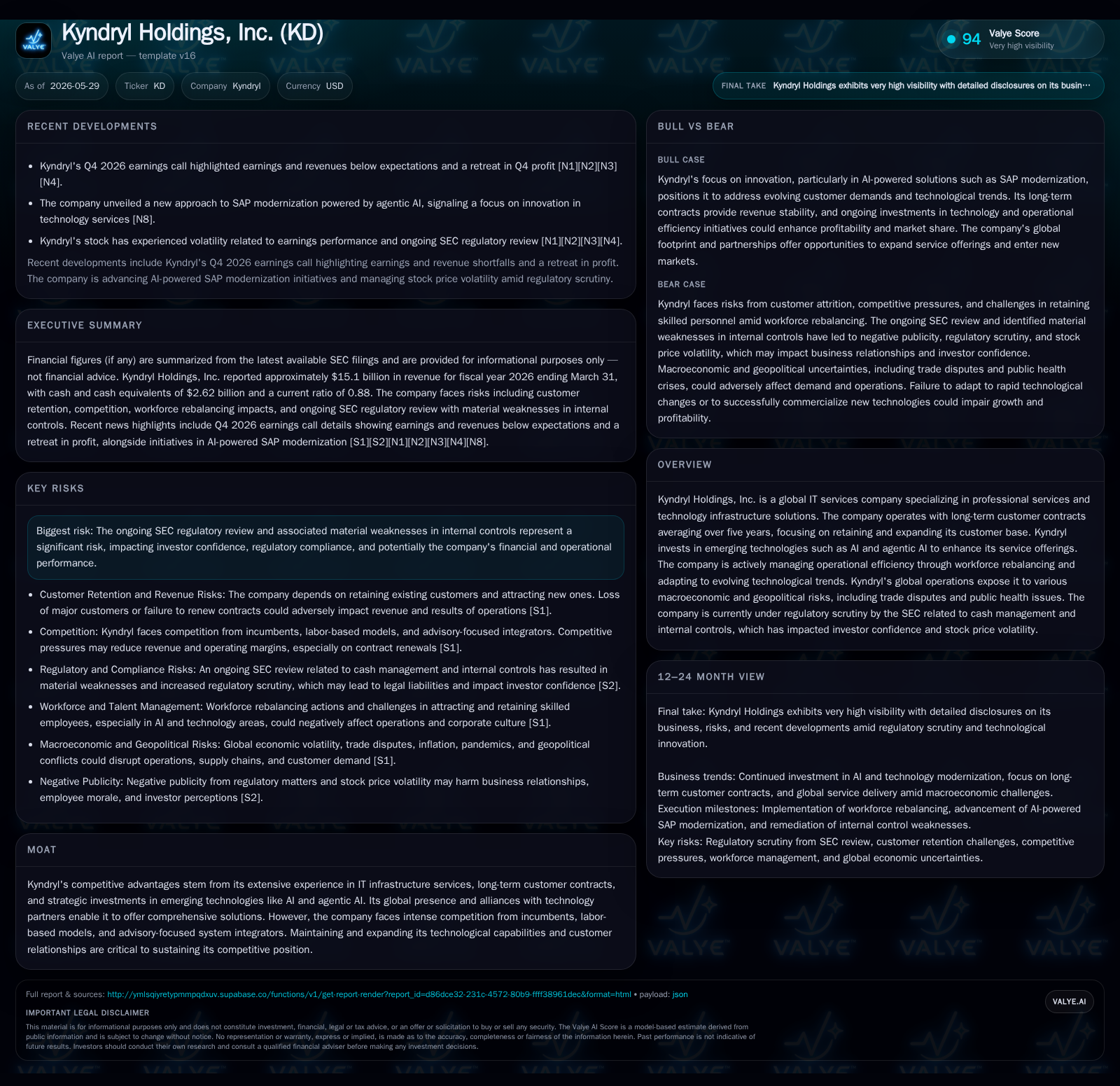
Kyndryl Holdings’ latest quarterly filing reveals ongoing SEC investigations related to cash management and internal controls, causing share price volatility and operational risks. The company’s business model centers on long-term IT infrastructure service contracts supplemented by investments in emerging technologies like agentic AI, aiming to maintain competitiveness amid intense industry competition. Growth drivers include client retention, expansion into higher-margin technology services, and strategic acquisitions. However, continued regulatory scrutiny and challenges in internal control remediation pose notable risks that could affect financial reporting credibility and capital access. Monitoring remediation progress and client engagement metrics will be key milestones ahead.
Recent Operating Update
Kyndryl’s most recent quarterly filing (10-Q dated February 17, 2026) disclosed ongoing regulatory scrutiny focused on its cash management practices and internal financial controls following voluntary document requests from the SEC’s Division of Enforcement [S2]. Material weaknesses in the company's internal control over financial reporting were identified, prompting a comprehensive remediation plan overseen by the Audit Committee. This issue introduces exposure to legal liabilities, increased compliance costs, and has precipitated notable volatility in the company’s stock price [S2].
An interim CFO appointment in early 2026 underlines the seriousness of governance challenges as management seeks to bolster disclosure controls and tighten operational oversight [S22]. The remediation plan targets full resolution by March 31, 2027; however, successful implementation remains uncertain at this stage.
Complementing these disclosures, the May 6, 2026 8-K filing reaffirmed the company's focus on transparency regarding its financial condition while emphasizing ongoing efforts to stabilize operations amid external pressures [S3]
Business Model
Kyndryl operates as a global IT services provider primarily focused on professional services coupled with core technology infrastructure solutions [S1]. Its revenue is derived chiefly through multi-year outsourcing contracts averaging more than five years in length. Customers pay for extensive managed services that span infrastructure design, deployment, maintenance, cloud integration, and increasingly advanced digital transformation offerings involving AI technologies.
The company leverages a bundled model where clients benefit from integrated solutions tailored to complex enterprise environments. Price realization depends heavily on contract volume and mix—larger clients with broad portfolios generally drive more stable revenues given contractual longevity but also command negotiation leverage.
Margins are sensitive to service mix: standardized infrastructure support is relatively lower margin compared to newer high-value professional services enabled by innovations like artificial intelligence acceleration. Kyndryl invests in strategic partnerships and acquisition targets (e.g., Skytap) to supplement its hybrid cloud capabilities and integrate agentic AI features aimed at automating complex operational workflows [S25], which potentially enhances differentiation in commoditized segments.
Customer retention is critical; loss or non-renewal of significant accounts could materially impact revenue given the concentration embedded within long-duration agreements [S1]. However, lengthy contract terms also limit short-term scaling flexibility.
Industry Structure and Competitive Position
The IT infrastructure services industry is intensely competitive with a mix of legacy labor-heavy outsourcers, niche managed service providers, large advisory-led system integrators (e.g., Accenture), and hyperscaler partnerships gleaning cloud-related wallet share. Kyndryl stands out by combining global scale with deep expertise in managing traditional enterprise IT environments transitioning towards hybrid cloud architectures.
Its primary advantage lies in strong existing client relationships secured via long-term contracts and its capacity to embed emerging tech such as AI into infrastructure management. Yet it faces margin pressure due to competitive bidding dynamics placing downward pressure on pricing power.
Switching costs remain moderately high because of the complexity of migrating critical IT workloads and integrating multi-vendor environments—this anchors demand somewhat structurally even as cloud alternatives proliferate. The industry also grapples with talent scarcity influencing delivery capacity constraints.
Competition is broadening from traditional peers towards newer digital-native entrants leveraging automation or platform-centric models that challenge classic labor-based cost structures. Kyndryl's strategic focus is thus on evolving its service mix towards higher-margin technology advisory combined with scalable AI-enabled automation.
Growth Drivers
- Contract Retention & Expansion: Maintaining renewals for its sizable installed base drives baseline revenue stability; upselling advanced services improves margin profile.
- AI Integration: Embedding agentic AI capabilities into offerings aims to differentiate Kyndryl by enhancing autonomous infrastructure management functionalities.
- Hybrid Cloud Services: Expansion through targeted acquisitions (e.g., Skytap) strengthens cloud workload migration and management competencies.
- Operational Efficiency Programs: Workforce rebalancing initiatives reduce fixed costs while re-skilling enables pivot into emerging tech areas [S1].
- Partnership Ecosystem: Alliances with leading technology vendors amplify solution breadth and sales pipeline access.
- Global Market Penetration: Geographic diversification across Principal & Strategic Markets segments mitigates regional macroeconomic volatility.
Risks / Watchpoints / Growth Constraints
- Regulatory Compliance Risks: Prolonged SEC investigations and unresolved material weaknesses threaten reputational damage and could constrain capital market access or increase financing costs [S21].
- Control Remediation Uncertainty: Failure or delays in fixing internal control issues might impair investor trust and invite further regulatory sanctions [S2][S22].
- Contract Renewal Risks: Client decisions to reduce scope or not renew contracts pose downside risks given their outsized contribution to revenues [S1].
- Competitive Pressures: Emerging digital competitors applying innovative delivery models may erode pricing power or market share.
- Technological Displacement: Rapidly evolving tech landscape demands continuous investment; failure to innovate quickly risks obsolescence.
- Operational Execution: Workforce rebalancing involves upfront charges with unclear timing of resultant savings impacting margins temporarily [S1].
- Macroeconomic & Geopolitical Factors: Global trade tensions and public health events inject uncertainty into demand forecasts especially across multinational client bases.
What To Watch Next
Key indicators for investors and analysts include:
- Progress updates on SEC investigations and timelines for full remediation of control deficiencies slated for FY 2027 reporting [S22].
- Contract renewal rates among top-tier customers; any indication of churn or softening demand particularly in lower-margin segments.
- Execution success on AI/agentic AI initiatives—including measurable sales pipeline contributions or early client case studies demonstrating incremental value.
- Impact of workforce optimization programs on operating expenses versus previously guided expectations.
- Financial performance trends in Strategic Markets versus Principal Markets reflecting geographic diversification strategy effectiveness.
- Share repurchase activity continuation given recent authorization expansions totaling $700 million capacity remaining [S16].
Financial Profile Snapshot
As of March 31, 2026, Kyndryl held approximately $2.62 billion in cash alongside $2.91 billion in total debt resulting in modest net debt of around $287 million, supporting a stable liquidity position despite regulatory headwinds [F1]. Current assets stood at $5.53 billion against $6.31 billion current liabilities yielding a current ratio below unity at 0.88 indicating working capital pressures typical for the sector [F1].
Conclusion
Kyndryl’s near-term operating environment is marked by dual challenges: managing significant regulatory scrutiny while pushing forward technological evolution strategies centered on AI-enabled infrastructure services. Its entrenched customer contracts provide revenue stability but necessitate constant innovation to avoid commoditization amid fierce competition from both traditional incumbents and disruptive new entrants.
Execution discipline around internal control remediation will be decisive for restoring investor confidence alongside demonstrating credible growth momentum through successful adoption of agentic AI offerings and hybrid cloud expansion. The company’s financial flexibility offers some cushion as it navigates this multifaceted transformation journey within an increasingly complex macroeconomic setting.
This analysis synthesizes information from Kyndryl Holdings’ recent SEC filings including the latest quarterly (10-Q), annual report (10-K), recent event filings (8-K), as well as company facts data as of fiscal year-end March 31, 2026. It does not constitute investment advice but aims to provide an informed thematic perspective rooted in validated disclosures.
Disclaimer: This is research-only, informational analysis and not investment advice. It may include AI-generated interpretation and general industry context. Always verify important details using primary sources.

Comments