
KinderCare Learning Companies Faces Enrollment and Liquidity Pressures in Q2 2026
KinderCare’s Q2 2026 financial report reveals enrollment declines and liquidity challenges that strain revenue growth and operational flexibility amid ongoing sector pressures.
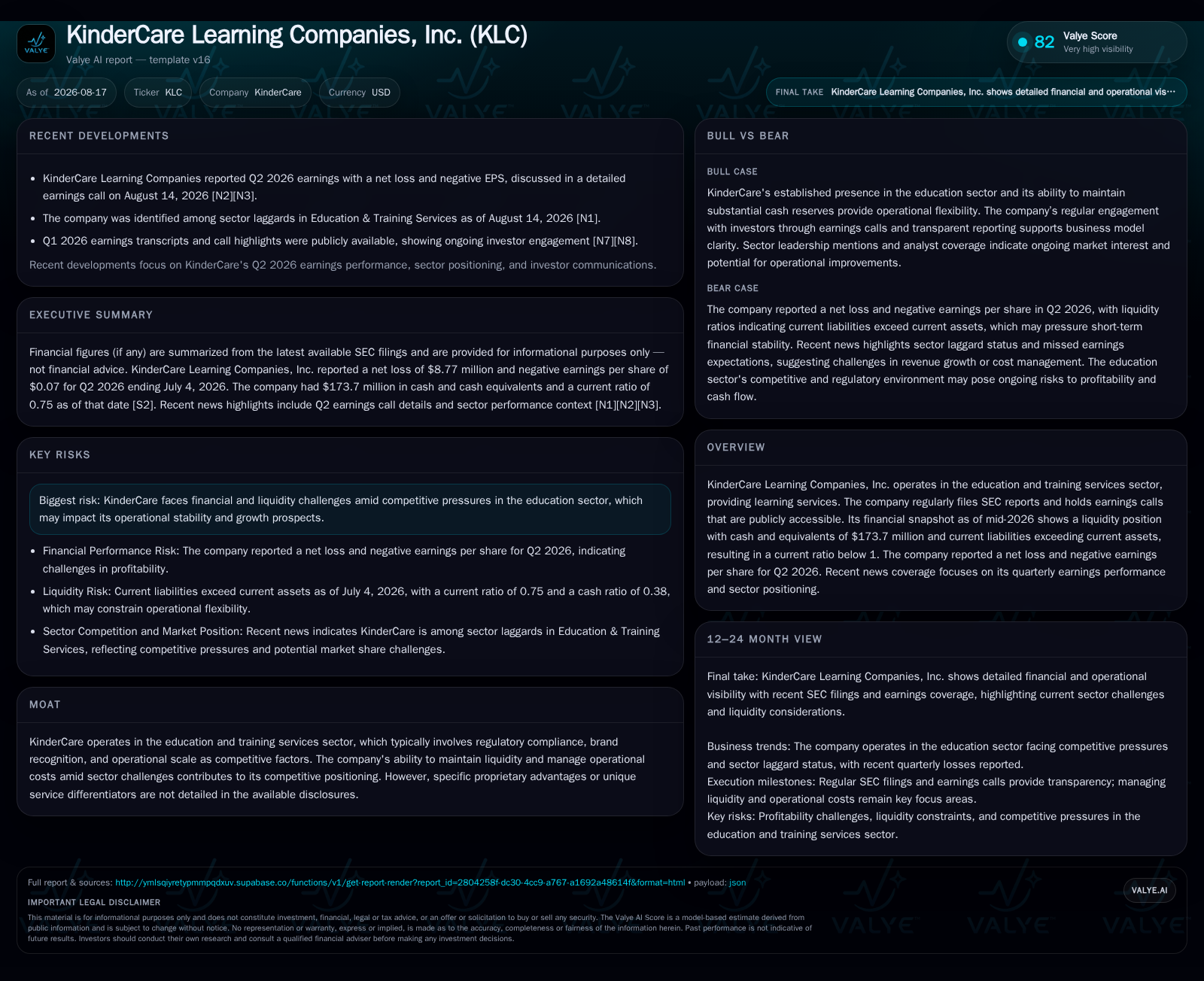
KinderCare Learning Companies reported a net loss and negative operating income in Q2 2026, reflecting enrollment softness and elevated fixed costs. The company’s liquidity is constrained, with a current ratio below one and significant net debt tied to facility leases covering hundreds of centers. Revenue depends primarily on tuition fees influenced by enrollment trends, while operational expenses rise due to regulatory compliance and staffing requirements. Competitive pressures from peers like Bright Horizons emphasize the importance of brand strength and geographic scale. Looking forward, milestone indicators such as occupancy stabilization, lease negotiations, and subsidy developments will be crucial for signaling recovery prospects.
Q2 Operating Results Signal Enrollment Contraction and Margin Pressure
KinderCare’s latest quarterly filing dated August 13, 2026 discloses an operating environment burdened by declining enrollment levels that directly suppress tuition revenue—the company’s principal earnings source [S2][F1]. The report confirms a notable net loss along with negative operating income which signals margin compression potentially linked to both softer demand and persistent fixed costs. This is further contextualized by the April 8, 2026 Fifth Amendment to its Master Lease Agreement covering 545 center sites, emphasizing KinderCare’s substantial long-term real estate commitments as a major component of fixed expenses despite fluctuating utilization [S3]. Such lease obligations limit flexibility when occupancy falls short of expectations.
Enrollment softness is often symptomatic of demographic headwinds seen sector-wide where early childhood education providers face varying regional birthrates and economic affordability constraints impacting family decisions about childcare spending. As tuition fees are generally paid direct or partially offset by government subsidies aimed at supporting access, quantum changes in enrollments manifest immediately in revenue trends. The linkage between enrollment rates and tuition collections underpins KinderCare’s revenue mechanics tightly [S1]. This makes sustained top-line growth challenging absent significant market expansion or pricing leverage.
"Service Model Economics: Tuition Dependency Meets Regulatory Cost Growth"
KinderCare operates under a business model typical in early childhood education settings: charging families tuition fees based largely on child enrollment counts while incurring costs driven heavily by regulatory staffing requirements [S1]. Licensing mandates enforce minimum staff-to-student ratios which ensure quality and safety but also inflate labor expense. Given staff salaries represent a large portion of operating cost, any upward inflationary pressure—such as wage increases or benefits—can erode profitability rapidly without commensurate tuition increases or occupancy gains.
Additionally, investment in curriculum development and program accreditation contributes to relative differentiation but adds to cost per student served. Balancing this discretionary spend while maintaining cost discipline in facility management is crucial given the scale of KinderCare’s footprint spanning hundreds of centers [S1]. Fixed-cost intensity like master leases further constrains operational leverage benefits when occupancy dips below breakeven thresholds.
The interplay between tuition-based revenues sensitive to enrollment fluctuations and largely inflexible expense base shaped by regulation-driven staffing requirements defines KinderCare’s margin dynamics. These dynamics are exacerbated when occupancy declines coincide with wage inflation cycles prevalent across the education services sector.
"Competitive Dynamics: Brand Strength and Market Challenges Among Peers"
Within the early childhood education industry, KinderCare competes alongside peer candidates such as Bright Horizons Family Solutions and Learning Care Group which similarly capitalize on broad geographical coverage combined with brand recognition to drive enrollment retention. Market participants endure analogous regulatory pressures requiring ongoing compliance investment.
Brand strength enables providers to maintain premium tuition pricing or sustain higher occupancy levels through parental trust—a vital intangible asset given the reputational sensitivity surrounding child safety and educational quality. Geographic footprint also matters because multi-site operators can achieve operational scale advantages through centralized curriculum management, procurement efficiencies, and cross-center staffing optimization.
However, these competitive advantages are challenged amid rising labor costs that compress margins industry-wide. KinderCare’s substantial lease obligations compound fixed cost strain relative to peers with more flexible real estate options. As such, competitive positioning today depends not only on curriculum innovation or pricing but also balancing operational efficiency under cost inflation constraints.
Key Growth Levers: Enrollment Trends, Subsidies, and Program Innovation
Several structural drivers underpin long-term demand for KinderCare’s services. Population growth within feeder age groups coupled with socioeconomic shifts such as rising dual-income households heightens reliance on formal childcare options. Government programs offering subsidies or grants can partially mitigate affordability barriers for families—potentially boosting effective enrollment volumes or enabling tuition stability during economic downturns.
In addition to demographic tailwinds, KinderCare can pursue incremental gains via curriculum enhancements fostering parent engagement and program accreditation that differentiate offerings from competitors’ baseline care services. These qualitative factors may elevate student retention rates which translate into steadier tuition streams.
Measurable KPIs such as occupancy rates at learning centers or average tuition per student remain critical barometers for growth realization prospects. Hence success in leveraging these growth levers depends on execution effectiveness in both marketing/admissions functions and ongoing service quality delivery.
Risks Amplified: Liquidity Constraints, Labor Costs, and Compliance
Financially, KinderCare grapples with pressing liquidity limitations reflected by a current ratio of approximately 0.75—current assets totaling $342 million against current liabilities of $459 million—a ratio below the conventional one-to-one benchmark indicating potential short-term funding pressure [F1]. Cash balances stand near $174 million while total debt approximates $926 million leaving net debt around $752 million which underscores significant leverage stress for an operator reliant on steady cash collection cycles [F1].
This liquidity tightness could constrain flexibility to invest in curriculum innovation or respond proactively to competitive challenges without incurring additional financing costs. Labor cost inflation risk persists as wages form a sizable fraction of expenses; inability to pass through increased costs via higher tuition could depress margins further.
Regulatory risks are ever-present given stringent licensing requirements coupled with reputational risks tied to child safety incidents or educational quality lapses—all capable of triggering costly legal proceedings or client attrition [S1]. The layered compliance demands necessitate ongoing expenditure commitments that limit financial maneuverability during difficult market phases.
"Looking Ahead": Milestones That Will Reveal KinderCare’s Recovery Trajectory
Future quarterly reporting will serve as vital checkpoints tracking change in core demand indicators such as enrollment rates coupled with operating margin trajectories reflecting cost-control effectiveness [S3]. Additional attention should be paid to any further lease agreement renegotiations or amendments building upon the April 2026 modification which could alleviate some rent burden over time
Operational markers including achieving improved staff-to-student ratios aligned with evolving regulations without incrementally inflating labor costs will be informative about management’s ability to balance quality with economics. Government subsidy developments may also emerge as catalysts influencing affordability trends among target families.
Ultimately, observable improvements across these dimensions would signal stabilization prospects while deterioration would underscore lingering vulnerabilities in KinderCare’s business model resilience amid sector headwinds.
Financial Profile Discussion: Liquidity Tightness Amid Elevated Debt
KinderCare reported cash and equivalents totaling approximately $174 million at quarter-end July 4, 2026 against total debt nearing $926 million resulting in net debt around $752 million—a substantial leverage level for an early childhood services provider heavily invested in leased properties [F1]. Current assets did not cover current liabilities fully leading to a current ratio of roughly 0.75 which indicates near-term liquidity stress requiring vigilant working capital management [F1].
With the Q2 reporting confirming negative operating income along with net losses reported earlier in January fiscal periods consistent with prior years’ trend lines but highlighting ongoing earnings pressure (operating income -$20 million as of January 3, 2026), cash flow generation challenges are implied despite scale advantages [F1]. This environment constrains discretionary capital allocation for growth initiatives such as curriculum expansions or new center openings that competitors might pursue more aggressively if less encumbered financially.
It does not constitute investment advice or research views. Readers should undertake their own due diligence regarding KinderCare Learning Companies’ securities or business prospects.
Disclaimer: This is research-only, informational analysis and not investment advice. It may include AI-generated interpretation and general industry context. Always verify important details using primary sources.

Comments