
Kilroy Realty's Strategic Balancing Act Amid Rising Rates and Geographic Concentration Risks
Examining how Kilroy Realty leverages mixed-use development expertise and regional focus to navigate headwinds in a complex real estate environment.
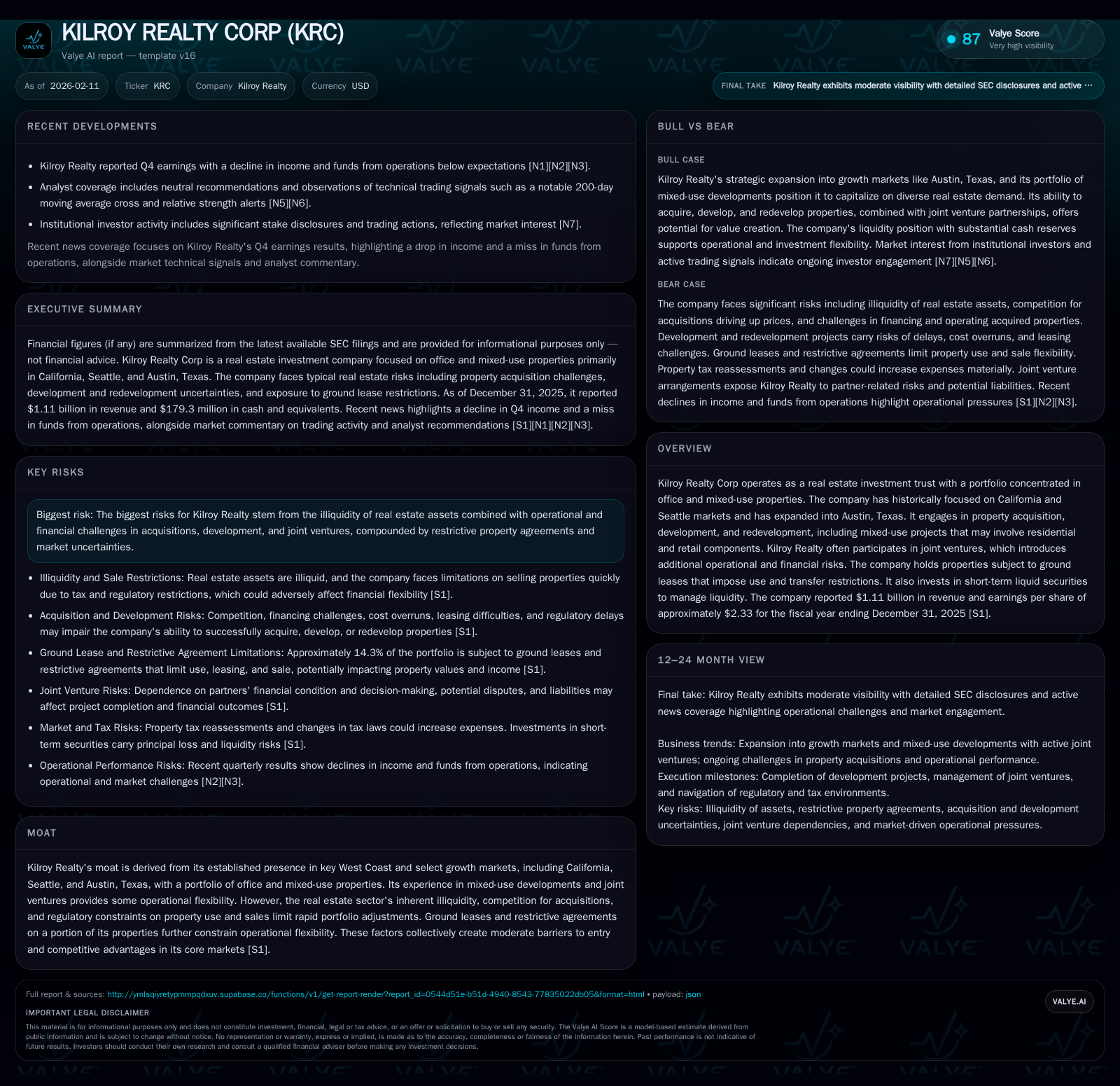
Kilroy Realty Corp maintains a concentrated portfolio centered in California, Seattle, and Austin, blending office and mixed-use properties that offer operational strengths but also exposures to regulatory complexity, natural disaster risk, and market cyclicality. The company’s recent Q4 earnings reflected pressures from selective leasing environments and cost inflation impacting development projects. Joint ventures provide capital sharing benefits yet introduce operational nuances that complicate strategic agility. Meanwhile, ground leases and restrictive agreements impose portfolio rigidity amidst macroeconomic headwinds including rising interest rates and inflation that heighten refinancing costs and depress property valuations.
Kilroy Realty’s Geographic Focus: Strength or Achilles' Heel?
Kilroy Realty's portfolio is squarely concentrated in three major innovation-driven markets: California (notably Los Angeles, San Diego County, San Francisco Bay Area), Seattle Metropolitan Area, and Austin, Texas. This regional concentration foregrounds both competitive advantages and pronounced risk exposures. California's office market remains pivotal given its scale but operates under one of the most complex regulatory regimes in the U.S., encompassing heightened environmental standards, taxes, workplace litigation risks, and increasingly stringent zoning laws [S1]. Additionally, California's susceptibility to natural disasters – particularly droughts which drive up water costs and introduce potential fines for excessive consumption – presents ongoing operational challenges.
Seattle introduces a tech-heavy economy but also faces rising regulation around commercial tenants and environmental compliance. The metro area's exposure to economic oscillations linked to dominant technology employers adds cyclical unpredictability to occupancy trends.
Austin represents Kilroy's strategic diversification into a high-growth market with expanding tech-sector employment. Yet this newer presence can amplify geographic concentration risks as Kilroy establishes footholds in competitive land acquisition environments where cost escalation is reported [S1]. While these hubs share the benefit of clustered innovation demand supporting office space absorption, their combined exposure tightens portfolio sensitivity to regional economic downturns or shifts—a double-edged sword requiring nimble management.
Performance Recap: Q4 Earnings Contextualized
Recent quarterly results underscored challenges facing Kilroy amid a cautious tenant backdrop. The company missed analyst expectations on Funds From Operations (FFO), a critical REIT profitability metric, reflecting neither transient nor isolated issues [N1][N3]. Concurrent income contraction signals softening leasing velocity or increasing incentives necessary to attract tenants in elevated supply contexts while grappling with higher operating costs [N4]. These dynamics reveal an occupational landscape where tenants remain selective—with more exacting demands on space utilization—and landlords compete intensively.
Simultaneously, escalating expenses associated with property management and rising wages pressure margins. This context tempers near-term rental revenue growth even as leasing uptake persists.
Navigating Development and Redevelopment Risks in a Rising Cost Environment
Kilroy’s commitment to mixed-use development integrating office with retail/residential components exposes it significantly to construction cost inflation [S1]. Input prices for materials such as steel and concrete surged post-pandemic onset remain elevated due to global supply chain dislocations compounded by wage growth in skilled trades.
The interplay between inflated baseline costs and extended project timelines magnifies execution risks. Slippages or budget overruns can erode anticipated internal rates of return on freshly developed assets—potentially prompting project postponement decisions when economic outlook dims [S1]. This conundrum places a premium on disciplined cost management alongside meticulous phasing aligned with demand signals.
Joint Ventures and Operational Nuances: Collaborative Strengths and Fragilities
Joint ventures feature prominently in Kilroy’s expansion playbook providing access to partner capital pools vital for large-scale developments or acquisitions [S1]. These partnerships enable risk-sharing mechanisms that hedge against singular exposures.
However, joint ownership intrinsically introduces governance complexities—decision-making must reconcile divergent stakeholder priorities possibly diluting operational agility or elongating approval cycles. For instance, acquisition opportunities requiring swift closure might be hampered by coordinating partner due diligence or alignment processes. Furthermore, profit-sharing arrangements naturally constrain upside capture limiting full-cycle returns for Kilroy alone.
Therefore, while JVs underpin financial engineering sophistication facilitating growth beyond balance sheet constraints, they pose nuanced risks demanding proactive joint management frameworks.
Ground Leases & Regulatory Constraints: Portfolio Rigidity Explored
A material portion of Kilroy’s properties are encumbered by ground leases imposing limitations on use modifications or transactions [S1]. These encumbrances translate into reduced flexibility when repositioning assets or seeking expedited dispositions—constraints unpopular among investors craving asset turnover agility especially amid volatile markets.
Such restrictions exacerbate liquidity challenges inherent in real estate investments which are already characterized by illiquidity relative to other asset classes. Moreover, the specter of prohibited transaction taxes discourages involuntary disposals further hardening the portfolio’s stickiness [S1]. This structural rigidity necessitates long-range planning horizons accommodating regulatory timelines intertwined with lease compliance.
Financial Health: Debt Profile, Liquidity, and Capital Recycling Challenges
Kilroy employs variable-rate debt instruments sensitive to Federal Reserve rate movements. Recent tightening cycles have increased its interest expense burden sharply [S1]. Escalating capital costs narrow spread margins between borrowing levels achievable versus anticipated asset yields on new investments or redevelopments.
The company holds approximately $179 million in cash equivalents providing some liquidity buffer; however, capital recycling faces inherent friction due to asset illiquidity compounded by ground lease restrictions [F1][S1]. Refinancing risks loom if maturities cluster during periods of high rates impacting cash flow stability needed to sustain dividends common across REIT peer groups.
Proactively managing debt maturities staggered over multiple years mitigates immediate refinancing burdens but does not insulate from midterm rate volatility effects potentially impairing growth initiatives reliant on external funding.
Macro Headwinds: Interest Rate Effects and Inflation Implications
The macroeconomic backdrop underscores sustained upward pressure on interest rates aligning with Fed policy aimed at tempering inflation [S1]. These rate escalations push capitalization rates higher which inversely depress property valuations—a critical valuation determinant within real estate investment trusts like Kilroy.
Higher cap rates imply sales processes yield less proceeds despite stable nominal dollar rents signaling valuation compression risk even if underlying cash flows hold steady initially. Inflation concurrently amplifies replacement costs exacerbating capex demands while compressing profit margins through input cost increments particularly evident in ongoing development efforts.
This cocktail diminishes near-term cash available for distributions or reinvestment absent operational performance boosts or easing cost structures [S1]. Hence the environment calls for tailored strategies balancing measured growth with prudent cost containment.
Strategic Outlook: Growth Trajectory in Select Innovation Hubs
Kilroy’s expansion into Austin reflects deliberate positioning within an emerging innovation ecosystem buoyed by tech sector migration trends complementing its entrenched West Coast foundation [S1][N5][N6]. Indicators such as relative strength alerts and favorable technical moving average crossings hint at nascent investor confidence or reduced volatility within these markets supportive of sustained leasing demand trajectories.
The firm’s demonstrated competence in mixed-use project execution confers differentiation when competing against pure office landlords particularly attractive to tenants seeking integrated amenity-rich environments incentivizing longer occupancies. Nonetheless balancing such growth aspirations requires vigilant monitoring of regulatory evolutions at state/local levels alongside continuous stress-testing assumptions underpinning development returns given cyclical uncertainties detailed herein.
Ultimately success hinges on capitalizing upon innovation cluster momentum concurrently managing embedded risks from geographic concentration constraints outlined above.
This report synthesizes publicly available data from SEC filings (Form 10-K), recent earnings releases as reported through Nasdaq sources, alongside Valye News analysis grounded in industry trends affecting REITs with focused portfolios. It is intended solely for informational purposes without any buy/sell/hold recommendation or price guidance. Market conditions are dynamic; readers should consider comprehensive due diligence tailored to their individual criteria before making financial decisions.
Disclaimer: This is research-only, informational analysis and not investment advice. It may include AI-generated interpretation and general industry context. Always verify important details using primary sources.

Comments