
Kohl's Quarterly Turnaround: Early Signs of Operational Renewal and Margin Stabilization
Kohl's Q1 2026 results indicate progress in inventory discipline and margin improvement amid a cautious retail environment.
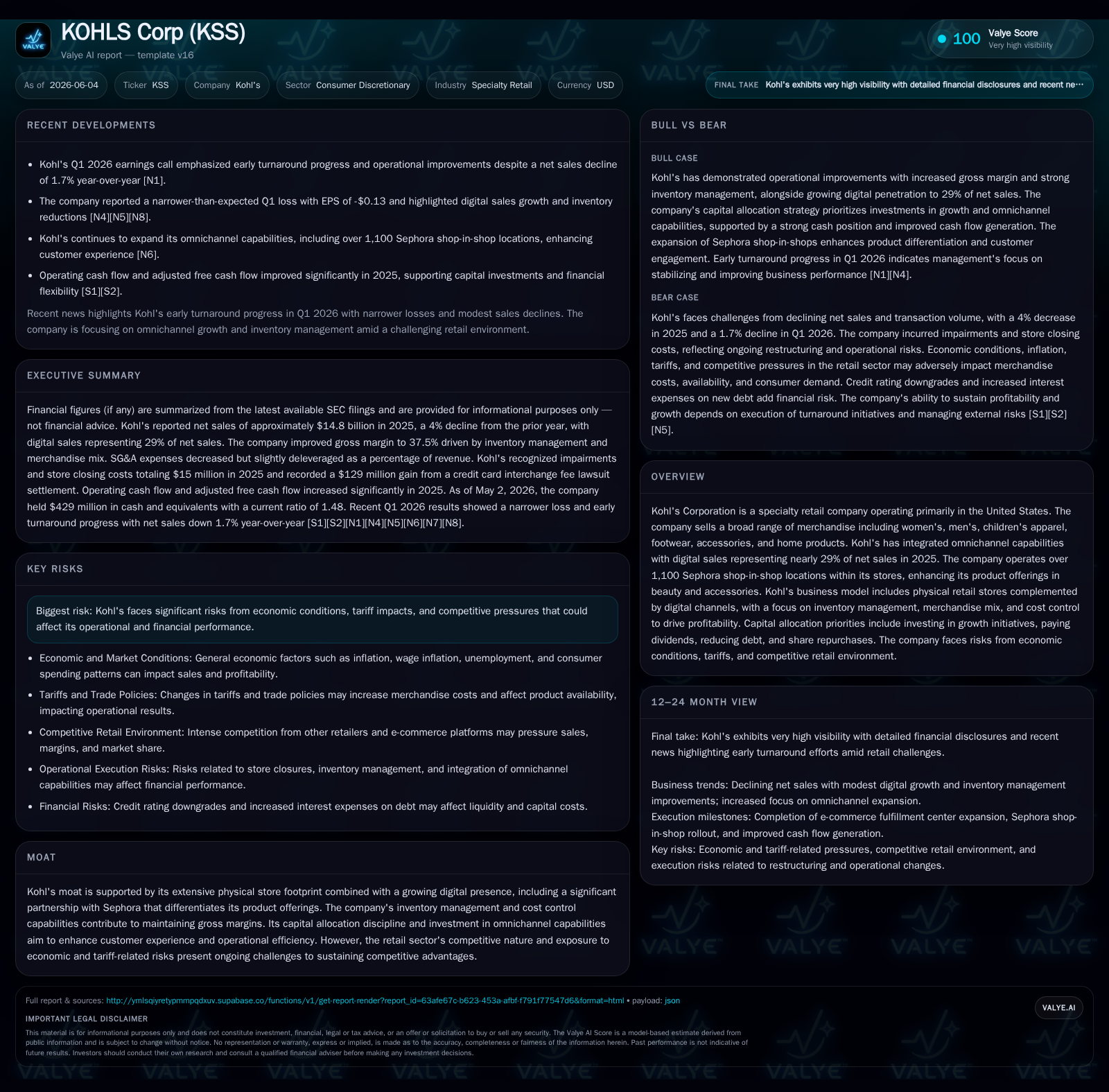
In its latest 10-Q filing for Q1 2026, Kohl's Corporation reported signs of early operational turnaround characterized by improved inventory management, slight gross margin expansion, and disciplined SG&A expenses despite ongoing revenue pressures. The company's hybrid retail model leverages its physical store network enhanced by digital sales growing to nearly 29% of net sales alongside the strategic Sephora shop-in-shop partnership, which strengthens its beauty and accessories category. While Kohl's faces macroeconomic risks such as tariffs and competitive pressures common across specialty retail, its focus on omnichannel growth and capital allocation prioritizing debt reduction and dividends support a modest recovery trajectory. The company reiterated full-year 2026 guidance, underscoring management’s confidence in execution milestones ahead.
Q1 2026 Operating Update: Recalibrating Performance Expectations
Kohl's latest quarterly filing dated June 4, 2026 [S2] reveals cautious but tangible progress in its multi-year turnaround plan. Net sales declined roughly 4% relative to prior year periods, driven by about a 4% decline in transaction volume with broad softness across apparel, footwear, and home product lines. Offsetting this trend somewhat was the accessories category which grew approximately 2%, fueled significantly by the ongoing expansion and integration of Sephora shop-in-shops within Kohl's stores [S1]. Gross margin increased by around 34 basis points year-over-year to 37.5%, propelled primarily by disciplined inventory management that reduced stock levels by about 7% compared to last year, thereby lessening reliance on clearance markdowns [S1]. SG&A expenses fell by 4.1% although as a percentage of revenue these costs slightly deleveraged by five basis points due to lower store payroll, marketing, and distribution expenses balanced against some corporate expense increases [S1]. Management affirmed full-year guidance for fiscal 2026 during the May earnings call [S3], signaling continued confidence in operational execution amidst an uncertain retail environment [N4].
These results denote incremental operational renewal as Kohl's balances top-line pressure against margin preservation and cost containment.
Kohl’s Retail Model: Blending Stores and Digital with Sephora Differentiation
Kohl’s business model operates through a large footprint of approximately 1,100+ physical stores supported by robust omnichannel capabilities that accounted for nearly 29% of net sales in calendar year 2025 [S1]. This digital segment includes all online-initiated transactions including those fulfilled via physical stores—a critical driver of convenience and fulfillment efficiency. The company’s partnership with Sephora markedly enhances its product assortment within beauty and accessories categories; Sephora shop-in-shops occupy around 1,100 Kohl’s locations featuring both full-size (approximate footprint of 2,500 sq ft) and smaller formats [S1]. This collaboration positions Kohl’s distinctively relative to apparel-centric peers by deepening offerings in higher-margin accessory segments.
Kohl’s broad merchandise assortment spans women’s, men’s, children’s apparel; footwear; accessories; and home products—all integrated with digital tools fostering customer engagement such as online browsing with in-store pickup options. This hybrid approach aims to capture customers across convenience preferences while leveraging store proximity.
Inventory Management and Merchandise Mix: Keys to Margin Stability
A cornerstone of Kohl’s recent operational progress is evidenced in its strategic inventory management detailed in the filings [S2][S1]. Inventory holdings were reduced approximately 7% year-over-year aligning closely with an approximate 8% reduction in receipts during the period—a deliberate effort to align supply with demand more precisely and avoid excessive clearance markdowns. This inventory discipline was instrumental in lifting gross margin despite pressure on sales volumes.
Further supporting improved profitability is the favorable merchandise mix shift toward accessories—including Sephora-driven beauty products—which posted about a 2% sales increase even as most other categories declined. Accessories generally carry higher gross margins than apparel or footwear, enhancing overall product mix quality.
The controlled markdown cadence and lower shrink levels reflect tighter operational execution consistent with value-chain best practices for specialty retailers grappling with inflationary input costs.
Competitive Retail Environment and Industry Positioning
In the challenging specialty retail landscape marked by fierce competition from traditional department stores, pure-play eCommerce players like Amazon, discount formats such as Target or dollar stores, Kohl's demonstrates resilience through a sizeable physical footprint combined with an evolving omnichannel presence [S1][N9]. However, broader economic pressures including tariff volatility impacting sourcing costs remain material headwinds [S17], warranting vigilant supply chain adjustments via diverse factory sourcing strategies adopted proactively by Kohl's.
Pricing power appears moderate given competitive discounting trends across apparel sectors; nevertheless Kohl’s focused merchandise diversification—particularly through beauty product partnerships—offers some differentiation from apparel-heavy peers. Vendor relationships also play a pivotal role here as procurement agility influences cost structures.
Growth Drivers: Omnichannel Momentum and Capital Allocation Focus
Momentum continues building behind Kohl’s omnichannel strategy as digital sales penetration nudges upward alongside physical store integration [N12][S1]. Digital sales reportedly grew around 4% recently [N12], reinforcing the strategic value of investing in eCommerce fulfillment infrastructure and seamless customer experiences across channels.
Capital allocation policy remains disciplined: investment initiatives prioritize long-term profitable growth projects including store enhancements and technology upgrades; payment of dividends remains steady at $0.125 per share quarterly as declared early in fiscal year [S28]. The absence of share buybacks during recent years reflects conservative cash stewardship aligned with credit rating considerations.
These financial management elements underpin sustainable growth prospects while optimizing shareholder returns opportunistically.
Risks to Watch: Economic Pressures, Tariffs, and Competitive Threats
Key risk vectors include macroeconomic uncertainties manifested through fluctuating consumer spending behaviors sensitive to employment rates wage inflation, energy prices affecting logistics costs, plus tariff-related merchandise cost escalations amid geopolitical trade dynamics [S17]. While tariff impacts did not materially affect recent results, pending rulings modifying US import duties inject uncertainty into cost forecasting.
The highly fragmented competitive environment imposes persistent challenges: discount retailers exert pricing pressure; pure online specialists attract digitally native customers demanding frictionless experiences; department stores evolve assortments rapidly—all compressing market shares for traditional specialty players like Kohl’s [N9]. Maintaining relevance requires continuous innovation in merchandise mix appeal leveraged by experiential concepts such as Sephora shops.
Near-Term Catalysts: Guidance, Execution Milestones, and Demand Indicators
The upcoming series of quarterly earnings releases provide critical checkpoints for validating Kohl's turnaround progress inclusive of top-line stabilization signals alongside margin enhancement metrics [S3][N13][N14]. Execution milestones tied to omnichannel expansion (e.g., fulfillment capacity ramps), store experience upgrades (including more Sephora openings), and advancing data-driven merchandising will serve as tangible demand proxies.
Management outlook reiterates FY2026 guidance indicating expectations for incremental performance improvements rooted in refined inventory control practices and controlled expense management—a narrative investors will track closely amid sector uncertainties.
Concise Financial Overview: Supporting Operating Narrative
As of May 2, 2026 balance sheet snapshots highlight liquidity reflected in cash & equivalents totaling $429 million accompanied by current assets approximating $3.65 billion vs current liabilities near $2.47 billion yielding a current ratio around a healthy 1.48 [F1][S2]. Operating income for the latest period stands at $624 million underscoring operational profitability despite top-line pressures while net income totals $272 million providing further affirmation of cost control benefits realized [F1]. These financial markers align cohesively with the operational commentary regarding margin resilience coupled with selective growth investments supporting Kohls’ strategic repositioning path.
Disclaimer: This analysis is based solely on publicly available filings from Kohl’s Corporation as of June 4, 2026, supplemented by sector knowledge without providing investment advice or research views.
Disclaimer: This is research-only, informational analysis and not investment advice. It may include AI-generated interpretation and general industry context. Always verify important details using primary sources.

Comments