
Lifeloc Technologies Faces Customer Concentration and Supply Challenges in a Mature Alcohol Testing Market
Recent quarterly results reveal modest revenues amid persistent competitive and operational headwinds for Lifeloc's fuel cell breath analyzers.
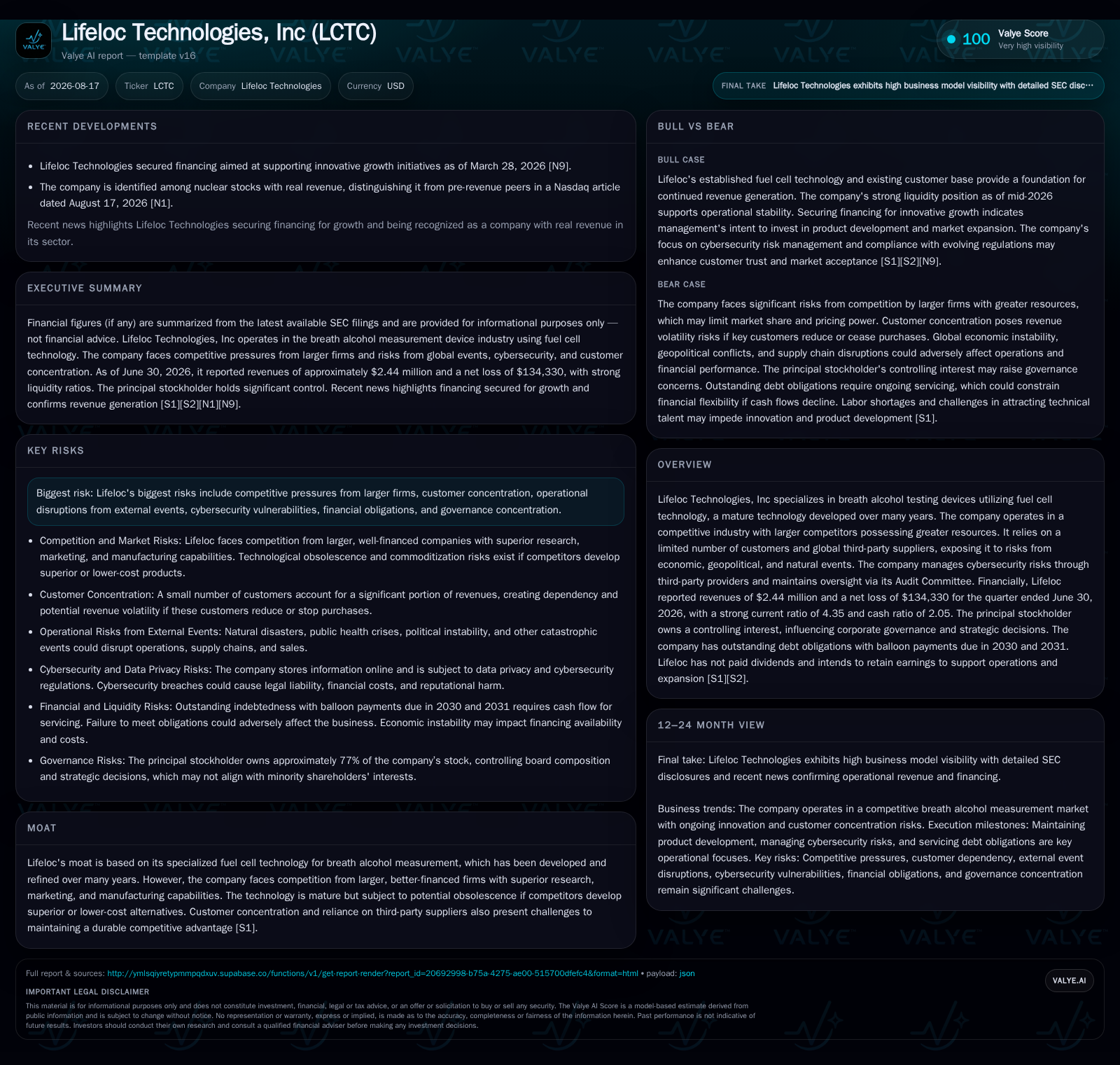
Lifeloc Technologies, Inc reported $2.44 million in revenue and a net loss of $134,330 for Q2 2026, reflecting continued pressure from competitive dynamics and customer concentration risks [S2][S3]. The company's specialized fuel cell technology anchors its niche in breath alcohol analyzers primarily used by law enforcement and workplace safety programs but faces challenges due to reliance on a small customer base and global suppliers [S1]. While regulatory enforcement offers structural demand drivers, Lifeloc navigates headwinds like supply chain disruptions, geopolitical instability, and cybersecurity risks. Financially, the company maintains strong liquidity with a current ratio of 4.35 but carries debt with balloon maturities extending to 2031 [F1]. Governance concentration under its principal stockholder also influences strategic flexibility [S1].
Recent Operating Update: Q2 2026 Performance
Lifeloc Technologies disclosed operating results for the quarter ended June 30, 2026, reporting revenues of approximately $2.44 million alongside a net loss of $134,330 [S2][S3]. This continuation of modest top-line scale underscores the company's challenge in scaling sales within a competitive breath alcohol testing device market dominated by larger peers with greater R&D budgets. The quarterly loss highlights persistent cost pressures likely driven by fixed overheads in manufacturing specialized fuel cell technology devices and investments in product development. Monitoring trends in quarterly revenue growth rates alongside margin improvements will be essential to gauge whether Lifeloc can advance toward profitability.
Business Model Analysis: Specialized Fuel Cell Breath Alcohol Testing
Lifeloc operates within a niche segment of industrial hardware focused on safety compliance equipment—specifically breath alcohol analyzers employing fuel cell sensor technology to measure blood alcohol concentration (BAC) levels through exhaled breath [S1]. This mature technology is broadly accepted among law enforcement agencies and workplace safety programs subject to regulatory screening mandates. Revenue is primarily generated through direct device sales to governmental bodies and private employers overseeing safety-sensitive workforces.
Additional monetization stems from consumables such as disposable mouthpieces and calibration services mandatory for maintaining device accuracy over time. Thus, recurring revenue potential exists via service contracts but likely remains modest given the company’s scale. The business relies on contracts often influenced by governmental funding cycles (e.g., federal or state grants), impacting the timing and volume of sales. Notably, customer concentration is high; withdrawals or delays from any large buyer could materially affect revenue stability. Service relevance depends heavily on ensuring sensor accuracy and compliance with evolving regulatory standards.
Industry Structure and Competitive Position
The industrial hardware space for breath alcohol testing devices is competitive with several larger firms possessing more substantial manufacturing capacity, integrated software offerings for data management, and stronger government relationships. Lifeloc’s main differentiation lies in its long-standing specialization in fuel cell technology which delivers accurate BAC readings—a key buying criterion for customers requiring reliable compliance equipment.
However, this mature technology faces risks from alternative detection methods such as infrared analyzers that some competitors leverage to offer broader product portfolios or potentially lower-cost devices. Device durability and service ecosystem robustness also serve as important competitive factors where larger peers often maintain an advantage through scale economies.
Supply chain resilience has emerged as another critical dimension; Lifeloc depends on multiple global third-party suppliers for crucial components [S1]. Geopolitical tensions such as ongoing international conflicts increase supply risk via tariffs or shipment delays. Natural disasters or public health crises affecting supplier facilities can disrupt operations abruptly.
Cybersecurity concerns are increasingly relevant given that some breath alcohol analyzers may store user data or operate connected systems subject to stringent privacy regulations [S1]. Lifeloc mitigates these through outsourced IT services monitored by its Audit Committee but remains exposed to breaches that could harm reputation or impose regulatory penalties.
Growth Drivers
Structural demand drivers stem from expanding regulatory enforcement around alcohol testing in workplace safety-sensitive industries like transportation and oil & gas sectors. Replacement demand is expected over time as aging devices require updates or recalibration. Moreover, government grants aimed at equipping law enforcement with approved testing equipment underpin capital purchase cycles.
Technological enhancements improving sensor usability or accuracy may facilitate new product introductions attracting incremental market share or new customer segments. Potential development of integrated hardware-software platforms could unlock higher-margin service revenues through analytics or compliance reporting solutions.
International expansion remains a prospective avenue where emerging regulatory frameworks gradually increase mandated alcohol testing requirements. However, Lifeloc must navigate complex currency fluctuations and trade policy shifts that can influence pricing competitiveness globally.
Risks and Watchpoints
Customer concentration represents perhaps the most immediate risk; significant sales dependency on a limited number of buyers who may delay purchases due to budget constraints or grant funding availability exposes Lifeloc to abrupt volume fluctuations [S1]. Competitors with deeper pockets could exert pricing pressure limiting margin expansion.
Supply chain vulnerabilities caused by tariffs, geopolitical conflicts (e.g., Ukraine-Russia war), or natural disasters pose operational continuity risks that could elevate production costs or cause shipment delays impacting order fulfillment lead times.
The possibility of technological obsolescence looms if alternatives outperform fuel cell technology either on price or effectiveness metrics. Regulatory changes might necessitate costly product adjustments or restrict access to certain markets.
Financially, although liquidity appears solid with a current ratio of 4.35 indicating ample short-term asset coverage relative to liabilities as of June 2026 [F1], Lifeloc’s debt structure includes subordinated notes carrying balloon payments due in the early 2030s, which may constrain long-term financial flexibility if earnings do not improve materially [S1].
Governance risks arise from controlling shareholder Mr. Kornelsen holding roughly 77% voting power enabling unilateral control over board composition and strategic decisions which may not always align with minority shareholder interests [S1].
Cybersecurity exposures require ongoing vigilance given increasing data privacy regulations impacting connected device manufacturers; effective incident response protocols will be key mitigation factors.
What to Watch Next
Key upcoming milestones include monitoring quarterly revenue growth trends reflecting sales momentum amid regulatory purchasing cycles [S2]. Watch for any updates regarding new product launches incorporating hardware-software integrations that could enhance service contract renewal rates.
Tracking changes in major customer ordering patterns or grant funding announcements from federal/state entities will provide insights into future demand visibility.
Observing supply chain performance indicators such as order fulfillment lead times or supplier dependency shifts will signal operational stability amidst geopolitical uncertainties.
Lastly, any material changes in governance structure or disclosures relating to debt refinancing plans should be noted due to their bearing on strategic flexibility.
Financial Profile Discussion
Lifeloc demonstrated liquidity strength at quarter-end June 30, 2026, with current assets totaling approximately $4.78 million against current liabilities near $1.10 million yielding a robust current ratio of about 4.35 [F1]. A cash ratio exceeding 2 indicates strong immediate liquidity buffers supportive of working capital needs.
Debt outstanding was estimated at around $1.24 million at mid-2022 levels against cash balances suggesting net cash positioning which should aid operational resilience absent material drawdowns [F1]. However, the company carries subordinated debentures accruing interest around 8.25%, requiring monthly interest plus future balloon payments scheduled in 2030-31—this liability profile warrants scrutiny given Lifeloc's history of quarterly losses within recent years [S1][F1].
The concentrated ownership under Mr. Kornelsen who doubles as Chairman and CFO introduces governance considerations that intersect financial strategy execution including financing decisions related to growth initiatives such as ongoing SpinDetect™ product development funded via internal lending structures [S28].
Overall financial signals point toward adequate liquidity management but underline the need for improved operating profitability driven predominantly by revenue scaling factors tied closely to industry regulatory environments and competitive positioning.
Disclaimer: This is research-only, informational analysis and not investment advice. It may include AI-generated interpretation and general industry context. Always verify important details using primary sources.

Comments