
Lument Finance Trust Eyes Transitional Multifamily CRE Loans to Sustain Yield
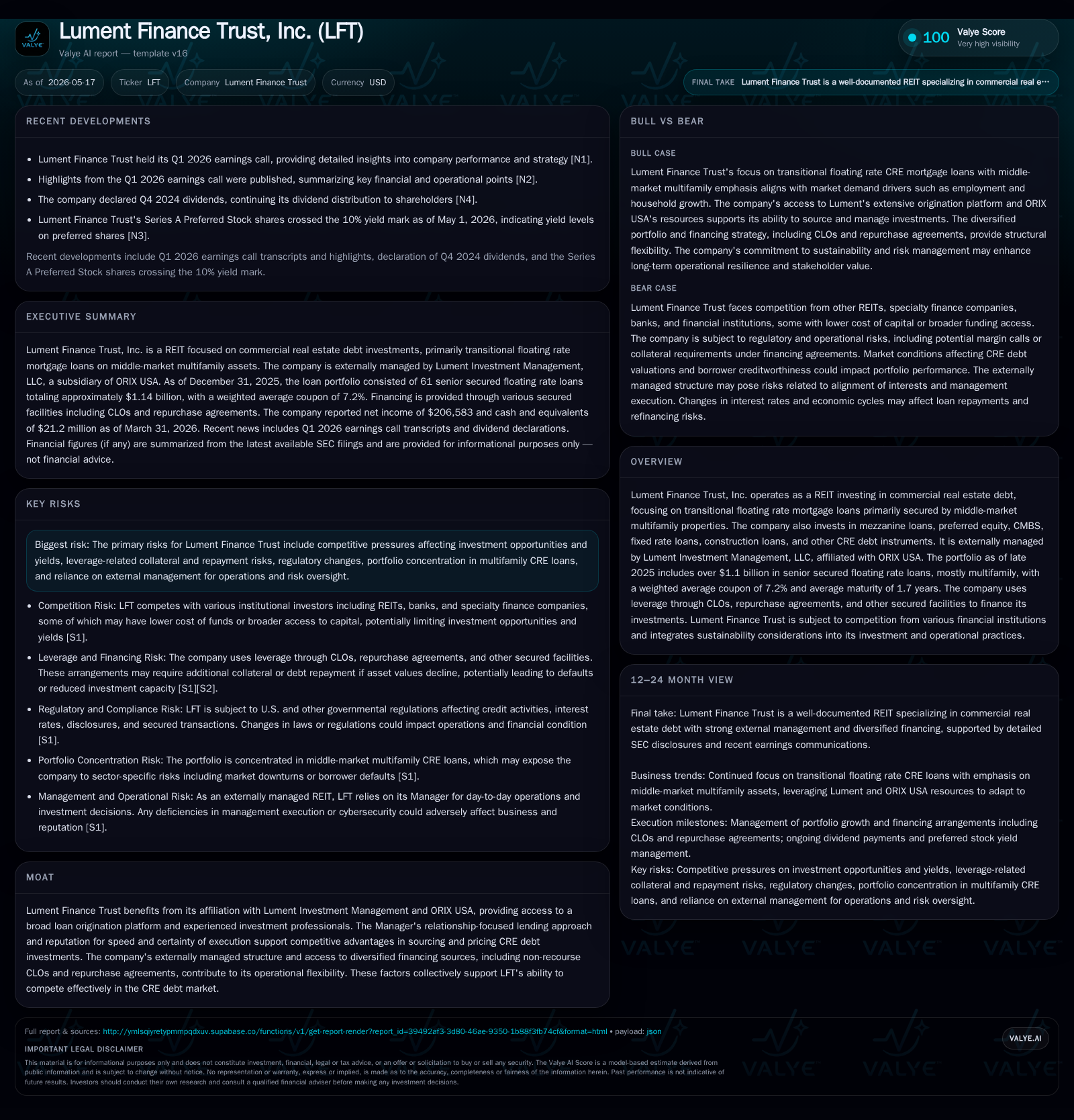
The latest quarterly filing underscores Lument Finance Trust's stable focus on floating-rate middle-market multifamily commercial real estate debt supported by a broad origination network and flexible financing.
In its May 2026 quarter filing, Lument Finance Trust reaffirmed its strategic emphasis on senior secured floating rate loans primarily backing middle-market multifamily properties, maintaining a $1.1 billion portfolio with a weighted average coupon of 7.2%. The company benefits from its external management affiliation with Lument Investment Management and ORIX USA, leveraging a relationship-driven loan origination model that supports consistent deal flow and competitive pricing power. Financing arrangements incorporating non-recourse CLOs and repurchase agreements provide capital flexibility while limiting margin call risks. Key risks include concentration in the multifamily sector, competitive pressures compressing yields, leverage-related liquidity demands, and reliance on external management for operational oversight. Upcoming milestones center on sustaining dividend payouts and managing portfolio maturities effectively.
Quarterly Operational Update: Portfolio and Financing Trends
Lument Finance Trust's latest quarterly report dated May 15, 2026 confirms its continued commitment to investing in senior secured floating rate commercial real estate loans focused on the middle-market multifamily sector. As of March 31, 2026, the loan portfolio stood at approximately $1.14 billion across 61 loans, all floating rate instruments indexed primarily to one-month term SOFR with a weighted average coupon of 7.2% and an average remaining maturity of about 1.7 years [S2][S11]. This stability in portfolio size reflects net originations slightly exceeding repayments during the recent period.
The company's transition loans are typically structured with three-year terms plus extension options, aimed at transitional property financing that offers yield enhancement opportunities in evolving real estate cycles. Multifamily assets continue to dominate the collateral pool (92.7% as measured at year-end 2025), underpinning the portfolio's geographic diversity across U.S. markets characterized by robust employment growth and household formation trends [S7].
On the financing side, LFT employs a sophisticated leverage strategy via non-recourse CRE CLOs, secured revolving repurchase agreements with credit marks rather than margin calls where possible, term lending facilities, warehouse lines, and asset-specific financings [S4][S14]. These arrangements facilitate matched funding to investments while dampening interest rate mark-to-market volatility. Recent amendments to secured term loans extended maturity profiles to February 2030 and enhanced borrowing base calculations for compliant collateral assets—improving capital structure flexibility [S27].
Business Model Overview: Debt Instruments Focused on Middle-Market Multifamily
Lument Finance Trust operates as a Real Estate Investment Trust (REIT) dedicated to originating and managing commercial real estate debt investments mainly consisting of transitional floating rate mortgage loans targeted predominantly at middle-market multifamily properties [S1]. The company's revenue model relies principally on net interest income generated from these loans—interest earned less associated funding costs—and supplemented by fee income from mezzanine loans, preferred equity interests, CMBS participations, fixed-rate loans, construction financing, and ancillary mortgage-related activities.
The firm’s externally managed structure under Lument Investment Management (a subsidiary of ORIX USA) leverages extensive originations capabilities through established borrower relationships nationwide [S24]. This relationship-driven lending ethos emphasizes fast execution certainty for borrowers—a differentiation that supports competitive pricing power and repeat business in a crowded CRE debt market. This platform enables efficient pipeline replenishment essential for sustaining loan volumes aligned with the company's REIT tax qualification requirements.
Importantly, all investments comply with investment guidelines designed to maintain REIT status under U.S. federal tax law while avoiding Investment Company Act regulation [S1]. Such disciplined asset selection targeting first mortgage liens with conservative loan-to-value ratios (generally up to 85% "as-is," down to 75% "as-stabilized") also serves as risk mitigation.
Competitive Positioning and Industry Context in Commercial Real Estate Debt
Within the highly competitive CRE debt sector, Lument Finance Trust benefits from affiliation with Lument Investment Management and ORIX USA—platforms that combine broad origination reach with capital markets experience facilitating complex financings such as CLO issuances [S1]. This structural advantage allows LFT access to diverse financing sources including CLOs that are non-recourse and therefore shield the company from margin calls commonly associated with repurchase facilities.
The CRE lending space features many competitors including other specialty finance REITs, commercial banks, insurance companies, private funds, and institutional investors. Many players have significant capital raised with overlapping investment mandates focusing on transitional or stabilized multifamily housing amidst evolving post-pandemic housing demand dynamics.
LFT’s emphasis on floating rate loans indexed to SOFR aligns its income profile favorably against rising interest rates—a strategic edge amid shifting monetary policy regimes affecting yield curves across fixed income sectors. However, such exposure also requires sophisticated risk management given potential borrower refinancing risks on relatively short maturities (~1.7 years average remaining) [S17].
Regulatory environment considerations center around maintaining REIT taxation eligibility alongside compliance with relevant securities oversight frameworks governing externally managed REITs—an operational layer that adds complexity but also governance rigor overseen by independent directors [S1].
Growth Drivers: Origination Platform Strength and Leverage Strategy
Key drivers supporting LFT’s growth trajectory rest upon its robust origination infrastructure underscored by deep borrower relationships cultivated by Lument IM’s extensive U.S.-wide footprint spanning over 30 offices with more than 550 employees [S1]. This relationship-driven approach not only accelerates sourcing but enhances underwriting quality through repeated counterparty interactions enhancing risk assessment.
Moreover, ability to compete on speed and certainty versus competitors sustains pricing power—a critical factor as competition intensifies in CRE transitional lending markets.
On capital deployment frontiers, LFT continues to employ leverage primarily through tailored CLO vehicles offering up to ~88% advance rates without mark-to-market risk exposure plus secured repurchase agreements subject to credit marks rather than outright margin calls wherever possible [S4][S14]. This ingenuity allows effective capital recycling balancing return optimization against liquidity safeguarding.
Recent amendment transactions enhancing secured term loan maturity extensions out to 2030 reduce refinancing timing risks while introducing financial covenants around liquidity minimums signaling proactive balance-sheet stewardship underpinning sustainable growth capacity [S27].
Risks and Challenges: Market Competition, Concentration, and Leverage Dynamics
Despite strengths, several operational challenges pose risks for sustained performance. Heavy concentration in middle-market multifamily assets introduces sector cyclicality exposure; downturns in residential rental fundamentals or regulatory shifts impacting this property class could materially affect collateral valuations or borrower cash flows [S11].
Competition poses continuous pressure potentially squeezing spreads achievable on new originations or curtailing volume growth as multiple well-capitalized rivals vie for deals in overlapping geographies.
Leverage includes master repurchase agreements which may trigger collateral posting requirements or margin calls if market values decline adversely. Failure to meet such calls might force distressed asset sales or increase refinancing costs negatively impacting returns or liquidity profiles [S9]. However, usage of CLO structures mitigates some mark-to-market volatility inherent in repo facilities.
Dependence on external management concentrates operational risk on third-party provider effectiveness in investment decision-making processes as well as cybersecurity governance—the latter supervised actively at board level but still a material intangible risk factor due to evolving threat landscapes [S9].
Milestones and What to Watch Next: Dividend Stability, Portfolio Evolution, and Capital Management
Investors should monitor upcoming dividend declarations closely; as announced in March 2026 filings common stock dividends were declared at $0.04/share quarterly alongside preferred stock series A dividend payments maintaining attractive yields amid inflationary pressures affecting capital costs [S3].
Portfolio seasoning effects will be key given relatively short-term loan maturities; monitoring refinancing success rates or prepayment activity provides insight into credit cycle positioning.
Additionally, developments around refinancings linked to secured term loan facilities—whether amendments tightening or easing borrowing bases—and usage levels of repurchase agreements inform operational liquidity status.
Potential expansion into other CRE debt categories beyond transitional multifamily may emerge subject to regulatory compliance while preserving REIT tax qualification.
Financial Snapshot: Cash Reserves and Income Trends
As of March quarter-end 2026, Lument Finance Trust held cash and equivalents totaling approximately $21.2 million providing operational liquidity headroom relative to ongoing funding needs [F1].
Fiscal year-end results for 2025 indicated a net loss of approximately $2.7 million reflecting macroeconomic headwinds including heightened cost of capital environments diminutive spread compression alongside portfolio repositioning costs or credit provisions that were not explicitly quantified in detail within recent quarterly commentaries [F1][S2].
Despite these near-term earnings challenges typical for transitional CRE debt managers calibrating portfolios in evolving markets, cash buffers combined with strong governance frameworks support ongoing operational continuity pending normalization of interest rate cycles.
This analysis synthesizes information exclusively from publicly available SEC filings dated up through May 2026 alongside relevant news transcripts without offering investment advice or price targets.
Disclaimer: This is research-only, informational analysis and not investment advice. It may include AI-generated interpretation and general industry context. Always verify important details using primary sources.

Comments