
La Rosa Holdings Balances Agent-Centric Real Estate Model with Strategic AI Expansion
The company’s May 2026 Series D Preferred Stock issuance underscores its dual pursuit of scaling traditional real estate brokerage while aggressively expanding into AI infrastructure.
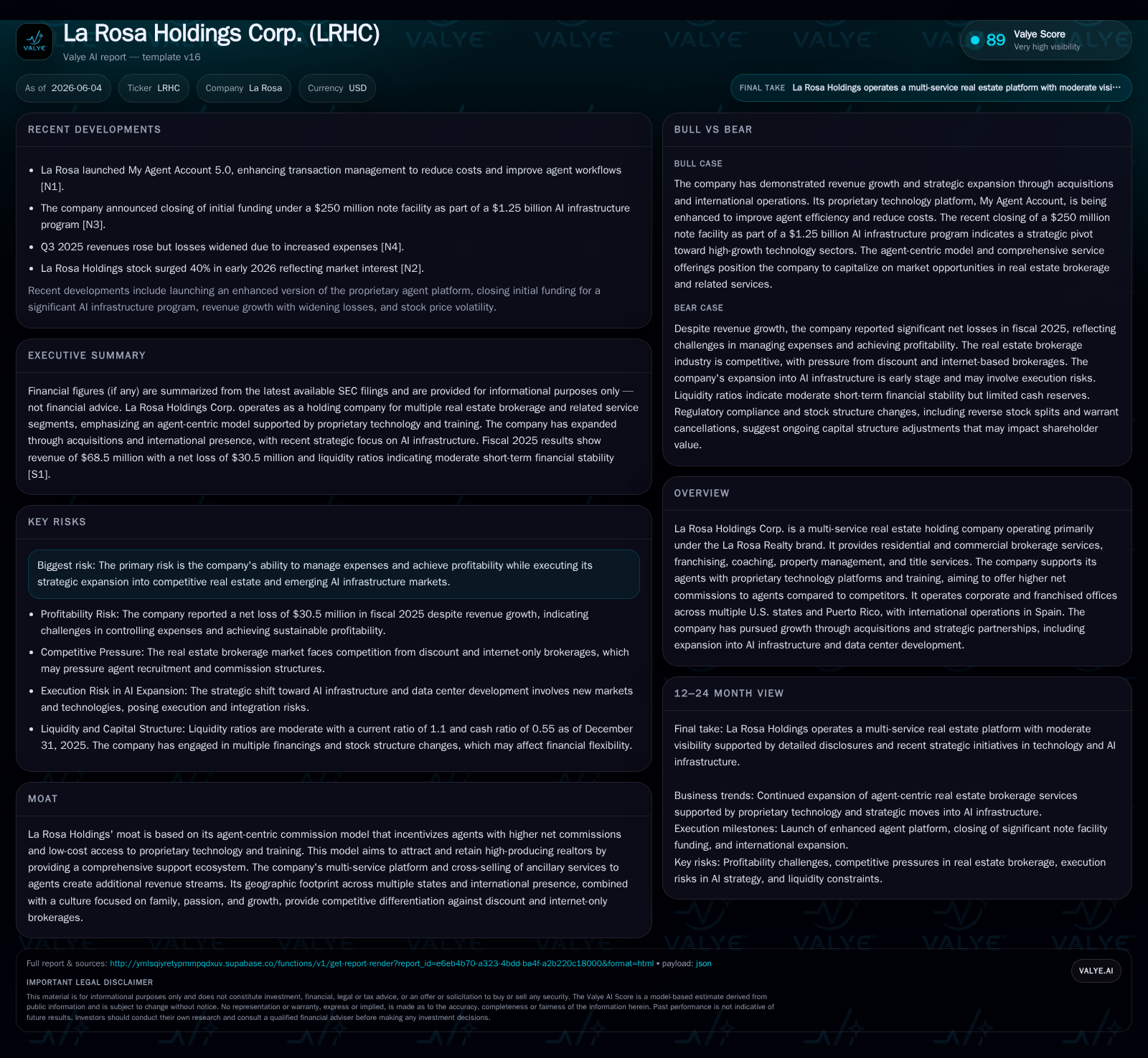
La Rosa Holdings Corp. recently issued Series D Convertible Preferred Stock to bolster liquidity, supporting a strategic pivot that combines its established multi-service real estate brokerage platform with new investments in AI-focused data center infrastructure. The firm operates across multiple U.S. states and internationally, providing residential and commercial brokerage, educative coaching, and ancillary services through a technology-enabled agent-centric model designed to deliver higher net commissions. Amid cyclical pressures in the residential real estate market and ongoing operating losses, La Rosa pursues growth via AI infrastructure development and acquisitions such as the proposed Consensus Core Technologies deal, positioning itself for a diversified revenue base. The near-term challenges include cash flow constraints, regulatory risks in real estate, and the execution demands of entering a capital-intensive AI ecosystem.
Recent Capital Raise Strengthens Liquidity for Growth Initiatives
In late May 2026, La Rosa Holdings Corp. completed an issuance of 250 shares of Series D Convertible Preferred Stock at $1,000 per share under a Securities Purchase Agreement with an institutional investor. This raise is part of a strategic financing framework designed to support the company’s expansion into real estate brokerage enhancements and emergent AI infrastructure opportunities [S3], [S5]. The rights attached to the Series D stock include an option for the investor to acquire an additional 250 shares contingent on the filing of the company's Annual Report on Form 10-K for 2025. While this preferred stock grants limited voting rights consistent with Nevada corporate law and excludes dividends, it provides critical incremental capital essential during this liquidity-sensitive phase given recurring operating losses [S3].
This capital infusion frames La Rosa’s pivot point between sustaining its foundational brokerage operations—which remain challenged by sector cyclicality and competitive pressures—and investing heavily into building AI computing infrastructure assets aimed at diversifying future revenues.
Multi-Segment Brokerage Model Supported by Agent-Centric Economics
La Rosa’s core business revolves around six integrated real estate service segments including residential and commercial brokerage under its flagship La Rosa Realty brand; franchising expansion; agent education/coaching; property management; title services; and commission financing programs exclusively for its agents [S1]. With nearly 2,850 licensed brokers and sales associates across corporate offices predominantly in Florida but also California, Texas, Georgia, Puerto Rico, plus franchises spanning seven states and an international office in Malaga, Spain—the company leverages broad geographic reach coupled with targeted local expertise.
The company deploys a proprietary SaaS-based technology suite exemplified by its recently launched My Agent Account (MAA) version 5.0 platform which incorporates a fully integrated Transaction Management module streamlining workflow by cutting manual processes previously reliant on third parties. This tech edge not only reduces operational friction but also delivers the ability to pay agents higher net commissions compared to many regional competitors—a strategic value proposition central to recruiting and retaining high-producing agents [N1], [S7].
Agents subscribe annually to MAA enabling La Rosa to generate recurring tech service revenues alongside its fundamentally transaction-commission-based fee structure. Cross-selling ancillary offerings such as title services or commission advances further enriches per-agent lifetime value.
Industry Dynamics: Cyclical Challenges amid Agent-Focused Differentiation
The residential real estate market’s inherent cyclicality—largely driven by broader economic health metrics such as GDP growth rates, employment levels, interest rates, and localized supply-demand imbalances—frames a constraining backdrop for La Rosa’s brokerage revenues. Margins fluctuate with sales volume seasonality and competition from discount brokerages pushing downward on agent commission splits.
However, La Rosa emphasizes its differentiated moat built around agent economics: offering significantly higher net commission rates attracts more productive agents who drive robust sales volumes. Complemented by extensive training programs reflecting founder Joseph La Rosa's coaching philosophy centered on family passion and personal growth fostering loyalty within its network agents strengthen the company's defenses against commoditization trends observed among internet-only platforms [S1], [S12].
Additionally, cross-selling various ancillaries through their full-service brokerage ecosystem mitigates isolated dependence on transactional commissions alone.
Strategic Pivot into AI Infrastructure with Tier III Data Center
Recognizing both sector headwinds in traditional brokering business lines and opportunity in high-margin tech infrastructure markets linked to artificial intelligence acceleration trends nationally and globally, La Rosa embarked upon an aggressive repositioning strategy initiated late 2025 focused on owning physical AI data centers optimized for compute-intensive workloads.
Acquisitions such as the pending potential purchase of Consensus Core Technologies—a provider specializing in critical infrastructure solutions for AI/high-performance computing—illustrate intent to anchor capabilities upstream along the AI value chain beyond property ownership/development [S5], [S21]. Additionally, a pivotal land acquisition in Osceola County (Central Florida)—chosen strategically due to regional growth dynamics—sets stage for development of a Tier III certified AI data center facility designed to handle approximately 1,500 kW IT load capable of serving enterprise cloud providers alongside AI workloads demanding high performance reliability standards typical of Tier III deployments [S6], [S21].
This move coheres with management's vision to leverage existing commercial real estate know-how fused with new tech infrastructure trends promising lucrative long-term contracts versus more cyclical residential sales revenues.
Growth Drivers: Enhanced Technology Platform + Franchise & Ancillary Expansion
Fundamental growth vectors underpinning La Rosa’s path forward center primarily on increasing adoption of proprietary technology platforms like MAA which improve agent efficiency thereby leading directly to higher closed transactions per active agent. By reducing reliance on manual interventions through integrated transaction management modules added in recent upgrades (version 5.0), operational costs decrease while augmenting agents’ capacity for client engagement—a recognized KPI correlating strongly with real estate firms’ top-line expansion potential.
Franchise network expansion—with currently five franchised offices plus three affiliated independent brokerages across seven U.S. states plus Puerto Rico along with LR Realty Spain—provides scalable volume increases via fee income streams without proportional fixed cost increments intrinsic in wholly owned corporate branches. These less capital-intensive license-fee revenue sources offer margin expansion opportunity as brand recognition expands internationally.[N1],[S7]
Cross-selling internal ancillary products such as escrow/title services exclusive commission advance financing programs generates diversified fee income helping smooth earnings volatility typically associated with pure transaction-based revenue models.
Risk Factors: Meaningful Operating Losses & Execution Challenges Loom Large
Despite ambitious initiatives and diversified models La Rosa reports significant ongoing challenges highlighted by recurring annual net losses amounting to $30.4 million in 2025 deepening from $14.3 million loss prior year raising substantial doubt about its ability to continue as going concern per auditors’ explanatory comments—signaling heavy reliance on external funding channels for survival liquidity needs exists presently.[F1],[S12]
Compliance issues with Nasdaq rules regarding timely filings risk suspension if unresolved although company is actively seeking remedial plans.[S18]
Ongoing litigation exists involving former executives claiming unpaid compensation impacting management focus though at present not disclosed as likely material liabilities [S12]
Financing constraints potentially limit ability to invest aggressively into required capital expenditures foundational for successful build-out of AI data center assets whose construction timelines are sensitive to macroeconomic cost inflation risk factors.
Finally competitive pressures from discount brokerages alongside regulatory evolutions related to antitrust scrutiny within US residential brokerage markets introduce uncertainty concerning sustainable pricing power especially if reforms reduce cooperative commission sharing models [S12]
Key Milestones: Acquisition Closures & Infrastructure Execution Will Define Trajectory
Crucial upcoming markers include closing definitive agreements related to Consensus Core Technologies acquisition which would validate strategic credibility within AI infrastructure domain.[S21]
Construction progress milestones at new Central Florida site including permitting approvals/start dates will signal tangible advancement from land acquisition toward operational data center delivery.[S6]
Agent platform usage metrics such as MAA subscription counts plus adoption rates by franchisees will provide forward-looking indicators tied directly to the scalability of La Rosa's core commission generation engine.[N1],[S7]
Capital raising efforts post-Series D preferred stock issuance need monitoring given continuing negative cash flows threatening runway safety [S3]
Financial Health Snapshot: Tight Liquidity Necessitates Ongoing Fundraising Vigilance
At fiscal year-end December 31, 2025 the company reported roughly $3.1 million cash against approximately $5.57 million current liabilities yielding a marginal current ratio just above one (approximately 1.1) [F1]. Recent preferred equity issuances inject necessary immediate working capital but do not resolve chronic profitability deficits mandating disciplined expense controls coupled with successful execution of growth strategies including acquisitions.[F1],[S3]
Liquidity constraints paired with going concern audit references reflect elevated financial risk condition potentially heightening cost of capital access moving forward.
This analysis is based exclusively on reported SEC filings up to June 2026 without any investment research view or speculative forecasting.
Disclaimer: This is research-only, informational analysis and not investment advice. It may include AI-generated interpretation and general industry context. Always verify important details using primary sources.

Comments